

×
ADVERTISEMENT

JANUARY 4, 2024

Rheumatic Patients Should Schedule COVID-19 Vaccinations

New data suggest that patients taking disease-modifying antirheumatic drugs (DMARDs) should continue to get vaccinated against SARS-CoV-2.

Many patients with autoimmune disease suffer from conditions that cause inflammation and thus place them at higher risk for serious cases of COVID-19. These patients often take DMARDs to treat their underlying condition, but unfortunately, patients treated with DMARDs have a less robust response to COVID-19 vaccination than people who don’t use these
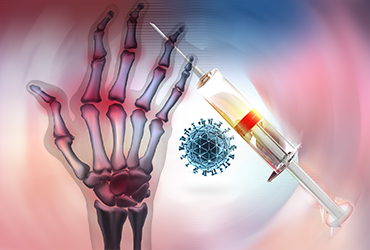


New data suggest that patients taking disease-modifying antirheumatic drugs (DMARDs) should continue to get vaccinated against SARS-CoV-2.

Many patients with autoimmune disease suffer from conditions that cause inflammation and thus place them at higher risk for serious cases of COVID-19. These patients often take DMARDs to treat their underlying condition, but unfortunately, patients treated with DMARDs have a less robust response to COVID-19 vaccination than people who don’t use these drugs, disincentivizing vaccination.
“Our findings suggest that receiving a fourth dose of the COVID-19 vaccine reduces the risk for breakthrough infection, including severe infection, among patients with rheumatic disease using immunosuppressants,” study investigator Zachary S. Wallace, MD, MSC, a clinical epidemiology researcher in the Division of Rheumatology, Allergy and Immunology at Massachusetts General Hospital, in Boston, told Pain Medicine News. “Since many patients have not yet received the recommended vaccine series by the CDC, these findings may be useful for guiding discussions between clinicians and patients.”

The study involved 4,305 patients with systemic autoimmune rheumatic diseases who were prescribed DMARDs and were eligible for a fourth dose of BNT162b2 (Pfizer-BioNTech) or mRNA-1273 (Moderna) vaccines between Jan. 16 and June 11, 2022 (Lancet Rheumatol 2023;6[1]:e21-e30. doi:10.1016/S2665-9913[23]00272-2). More than 54% of 2,563 participants had rheumatoid arthritis. The most frequent treatments were conventional synthetic or biological DMARDs.

The incidence rate of COVID-19 infection in study participants who received a fourth vaccine dose was 188.1 per 1,000 person-years compared with 296.1 per 1,000 among those who did not get the fourth dose. Furthermore, administration of a fourth dose of vaccine also reduced participants’ risk for hospital admission when infected with COVID-19.

The findings were limited by the fact that the Moderna vaccine used in the study is no longer available. “However, [the] findings likely have relevance for those considering the currently used boosters,” Wallace said.
The researchers said they plan to continue their work by studying the effectiveness of newer COVID-19 vaccines in rheumatic patients in the future.

—Myles Starr

Wallace reported funding from the National Institutes of Health and the National Institute of Arthritis and Musculoskeletal and Skin Disease for the present manuscript; grants or contracts from Bristol Myers Squibb and Principia/Sanofi; consulting fees from BioCryst, Horizon, Medpace, Sanofi, Viela Bio and Zenas BioPharma; and advisory board participation for Horizon, Novartis, Otsuka/Visterra and Shionogi.