

×
ADVERTISEMENT

APRIL 8, 2026

Rural Healthcare, Drug Pricing Amid 2026 Challenges—and Opportunities


Originally published by our sister publication Pharmacy Practice News

image
Bonnie Kirschenbaum, MS, FASHP, FCSHP
“Reimbursement Matters” is a tool for maintaining your health system’s fiscal health. Please email the author at bonniekirschenbaum@gmail.com with suggestions on reimbursement issues that you would like to see covered.


Each new year brings change to how healthcare is offered and paid for. Some of those changes are opportunities for pharmacy to provide more services to

Originally published by our sister publication Pharmacy Practice News

image
Bonnie Kirschenbaum, MS, FASHP, FCSHP
Reimbursement Matters is a tool for maintaining your health system’s fiscal health. Please email the author at bonniekirschenbaum@gmail.com with suggestions on reimbursement issues that you would like to see covered.


Each new year brings change to how healthcare is offered and paid for. Some of those changes are opportunities for pharmacy to provide more services to the patients in their healthcare systems, and some are challenges to remain fiscally responsible. Whether you are clinically oriented, operationally involved, or administratively responsible, knowing who your payors are and what terms your facility has negotiated with them is essential.

Rural Health Transformation

The Centers for Medicare & Medicaid Services has created the Office of Rural Health Transformation (ORHT) to lead implementation of a $50 billion Rural Health Initiative within the Center for Medicaid and CHIP Services. The initiative aims to strengthen rural health systems and expand sustainable access to care nationwide. Beginning in 2026, states will receive approximately $147 million to $281 million annually. Funding will total $50 billion over five fiscal years (FY2026-FY2030), with $10 billion available each year. Half of the funds will be distributed evenly across all 50 states, while the remaining half will be allocated based on rural health needs, state policy actions, and proposed initiatives.

The initiative seeks to reverse decades of declining rural health outcomes while avoiding costly new construction. Pharmacists are encouraged to participate, and there are significant opportunities to bolster the rural health workforce, modernize facilities through technology, and support innovative, affordable care models. Health systems should consider how they can expand preventive, primary, maternal, and behavioral health services; create new access points closer to home; and help sustain local providers.

 02260231 Rural-Healthcare-Drug-Pricing AS24794807

Participation is encouraged in evidence-based, outcomes-driven strategies—such as chronic disease prevention and management—with a focus on interoperability, telehealth expansion, and remote patient monitoring. Systems may engage through hub-and-spoke models, rural regional centers of excellence, shared data platforms, or rural clinically integrated networks.


ORHT Information: bit.ly/45dYhPf

RHT information, including state resources and program updates: bit.ly/4szbSdM


4th DEA Waiver Extension

This temporary extension allows clinicians to prescribe Schedule II through Schedule V controlled substances (including Schedule III-V medications FDA approved for treatment of opioid use disorder) remotely—via audio-video telemedicine encounters, without a prior in-person medical evaluation—through 2026. The extension applies to all practitioner-patient relationships, not just those established during the COVID-19 public health emergency, and prevents a sudden return to pre-pandemic restrictions that could disrupt patients’ access to care while the agency finalizes permanent regulations. For more information on this extension, see the Federal Register document at bit.ly/3LkXWn8.

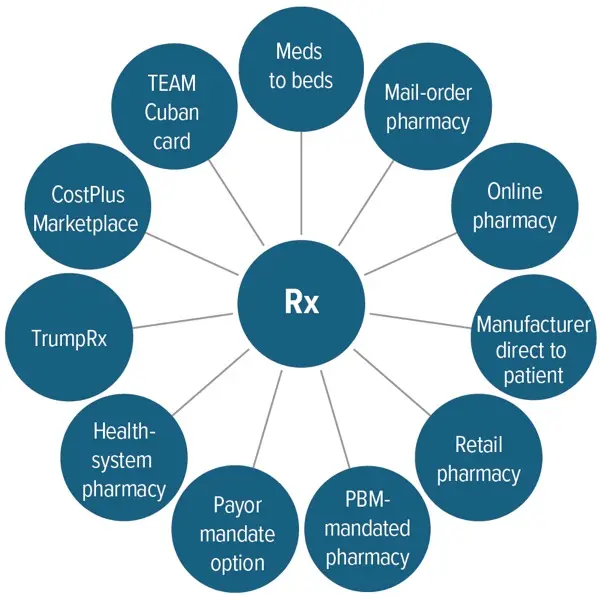
 Rx-Options
  • Is your meds-to-beds program at risk?
  • Making assumptions or determining the patient’s choice?
  • Limited distribution networks adding complications?
  • Know the patient’s payor requirements?
Figure. The Patient’s Options for Rx Fill
Source: Bonnie Kirschenbaum

Notable Drug Pricing Policies: IRA 2026

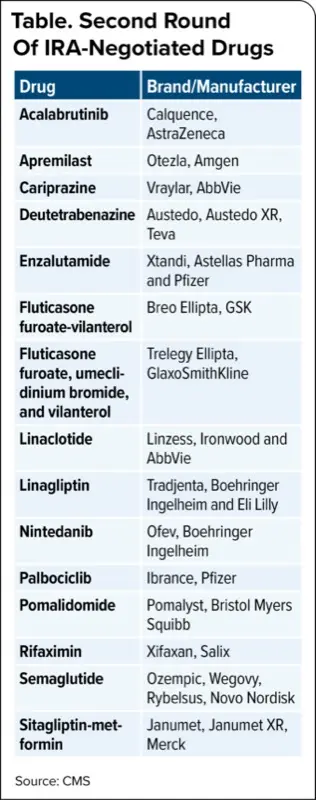
These negotiated prices were set in law by the Inflation Reduction Act of 2022, with new prices for the first 10 drugs available Jan. 1, 2026. The second round of negotiations finalized lower prices for 15 additional drugs, beginning in January 2027 (For a list of all 15 drugs, see Table and also bit.ly/49VCA7N).

Table. Second Round of IRA-Negotiated Drugs
Table. Second Round Of IRA-Negotiated Drugs
DrugBrand/Manufacturer
Acalabrutinib Calquence, AstraZeneca
Apremilast Otezla, Amgen
Cariprazine Vraylar, AbbVie
Deutetrabenazine Austedo, Austedo XR, Teva
Enzalutamide Xtandi, Astellas Pharma and Pfizer
Fluticasone furoate-vilanterol Breo Ellipta, GSK
Fluticasone furoate, umeclidinium bromide, and vilanterol Trelegy Ellipta, GlaxoSmithKline
Linaclotide Linzess, Ironwood and AbbVie
Linagliptin Tradjenta, Boehringer Ingelheim and Eli Lilly
Nintedanib Ofev, Boehringer Ingelheim
Palbociclib Ibrance, Pfizer
Pomalidomide Pomalyst, Bristol Myers Squibb
Rifaximin Xifaxan, Salix
Semaglutide Ozempic, Wegovy, Rybelsus, Novo Nordisk
Sitagliptin-metformin Janumet, Janumet XR, Merck
Source: CMS

Notable Drug Pricing Policies: Maximum Fair Price

Drug Price Negotiation Program Maximum Fair Price (MFP) units will be included in and thus will lower average sales price (ASP) starting in 2028, when the first Medicare Part B drugs will be eligible for MFP. CMS has clarified that MFP units should be included in the calculation of ASP, given their inclusion in the calculation of best price under Medicaid. This inclusion of MFP units in ASP is likely to drive ASPs lower. In response, CMS will publish an MFP-based payment limit for a selected drug instead of the ASP-based payment limit in the quarterly pricing files, starting with Initial Price Applicability Year 2028 when the MFP is live for Part B. As a result, there will no longer be a published ASP-based payment limit for a selected drug while that drug is subject to an MFP. This change will have a downstream impact on commercial payors that tie their reimbursement rates to Part B payment rates published in the Part B payment file. Add-on payments also will be lower as they will be calculated as 6% of the MFP instead of 6% of ASP.

Notable Drug Pricing Policies: ASP

CMS finalized certain policies in how service fees affect ASP calculations. These policies include new documentation requirements to demonstrate that a fee isn’t passed on to any entity other than the fee recipient. It may be more common that these fees are included in—and lower—ASP, which in turn likely will decrease provider reimbursement rates under Part B. (See box for more ASP calculation hints.)

Remember These CMS And ASP Hints!

Payment is determined by two factors: ASP and a percentage markup. Although we have become accustomed to only focusing on the markup component, ASP calculation may very well be changing too.

Markup varies by OPPS vs PFS

  • G = ASP+6% by statute
  • Biosimilars = ASP+8% of reference product ASP
  • K in OPPS is variable each year (currently ASP+6%)
  • K in PFS is ASP+6% and fixed by statute

Know the SI assigned to each payable drug

  • G = passthrough
  • K = separately payable if drug meets $140/day ASP threshold
  • N = payable in a bundle by statute, regardless of price or payable in a bundle if drug is less than $140/day ASP threshold
ASP, average sales price; OPPS, Outpatient Prospective Payment System; PFS, physician fee schedule.
OPPS Drug Acquisition Cost Survey: Are You Prepared?

The BALANCE Model

The Better Approaches to Lifestyle and Nutrition for Comprehensive Health Model aims to make glucagon-like peptide-1 (GLP-1) medications for metabolic control and weight loss more accessible and affordable to Medicaid and Medicare beneficiaries by negotiating directly with participating GLP-1 manufacturers to lock in lower net prices and standardize coverage criteria. Controlled costs will enable Medicare Part D plans and state Medicaid agencies to cover the therapies and couple them with evidence-based lifestyle support to achieve favorable health outcomes. Rollout is expected in May 2026 for Medicaid, followed by July 2026 for Medicare, when CMS will adopt a GLP-1 payment demonstration project that allows beneficiaries to take advantage of negotiated prices sooner. The BALANCE Model launches fully in January 2027, with the CMS Innovation Center assessing program performance. For more information, see CMS press release at bit.ly/4pMcUkb.

Preparing for OPPS Survey

On Jan. 1, CMS launched the OPPS Drug Acquisition Cost Survey (ODACS). Register for the survey, create an account in the CMS Enterprise Portal (bit.ly/4pCq7Mb), complete the identity verification process, then email your completed survey to OPPSDrugSurvey@cms.hhs.gov. Be sure to include your hospital’s CMS Certification Number!

Hospitals that received OPPS payments for outpatient drugs from July 1, 2024, through June 30, 2025, must complete the survey and report data on all payable outpatient drugs purchased during this period. The data submission deadline is 11:59 p.m. ET on March 31, 2026. The submission should cover the acquisition costs for each separately payable drug acquired by hospitals and paid under the OPPS, including both specified covered outpatient drugs (SCODs), and drugs and biologicals that CMS has historically treated as SCODs.

CMS is expected to use the survey results to re-evaluate (and likely reduce) reimbursement for separately paid drugs, when they believe ASP-based reimbursement is disproportionately higher than hospitals’ acquisition costs. More information is available at bit.ly/4sGCCJx.

ACTION ITEM: Important information on key reimbursement trends is easily available on the Medicare Learning Network (MLN). Subscribe and start hunting through the archives for reimbursement gold! The Dec. 8 edition, for example, includes payment information for critical access hospitals, skilled nursing facility consolidated billing tips, and more (bit.ly/4sDVLfb). To subscribe to the MLN Connects newsletter and access the newsletter archives, visit bit.ly/4jR7SBC. Also be sure to sign up for CMS email updates at bit.ly/4jKBO23.