Originally published by our sister publication Anesthesiology News
Cleveland Clinic Lerner College of Medicine
Director of Clinical Research
Department of General Anesthesia
Anesthesia Institute
Cleveland Clinic
NOVEMBER 15, 2023
Originally published by our sister publication Anesthesiology News
Introduction
Spine surgery is associated with severe postoperative pain that can have a negative effect on recovery. Major complex spine surgery is defined as surgery involving two or more levels of the spinal column. In a review of 179 surgical procedures, lumbar fusion and large spinal reconstruction procedures represented the top six surgeries with the highest pain scores on postoperative day 1. Spine surgery includes a high risk for persistent postsurgical pain, with a frequency ranging from 5% to 75%. Pain is often a presenting symptom and an indication for spine surgery. Up to 55% of spine surgery patients have chronic pain preoperatively.1-3
A systematic literature review with aggregate data from 21,180 patients who underwent single-level diskectomy without instrumentation showed that persistent pain was experienced in both the short term (3%-34% over six to 24 months) and long term (5%-36% over >24 months).4,5
Wang et al found that persistent low back pain was seen in 7.2% of patients after posterior decompression and instrumented fusion. Risk factors included preoperative low back pain, surgery to segment L5-S1 and preoperative paraspinal muscle degeneration.6 Armaghani et al studied 583 patients undergoing spinal surgery for a structural lesion, in which 55% were preoperative opioid users.7 The authors calculated that each 100 morphine equivalents dosed preoperatively translated to an extended 1.1 days in the hospital postoperatively.7
Multimodal Analgesia
Multimodal analgesia that prevents opioid overuse is considered the ideal approach to control postsurgical pain after complex spine surgeries.8 The purpose of this review is to discuss recent advances in multimodal analgesia for complex spine surgeries.
Nonsteroidal Anti-Inflammatory Drugs
Both nonsteroidal anti-inflammatory drugs (NSAIDs) and selective cyclooxygenase (COX)-2 inhibitors improve postoperative analgesia in a myriad of surgical populations. A meta-analysis of 20 randomized controlled trials of preoperative celecoxib administration for noncardiac surgery showed a decrease in 24-hour opioid consumption, pain scores, and postoperative nausea and vomiting.9 Similarly, a systematic review of 22 placebo-controlled, randomized controlled trials involving preoperative COX-2 inhibitors also found improved postoperative pain scores, analgesic consumption and patient satisfaction.10
Brattwall et al conducted a randomized controlled trial of COX-2 inhibitors over a short period and found no significant difference in the presence of nonunion of bone compared with control in orthopedic surgeries.11 COX-2 inhibitors have no effect on platelet function and perioperative bleeding due to the absence of COX-2 receptors on platelets. However, COX-2 is necessary for normal endochondral ossification during fracture healing. Of interest, celecoxib was found to reduce the incidence of early postoperative cognitive dysfunction in older patients after total knee arthroplasty.
Similarly, a meta-analysis of eight randomized controlled trials involving lumbar spine surgery reported improved pain scores in patients receiving NSAIDs, especially with selective COX-2 inhibitors.12 Ketorolac improves early pain control but decreases opioid consumption only at a higher ketorolac dose of 60 mg. Ketorolac should be carefully used in patients with impaired kidney function. There is a potential for nonunion or failed spinal fusion in patients who smoke tobacco.
In a meta-analysis of six randomized controlled trials (N=609 patients) on the effect of NSAIDs on post-fracture bone healing, the authors found that use of NSAIDs for less than two weeks does not have a significant effect on risk for nonunion. In contrast, long-duration use of NSAIDs for more than four weeks carries a significant risk for nonunion.13 Indomethacin was associated with a significantly higher nonunion rate, with an odds ratio ranging from 1.66 to 9.03 compared with other NSAIDs.13
Acetaminophen
The analgesic effect of acetaminophen may be due to indirect central COX inhibitors or modulation of the endogenous cannabinoid system. Acetaminophen use should not exceed the recommended maximum daily dose of 4 g to avoid hepatotoxicity. No difference in efficacy was found between the oral or IV route as part of a multimodal analgesic regimen that is continued for 24 hours after total joint arthroplasty.14 Hickman et al also found no difference between preoperative oral acetaminophen versus intraoperative IV acetaminophen for patients undergoing total joint arthroplasty.15
While acetaminophen has an excellent safety profile, a reduced dose should be used in patients with mild to moderate hepatic insufficiency or alcoholism, and in low-weight adults and adolescents. Acetaminophen should be avoided in patients with severe liver disease. Collectively, perioperative acetaminophen provides postoperative analgesic and opioid-sparing benefits. It remains unclear about the optimal dosage and route of administration of acetaminophen for preemptive analgesia.16,17
Ketamine as Analgesic and Novel Antidepressant Agent
Ketamine is a phencyclidine derivative, which at subanesthetic doses exhibits analgesic and anti-hyperalgesic properties. Ketamine is a noncompetitive antagonist of N-methyl-D-aspartate (NMDA) receptors that prevents central sensitization, attenuates opioid-induced hyperalgesia and reduces opioid tolerance. Ketamine is a novel and promising approach in treating comorbid pain and depression. Ketamine is thought to reduce pro-inflammatory cytokine formation, such as tumor necrosis factor-alpha and interleukin (IL)-6.
Low-dose infusion of ketamine has gained favor as part of a multimodal opioid-sparing analgesia regimen for the treatment of acute pain. A study randomized 150 chronic pain patients scheduled for spinal fusion surgery to receive intraoperative S-ketamine (esketamine) bolus 0.5 mg/kg and S-ketamine infusion of 0.25 mg/kg per hour or placebo, while in the postoperative period the patients received morphine and acetaminophen via IV patient-controlled analgesia (PCA). Postoperative morphine consumption was reduced in the ketamine group versus placebo (79 [47] vs. 121 [53] mg; mean difference, 42 mg). In addition, sedation was markedly reduced in the ketamine group during the first 24 hours postoperatively. There were no significant differences regarding acute pain scores, nausea, vomiting, hallucinations or nightmares.18
Back pain improved markedly in the ketamine group at six months postoperatively compared with the placebo group (P=0.005). Common ketamine dosing is usually a bolus dose of 0.1 to 1 mg/kg after induction of anesthesia, followed by infusion at a rate of 0.1 to 0.25 mg/kg per hour.18
Chronic Pain, Depression and Complex Spine Surgeries
A considerable number of patients scheduled for complex spine surgeries have been treated for chronic back pain. Chronic pain and depression are highly intertwined and may co-exacerbate physical and psychological symptoms. Injuries to sensory pathways have been shown to share the same brain regions that are involved in mood management.19
Ketamine was first derived from phencyclidine and administered to humans in the 1960s as an anesthetic and analgesic agent. The use of IV ketamine has been shown to be a breakthrough for the management of major depressive disorder with suicidal thoughts or actions and treatment-resistant depression.20 The use of S-ketamine nasal spray (under the brand name Spravato [Janssen Pharmaceuticals]) received FDA approval in March 2019 as an adjunct treatment for adults with treatment-resistant depression and major depression.21
The following sections explain the myriad antidepressant mechanisms of ketamine and its metabolites.
NMDAR Inhibition-Mediated Mechanisms
NMDA receptors (NMDARs) are glutamatergic, ligand-gated ion channel receptors that exist as heterotetramers. NMDAR activation requires concurrent binding of L-glutamate and glycine/D-serine at GluN2 and GluN1 subunits, respectively, as well as voltage-dependent repulsion of the magnesium block at the ion channel pore via membrane depolarization, resulting in calcium influx.21
Inhibition of NMDARs Expressed on GABAergic Interneurons
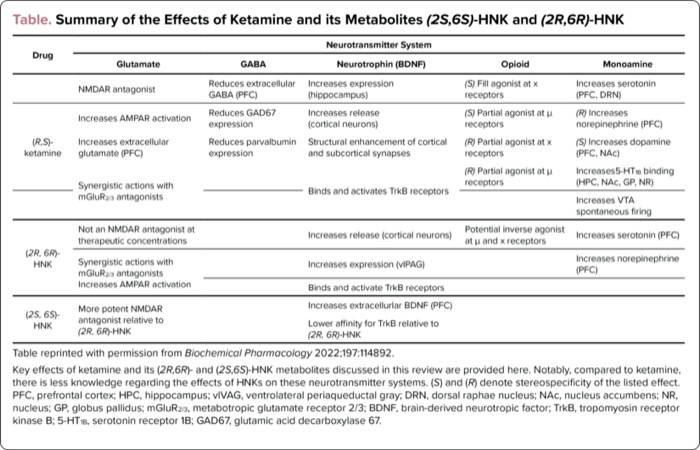
Ketamine inhibits the NMDARs expressed on GABAergic interneurons. Inhibition of the NMDARs expressed on GABAergic interneurons leads to pyramidal cell disinhibition and enhancement of excitatory glutamatergic neurotransmission in the medial prefrontal cortex (mPFC), and potentially other mood-relevant corticolimbic brain regions (Table).
| Table. Summary of the Effects of Ketamine and its Metabolites (2S,6S)-HNK and (2R,6R)-HNK | |||||
| Drug | Neurotransmitter System | ||||
|---|---|---|---|---|---|
| Glutamate | GABA | Neurotrophin (BDNF) | Opioid | Monoamine | |
| NMDAR antagonist | Reduces extracellular GABA (PFC) | Increases expression (hippocampus) | (S) Fill agonist at x receptors | Increases serotonin (PFC, DRN) | |
| (R,S)-ketamine | Increases AMPAR activation | Reduces GAD67 expression | Increases release (cortical neurons) | (S) Partial agonist at µ receptors | ® Increases norepinephrine (PFC) |
| Increases extracellular glutamate (PFC) | Reduces parvalbumin expression | Structural enhancement of cortical and subcortical synapses | ® Partial agonist at x receptors | (S) Increases dopamine (PFC, NAc) | |
| Synergistic actions with mGluR2/3 antagonists | Binds and activates TrkB receptors | ® Partial agonist at µ receptors | Increases5-HT1B binding (HPC, NAc, GP, NR) | ||
| Increases VTA spontaneous firing | |||||
| (2R, 6R)- HNK | Not an NMDAR antagonist at therapeutic concentrations | Increases release (cortical neurons) | Potential inverse agonist at µ and x receptors | Increases serotonin (PFC) | |
| Synergistic actions with mGluR2/3 antagonists Increases AMPAR activation | Increases expression (vIPAG) | Increases norepinephrine (PFC) | |||
| Binds and activate TrkB receptors | |||||
| (2S, 6S)- HNK | More potent NMDAR antagonist relative to (2R, 6R)-HNK | Increases extracellurlar BDNF (PFC) | |||
| Lower affinity for TrkB relative to (2R, 6R)-HNK | |||||
| Table reprinted with permission from Biochemical Pharmacology 2022;197:114892. Key effects of ketamine and its (2R,6R)- and (2S,6S)-HNK metabolites discussed in this review are provided here. Notably, compared to ketamine, there is less knowledge regarding the effects of HNKs on these neurotransmitter systems. (S) and ® denote stereospecificity of the listed effect. PFC, prefrontal cortex; HPC, hippocampus; vlVAG, ventrolateral periaqueductal gray; DRN, dorsal raphae nucleus; NAc, nucleus accumbens; NR, nucleus; GP, globus pallidus; mGluR2/3, metabotropic glutamate receptor 2/3; BDNF, brain-derived neurotropic factor; TrkB, tropomyosin receptor kinase B; 5-HT1B, serotonin receptor 1B; GAD67, glutamic acid decarboxylase 67. | |||||
Ketamine enhances the alpha-amino-3-hydroxy-5-methyl-4-isoxazolepropionic acid receptors (AMPARs) by blocking discrete postsynaptic NMDARs, such as those containing GLuN2B subunits, which otherwise inhibit AMPAR signaling. The GluN2B subunit of NMDARs confers different characteristics to NMDARs: GluN2B-containing receptors have higher calcium permeability; lower open probability and peak current; and slower deactivation, rise and decay times than GluN2A-containing NMDARs.22 GluN2B subunits suppress AMPARs synaptic incorporation and enhance their endocytosis in the hippocampal neurons.23 Therefore, inhibiting the NMDARs containing GluN2B subunits by ketamine will enhance the activity of AMPARs in the mPFC and the hippocampus. Of note, no evidence supports either ketamine or its metabolites binding or functionally acting on AMPARs.20
The lateral habenula (LHb) is a highly conserved region of the epithalamus that acts as an intermediary between the forebrain and midbrain monoaminergic systems. Stimulation of the glutamatergic LHb neurons by aversive stimuli, including acute stressors, inhibits the activity of midbrain dopamine neurons via the GABAergic cells in the rostromedial tegmental area. Thus, activation of LHb neurons is associated with major depressive disorder. It has been shown that ketamine-induced reduction in bursting activity in the LHb was associated with an acute antidepressant effect in rats.24
Ketamine and BDNF
The disinhibition effect of ketamine by blocking NMDARs in GABAergic inhibitory interneurons leads to enhanced glutamatergic firing. Evoked-release glutamate binds to and activates postsynaptic AMPARs, resulting in enhanced brain-derived neurotrophic factor (BDNF) release. In addition, ketamine enhances the release of BDNF by blocking the NMDARs’ miniature excitatory postsynaptic currents (mEPSCs). In particular, mEPSCs tonically suppress protein synthesis by reducing the production of BDNF.
Blocking the mEPSCs by ketamine will reduce the activity of eukaryotic elongation factor 2 kinase (eEF2K). The primary downstream substrate of eEF2K is eukaryotic elongated factor 2 (eEF2), which is associated with the regulation of protein synthesis and synaptic plasticity. Under physiologic conditions, NMDAR-dependent activation of eEF2K results in inactivation (phosphorylation) of eEF2, leading to the blockade of the elongation phase of protein synthesis and thus inhibition of protein translation. Subanesthetic doses of ketamine inhibit NMDAR-dependent activation of eEF2K and enhance BDNF protein translation. BDNF activates tropomyosin receptor kinase B (TrKB) and subsequently promotes protein synthesis via the activation of the mechanistic target of rapamycin complex 1 (mTORC1).25 Of note, a single antidepressant dose of ketamine enhanced protein translation in the hippocampus and PFC via the mTOR pathway, indicating that acute activation of mTOR, and thus protein translation may induce sustained synaptic plasticity changes responsible for the prolonged antidepressant effects of ketamine.25
Disruption of neurotrophic factors such as BDNF could contribute to neuropsychiatric disease, especially depression. The loss of brain volume due to disruption to BDNF signaling, as in patients who carry a polymorphism in the BDNF gene (Val66Met) that disrupts BDNF secretion and who have significantly lower hippocampal volumes, could lead to the development of depression in these patients. Of note, the loss of brain volume coincides with a loss in synapses in depressed patients.20,26 In a mouse study, a single ketamine treatment restored the dendritic spines that were specifically lost during chronic corticosterone treatment. The loss of dendritic spines could explain the development of depression as an adverse effect of chronic corticosterone treatment.20 Ketamine enhances astrocyte-to-neuron cholesterol transfer, thus facilitating TrKB signaling and synaptic maturation.27
Many antidepressants, including fluoxetine, imipramine, ketamine and its metabolite (2R,6R)-hydroxynorketamine [(2R,6R)-HNK], disrupt the interaction between TrkB and the AP-2 protein complex, which is involved in the endocytosis of TrkB. This leads to an increase in surface expression of TrkB, thus enhancing the availability for rebinding BDNF and protein synthesis. In addition, it is suggested that fluoxetine, ketamine and (2R,6R)-HNK may act by directly binding to the transmembrane domain of the TrkB receptor.20,28 Of note, R-ketamine is a more potent antidepressant compared with S-ketamine; therefore, the (2R,6R)-HNK metabolite, which is solely produced via metabolism of ®-ketamine, exerts more potent and longer-lasting antidepressant actions compared with the (2S,6S)-HNK enantiomer, which is produced via the metabolism of S-ketamine, while racemic ketamine produces (2S,6S,2R,6R)-HNK metabolite.25
Collectively, BDNF signaling is critical for the cellular, molecular and behavioral effects of ketamine and its metabolites. Ketamine and its metabolites can enhance AMPAR signaling through a disinhibition mechanism involving either GABAergic interneuron NMDARs or inhibitory extrasynaptic NMDARs in pyramidal neurons. Given that AMPARs drive BDNF secretion, disinhibition mechanisms by ketamine and its metabolites are enhancing BDNF effects, thereby resulting in enhanced synaptic plasticity. Enhancement in synaptic activity is one of the key phenomena that contributes to the antidepressant effects of ketamine.29
The Opioid System
Ketamine has agonist properties at the mu- and kappa-opioid receptors, an interaction that may be necessary for its antidepressant effects.30
Ketamine is useful for the management of neuropathic pain in which there is upregulation of NMDARs in ascending central pain circuity and/or loss of top-down regulation of pain. Ketamine counters the hyperexcitatory state present in ascending pain circuity through NMDAR inhibition while also enhancing the activity of brain regions involved in top-down inhibition of pain centers, such as the PFC and brainstem.31
The ketamine metabolite (2R,6R)-HNK acts as an inverse agonist at the mu- and kappa-opioid receptors, thus restricting the potential for abuse of (2R,6R)-HNK.
Intravenous Lidocaine
Lidocaine works via several mechanisms to reduce opioid consumption, and it prevents hypersensitization and hyperalgesia. Systemic lidocaine inhibits voltage-gated sodium and calcium channels, various potassium channels, NMDA receptors, the glycine system, and G-protein pathways. Lidocaine blocks the priming neutrophils and inhibits the release of superoxide anions and IL-1B. Moreover, lidocaine may work on specific sites in the thalamus to reduce chronic neuropathic pain.
In a randomized controlled trial of 116 patients undergoing complex spine surgeries, Farag et al showed that IV lidocaine reduced opioid consumption and improved quality of life. Lidocaine infusion was given in a dose of 2 mg/kg per hour up to a maximum 200 mg per hour.32
Dexamethasone
Dexamethasone reduces prostaglandin synthesis by inhibiting phospholipase enzyme and COX-2. Reduction in central sensitization has been hypothesized for the sustained postoperative opioid-sparing and pain relief continuing for three days after a single dose of glucocorticoids. Preoperative administration of 16 mg IV dexamethasone reduced acute pain during mobilization from two to 24 hours after primary disk surgery.33,34
Magnesium
Magnesium improves pain scores at rest and with movement and reduces postoperative opioid consumption. Magnesium inhibits calcium ions by blocking NMDARs, resulting in an analgesic effect. Increased intracellular calcium appears to play a major role in the initiation of central sensitization.35 In addition, magnesium ions are involved in carbohydrate metabolism and insulin response, whereas magnesium deficiency is reportedly related to endocrine and metabolic disorders. An inverse relationship exists between serum magnesium and fasting glucose or glycated hemoglobin levels.35,36
After analyzing 11 randomized controlled trials, Peng et al described the systemic perioperative use of magnesium sulfate, reducing the amount of analgesics and unpleasant experiences, including nausea, vomiting and shivering.37 Taheri et al demonstrated that a single dose of magnesium sulfate 50 mg/kg-1 in 100 mL of normal saline during balanced general anesthesia could be an effective method to reduce postoperative pain and opioid consumption after total abdominal hysterectomy.38
Perioperative Gabapentinoids
Gabapentinoids are helpful in patients with painful diabetic neuropathy, post-herpetic neuralgia and traumatic spinal cord injury. The gabapentinoids have de rigueur components of protocols for early recovery after surgery and multimodal analgesia. A recently published meta-analysis, consisting of 281 randomized controlled trials involving 24,682 adults, compared gabapentinoids with placebo or another analgesic regimen/usual care when initiated one week before and 12 hours after elective or emergent surgery. Gabapentinoids were associated with statistically lower but clinically unimportant postoperative opioid use. They were associated with less postoperative nausea and vomiting but also more side effects, including dizziness and visual disturbances.
Gabapentinoids bind to the alpha2-delta subunit of voltage-gated calcium channels, which are richly expressed in the cerebellum and hippocampus, and their use will result in dizziness, balance disorders, ataxia, visual disorders, sedation, somnolence and cognitive impairment. Furthermore, the use of pregabalin was associated with severe adverse events that could lead to death, disability or prolonged hospitalization.
Day-of-surgery gabapentinoid use was associated with a dose-dependent increase in odds of postoperative pulmonary complications and ICU admission due to respiratory depression that is independent of opioid use. The French Society of Anesthesia and Intensive Care Medecine recommends that gabapentinoids should not be used in outpatient surgery. In December 2019, the FDA issued a drug safety alert about serious breathing problems with gabapentin and pregabalin when used with central nervous system (CNS) depressants or in patients with lung problems. Collectively, evidence-based practice impels revising the routine use of perioperative gabapentinoids.39,40
Sublingual Sufentanil
Sufentanil is a pure mu-receptor agonist within the CNS. It is 7,000 times more potent than morphine, with an onset time like fentanyl and a half-life of 6.5 hours. Patient-controlled systems, like PCA pumps, allow for 15-mcg tablets to be dispensed every 20 minutes, with recommended treatment up to 72 hours postoperatively. Compared with morphine PCA, sublingual sufentanil has faster analgesia, greater ease of use and better levels of patient satisfaction. Patients scheduled for lumbar instrumentation and fusion at single or double levels were randomized to either sufentanil or fentanyl IV PCA postoperatively. Sufentanil displayed no analgesic advantage over fentanyl postoperatively. However, patients in the sufentanil group experienced lower rates of postoperative nausea and vomiting.41
Methadone
Intraoperative methadone dosed at 0.2 mg/kg was shown to reduce pain scores and postoperative pain medication requirements by 50% and lasted up to 72 hours. Postoperative respiratory depression, hypoxemia, need for reintubation and cardiac complications, such as arrythmias or prolonged QT interval, were reported after intraoperative use of methadone. Methadone can be administered orally 0.2 to 0.3 mg/kg preinduction or as a single IV bolus (0.14-0.2 mg/kg) intraoperatively.42,43
Regional Anesthesia; Epidural Analgesia
Potential benefits of epidural analgesia include increased patient satisfaction with decreased pain, lower opioid requirements, earlier mobility, and reduced postoperative nausea and vomiting.
In a retrospective study of 245 patients from our group undergoing major spine surgery, who received either patient controlled epidural analgesia or IV PCA for postoperative pain management, the use of epidural analgesia was associated with reduced opioid requirements and their related side effects, especially in older patients.44,45
Erector Spinae Plane Block
In another study, 50 patients scheduled for lumbar spine surgery were randomized to receive bilateral erector spinae plane block (ESPB) with ropivacaine versus saline before surgery. No difference between the two groups in opioid sparing, pain scores and side effects in the postoperative period were noted. Results of a meta-analysis of 13 studies of patients receiving ESPB after spine surgeries showed reduced total opioid use, better pain scores and a lower risk for postoperative nausea and vomiting with ESPB. Of note, the authors of the meta-analysis cautioned that the quality of pooled findings was judged to be low to moderate. In addition, none of the pooled studies had used continuous ESPB for postoperative analgesia.46,47
Liposomal Bupivacaine
The use of liposomal bupivacaine for intraoperative local infiltration in spine surgeries is controversial. In a review that comprehensively summarizes the results of all published randomized controlled trials (N=76) involving the clinical administration of liposomal bupivacaine to control postoperative pain, the authors found that of the trials deemed to be at high risk for bias, 84% (16/19) reported statistically significant differences for their primary outcome measures, compared with only 14% (4/28) of those with a low risk for bias. The preponderance of evidence fails to support the routine use of liposomal bupivacaine over standard local anesthetics for spine surgeries.48
Biased Agonists: The New Opioid Agents
Opioids are considered the mainstay in complex spine surgeries for postoperative pain. However, the use of opioids is not without side effects, such as sedation, respiratory depression, constipation, pruritus, vasodilation, nausea and vomiting.49 In addition, coupling of opioids to the G-protein will lead receptor downregulation and tolerance to the drugs.50
Classic opioid analgesics, such as fentanyl, morphine and oxycodone, are full agonists at the mu-opioid receptor.51 After receptor activation, these opioids engage two distinct transduction pathways, the G-protein–coupled signaling pathway and beta-arrestin pathway, with separate pharmacologic effects. The G-protein pathway is primarily involved in analgesia, reward and liking, whereas the beta-arrestin pathway is involved in adverse effects, such as respiratory depression and gastrointestinal side effects, as well as the attenuation of analgesic effects.52
Considering the high incidence and potentially serious consequences of respiratory depression, recent focus has been on developing a new class of opioids: biased ligands, which are mu-receptor agonists that selectively engage the G-protein–coupled signaling pathway with reduced activation of the beta-arrestin pathway.53 Biased ligands may have an advantage over nonbiased or nonselective mu-opioid receptor agonists, since they may associated with less side effects, especially respiratory depression. Oliceridine is a newly FDA-approved biased ligand for treatment of moderate and severe acute pain.52
The usual loading dose of oliceridine is 1 to 2 mg, to be supplemented by a 1- to 3-mg dose every one to three hours as needed; PCA dosing is a 1.5-mg loading dose, followed by 0.35 or 0.5 mg, with a six-minute lockout interval. There are no proper randomized trials investigating the dosage or perioperative pain effects after complex spine surgeries.
Conclusion
Multimodal analgesia is the ideal method for perioperative pain management for spine surgeries, especially the complex ones, but a specific regimen cannot be recommended from the literature.
References
Copyright © 2023 McMahon Publishing, 545 West 45th Street, New York, NY 10036. Printed in the USA. All rights reserved, including the right of reproduction, in whole or in part, in any form.
Download to read this article in PDF document:
Multimodal Analgesia For Complex Spine Surgeries