

×
ADVERTISEMENT

NOVEMBER 8, 2023

Getting Into the Weed(s):

Breaking Down the ASRA Pain Medicine Perioperative Cannabis And Cannabinoid Guidelines


Originally published by our sister publication Anesthesiology News

Jeffrey J. Mojica, DO
Clinical Assistant Professor of Anesthesiology
Sidney Kimmel Medical College
Eric S. Schwenk, MD, FASA
Professor of Anesthesiology
Sidney Kimmel Medical College
Director, Orthopedic Anesthesia
Thomas Jefferson University Hospital
Philadelphia
The authors reported no relevant financial disclosures.

Cannabis use is widespread in the United States and has important implications for us as anesthesiologists, whether we


Originally published by our sister publication Anesthesiology News

Jeffrey J. Mojica, DO
Clinical Assistant Professor of Anesthesiology
Sidney Kimmel Medical College
Eric S. Schwenk, MD, FASA
Professor of Anesthesiology
Sidney Kimmel Medical College
Director, Orthopedic Anesthesia
Thomas Jefferson University Hospital
Philadelphia
The authors reported no relevant financial disclosures.

Cannabis use is widespread in the United States and has important implications for us as anesthesiologists, whether we like it or not. It is no longer a theoretical future event but a reality that confronts us in our ORs and pain clinics every day.

Introduction

Cannabis is the most frequently used recreational drug in the United States with up to 18.7% of the population having reported using cannabis in the past 12 months, according to a 2021 survey.1 Additionally, about 10% of users worldwide meet the definition for cannabis use disorder.2 Patients who use cannabis and cannabinoids represent an increasingly larger segment of the population presenting for surgery, and introduce some specific concerns that are worthy of discussion.

Recently, the American Society of Regional Anesthesia and Pain Medicine (ASRA Pain Medicine) published consensus guidelines on the perioperative management of patients taking cannabis and cannabinoids.3 One of this article’s authors, Eric S. Schwenk, MD, FASA, was part of the expert panel that created the guidelines. Some of the main reasons the guidelines were created include the increasing frequency of cannabis-using patients undergoing surgery, the overall paucity of guidance for perioperative management and a lack of understanding by physicians of the implications of cannabis use.4 Furthermore, there is a growing public perception that cannabis consumption is low risk,5 and the implications of cannabis use on the body, particularly during stressful times such as the perioperative period, may not be discussed between patients and their physicians. A lack of clarity exists when it comes to cannabis terminology, and misconceptions exist regarding differences between cannabidiol (CBD) and delta-9-tetrahydrocannabinol (THC), which are very relevant, given the lack of regulation of THC content in products advertised as CBD.6

image

The objective of this article is to break down some of the key points made in the guidelines and discuss some practical implications for anesthesiologists.

Universal Screening

Perhaps the most misunderstood portion of the cannabis guidelines is the grade A recommendation for universal screening for all patients scheduled for elective surgery. Screening does not imply “urine drug testing,” and in fact, the guidelines explicitly state that “universal toxicology screening is not currently indicated based on insufficient evidence” (grade D). We believe that these guidelines could lead to improved patient care simply through the asking of a “yes” or “no” question about cannabis use as part of the preoperative anesthetic evaluation.

While reliable data on preoperative cannabis screening habits by anesthesiologists do not exist, it has been our experience that cannabis use is often lumped into the broader “drug use” category, and this can prevent accurate assessment and subsequently appropriate discussions and care. The dose, frequency, route of administration and time of last cannabis use are particularly important because the available evidence suggests that these factors may affect anesthetic management and postoperative outcomes.

It is our opinion that building cannabis-specific questions into a standard preoperative evaluation form can be an easy and effective way of obtaining and incorporating this important information into routine practice.

Should Cannabinoids Be Continued Perioperatively?

The decision to continue or discontinue perioperative cannabinoids is complicated and dependent on numerous factors. This is partly due to the variations in dosing and indication, drug composition and formulation, and the different routes of administration. However, what is clear is that elective surgery should be delayed if patients are acutely intoxicated or have an altered mental state from suspected cannabis intoxication—or any other illicit substance (grade A recommendation).7 From a medicolegal standpoint, patients who are acutely intoxicated may not have the cognitive ability to provide informed consent, and as discussed later in this article, they may experience increased morbidity and mortality during the first few hours after consumption.

Acute cannabis intoxication may present with anxiety, paranoia or even psychosis.8 However, these symptoms may not be evident in chronic cannabis users and reinforce the guideline’s position that all perioperative patients be screened for cannabis use.7,8

Acute cannabis exposure has been shown to activate the sympathetic nervous system, resulting in an increase in blood pressure and heart rate.9 These effects occur within 60 minutes of acute exposure and persist for up to 120 minutes.

This acute increase in cardiovascular function may explain the increased risk in perioperative myocardial infarction (MI) that was observed in a multicenter study of nearly 4,000 patients.10 In the study, patients who smoked within one hour of surgery were found to have a fivefold greater risk for an MI. The relative risk of MI decreased to 1.7 in patients who smoked within two hours of surgery.10 As a result of these findings, the authors of the cannabis guidelines recommended that elective surgeries be delayed for a minimum of two hours after cannabis smoking to mitigate the risks for perioperative cardiac events.7

This recommendation is probably the most controversial in the guidelines paper. Some may question it, given the low-quality evidence upon which it was based, although this is acknowledged in the strength of the recommendation.

Of note, the guidelines do not recommend mandatory cancellation of surgery for cannabis smoking. While the practical realities of the OR could lead to some patients having surgeries canceled, such as those scheduled for late afternoon, the guidelines clearly state that the increased risk is fairly transient and returns to the level of a non–cannabis-using patient after approximately two hours. For most patients, a brief delay in the induction of anesthesia would be consistent with following the guidelines. In our institution, it is common for at least two hours to elapse from when patients leave their homes to the time the anesthesiologist evaluates them in the preoperative holding area. In these instances, the two-hour waiting time would already be satisfied.

Regardless of whether or not an anesthesiologist chooses to follow this recommendation, more evidence is clearly needed. A randomized controlled trial would generate the highest level of evidence but may not be possible for ethical reasons or simply due to an inability to control the variables. If newer observational data are published that refute this recommendation and suggest that it is safe to proceed with surgery without delay, then the recommendation may change in the future. It is important to note that the recommendation was directed to those smoking cannabis and would not apply to those consuming edibles or CBD-dominant products. It is unclear whether consuming these other forms of cannabis is associated with the same adverse cardiac events as smoking cannabis.

Cannabinoid Effects on Anesthesia Requirements

Acute cannabis use is thought to decrease anesthetic requirements while chronic cannabis use may increase anesthetic requirements. However, the overall evidence supporting these concepts is limited. In a retrospective review of 118 patients undergoing tibial fracture repair, sevoflurane requirements were found to be higher in cannabis users than non-cannabis users.11 Cannabis use was defined as consumption of any cannabis product within 30 days of surgery, and the authors noted that titration of inhalational anesthetics was at the discretion of the individual anesthesia providers and not based on any specific monitoring devices or physiologic parameters.

In one of the only prospective randomized studies examining the effects of cannabis use on anesthetic requirements, cannabis users were found to require larger induction doses of propofol (314.0±109.3 vs. 263.2±69.5 mg; P<0.04) for the successful placement of a laryngeal mask airway and to achieve a bispectral index value of less than 60.12 The implications of this study remain unclear, as intraoperative EEG monitoring is fraught with its own inherent limitations, including the unknown accuracy and reliability of assessing anesthetic depth in cannabis-smoking patients. Hence, the guidelines concluded that there is insufficient evidence to recommend for or against the use of intraoperative EEG monitoring in patients who consume cannabis.

However, these studies introduce some relevant issues related to how we should manage these patients. In our view, anesthesiologists should be prepared for higher doses of anesthetic medications when treating cannabis users, especially those who have reported chronic use and high doses. With the understanding that each patient is different, we should at least approach these patients with increased awareness that greater anesthetic levels are possible and not be surprised if we experience this.

image

Cannabis Withdrawal Syndrome

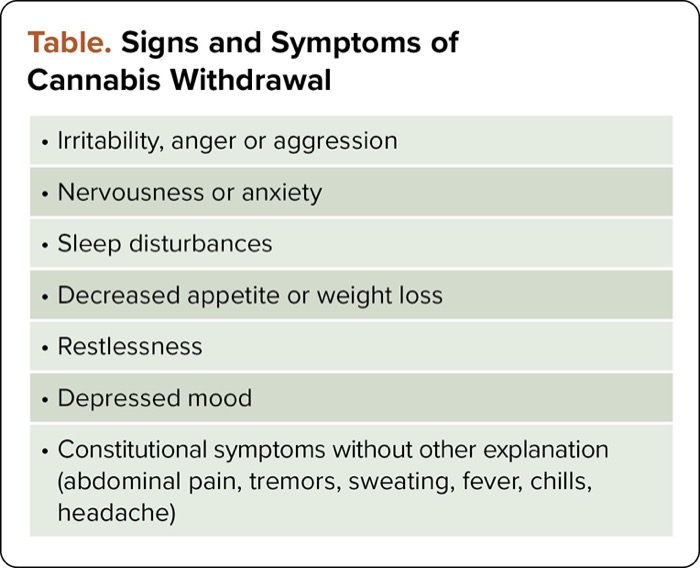
Patients who consume large quantities of THC are at risk for developing cannabis withdrawal symptoms (CWS) in the postoperative period. CWS can occur 24 to 72 hours after last cannabis use, peak in the first week and can last up to two weeks. Common signs and symptoms of CWS are listed in the Table.

image
Table. Signs and Symptoms of Cannabis Withdrawal
  • Irritability, anger or aggression
  • Nervousness or anxiety
  • Sleep disturbances
  • Decreased appetite or weight loss
  • Restlessness
  • Depressed mood
  • Constitutional symptoms without other explanation (abdominal pain, tremors, sweating, fever, chills, headache)

Patients who are high risk for CWS include those who consume 1.5 g per day of inhaled cannabis, 20 mg per day of THC-dominant cannabis oil or those consuming a cannabis product with unknown concentrations of THC products. These high-risk patients should be assessed in the postoperative period with a validated scale such as the Cannabis Withdrawal Scale if any clinical suspicion of CWS exists. Cannabinoid agonists, such as dronabinol and nabilone (Cesamet, Bausch Health), may be helpful in attenuating the symptoms of cannabis withdrawal. Dronabinol 20 mg twice daily, nabilone 6 mg once daily or nabilone 4 mg twice daily have been shown to be efficacious in treating CWS. The availability of these two medications may vary by hospital.

Recognition of CWS in the PACU may be challenging because it is often not high on the differential diagnosis of most anesthesiologists. Symptoms such as irritability, restlessness and headache, or abdominal pain may be difficult to identify and associate with cannabis.3 This may be further compounded by the fact that a detailed cannabis use history is often omitted from the preoperative evaluation.

The most impactful thing we can do is raise awareness that CWS exists and educate our colleagues when a patient is not recovering as expected and if something just seems “off.” If CWS is suspected, another effective and readily available treatment is gabapentin. In one study, a dose of 1,200 mg effectively reduced the symptoms of cannabis withdrawal compared with placebo.13

Effects of Cannabis on Postoperative Pain

There is a growing body of evidence that preoperative cannabis use increases the severity of postoperative pain, particularly with chronic use. In a retrospective study of patients undergoing major orthopedic surgery, self-reported cannabis users had more severe pain at rest and with movement and reported more sleep interruption compared with patients who did not use cannabis.14 In a separate study, patients who reported preoperative cannabis use experienced more severe postoperative pain and consumed more opioids than non-cannabis users.15 The preoperative characteristics of the cannabis users also included more pain-related disabilities and impairments, including worse centralized pain, anxiety, depression, and concomitant opioid and benzodiazepine use.15

Management of postoperative pain is an area where anesthesiologists shine and have the potential to create a real impact. For patients using cannabis chronically, the analgesic plan can be potentially adjusted if this is identified preoperatively. Incorporating regional anesthesia, ketamine infusions, lidocaine infusions and other potent analgesics into the perioperative analgesic plan is a logical starting point for these patients.

While these things should always be on our minds as anesthesiologists, they are particularly germane in this patient population and may give us yet another evidence-based and persuasive argument in favor of more advanced analgesic approaches when discussing patients with surgeons.

Obstetric and Neuraxial Anesthesia Considerations

The use of cannabinoids during pregnancy has steadily increased, and anesthesiologists should be aware of the physiologic effects of cannabis on the parturient, fetus and newborn. From a practical standpoint, an understanding of the neuraxial implications of cannabis is likely to suffice for most anesthesiologists. Fortunately, cannabis does not appear to have any specific implications regarding the use of neuraxial anesthesia for either labor or cesarean delivery.

Conclusion

Cannabis use is widespread in the United States and has important implications for us as anesthesiologists, whether we like it or not. It is no longer a theoretical future event but a reality that confronts us in our ORs and pain clinics every day. The recently published consensus guidelines on the management of perioperative patients on cannabis and cannabinoids are a big step in the right direction toward helping us better understand the effects of cannabis on the body and how to prepare for the perioperative challenges it presents. Increased levels of postoperative pain and possibly a greater likelihood of postoperative nausea and vomiting should prompt us to plan and treat accordingly.

Generic screening questions about “drug use” should be abandoned in favor of more specific questions focused on type, amount, frequency and duration of cannabis use. We believe that ASRA Pain Medicine made the right decision by neither endorsing nor condemning cannabis use, but rather focusing its attention on the practical aspects of management that affect all anesthesiologists.

Whether we support or oppose the legalization of cannabis, it is here to stay. Our focus now must shift toward safely and appropriately managing patients who consume cannabis products through the understanding of the latest evidence and, in doing so, prevent ourselves from getting “caught up in the weeds” of public perception.

References

  1. National Institute on Drug Abuse. July 2020. Accessed July 14, 2023. https://nida.nih.gov/publications/research-reports/marijuana/what-scope-marijuana-use-in-united-states
  2. Nat Rev Dis Primers. 2021;7(1):16.
  3. Reg Anesth Pain Med. 2023;48(3):97-117.
  4. Cannabis Cannabinoid Res. 2023 Apr 25.
  5. Drug Alcohol Depend. 2021;226:108873.
  6. Substance Abuse and Mental Health Services Administration. February 2023. Accessed July 14, 2023. https://store.samhsa.gov/sites/default/files/pep22-06-04-003.pdf
  7. Reg Anesth Pain Med. 2023;48(3):97-117.
  8. Proc (Bayl Univ Med Cent). 2019;32(3):364-371.
  9. J Clin Anesth. 2019;57:41-49.
  10. Circulation. 2001;103(23):2805-2809.
  11. J Clin Anesth. 2020;67:109980.
  12. Eur J Anaesthesiol. 2009;26(3):192-195.
  13. Neuropsychopharmacology. 2012;37(7):1689-1698.
  14. Anesth Analg. 2019;129(3):874-881.
  15. Reg Anesth Pain Med. 2021;46(2):137-144.

Copyright © 2023 McMahon Publishing, 545 West 45th Street, New York, NY 10036. Printed in the USA. All rights reserved, including the right of reproduction, in whole or in part, in any form.

Download to read this article in PDF document:
Getting Into the Weed(s): Breaking Down the ASRA Pain Medicine Perioperative Cannabis And Cannabinoid Guidelines

This article is in PDF format and it requires Abobe Reader. If you do not have Adobe Reader installed on your computer then please download and install from the link below.

Related Keywords