

×
ADVERTISEMENT

JUNE 12, 2024

How Some Hospitals Joined Forces to Reduce Anesthesia-Related Emissions


Originally published by our sister publication Anesthesiology News

When anesthesiologist Elizabeth Hansen, MD, PhD, joined Seattle Children’s Hospital about seven years ago, she jumped into the medical center’s sustainability efforts and became concerned about what she saw. Anesthetic gases made up 7% of the hospital’s greenhouse gas emissions—the third-highest contributor following those from commuting and natural gases used in steam boilers—representing more than

Originally published by our sister publication Anesthesiology News

When anesthesiologist Elizabeth Hansen, MD, PhD, joined Seattle Children’s Hospital about seven years ago, she jumped into the medical center’s sustainability efforts and became concerned about what she saw. Anesthetic gases made up 7% of the hospital’s greenhouse gas emissions—the third-highest contributor following those from commuting and natural gases used in steam boilers—representing more than 1,200 metric tons of carbon dioxide equivalents. She vowed to do something about it.

“It was perfect timing for me because I was feeling a lot of eco-anxiety and despair about the future of the planet,” said Hansen, who also is an assistant professor of anesthesiology and pain medicine at the University of Washington, in Seattle. “It was a really good way for me to channel that anxiety and worry into action, because there are great tools that we can use and steps that we can take to reduce emissions from our anesthesia gas use that are safe, evidence-based and effective.”

Through efforts led by Hansen, the anesthesiology team achieved a nearly 10-fold reduction in anesthesia gas–related emissions over a five-year period, eliminating the equivalent of more than 500,000 kg of carbon dioxide emissions annually, and gained a cost savings of more than $175,000 per year, with no harm to patient care. Now she’s co-directing an international effort, called Project SPRUCE—Saving Our Planet by Reducing Carbon Emissions—to help other children’s hospitals achieve 50% or greater reductions in anesthesia-related hospital emissions. Nearly a dozen hospitals have joined already.

Multiple-Step Effort

Hansen began by having conversations with her colleagues, urging them to cut out desflurane, which is 2,540 times more potent at warming the planet than carbon dioxide, and to lower their use of nitrous oxide, which is 300 times more potent and persists in the environment for over 100 years (Lancet Planet Health 2023;7[7]:e622-e629). She moved from conversations to formal education for her colleagues and residents during staff meetings. This converted some of her colleagues to more sustainable practices and built momentum.

image

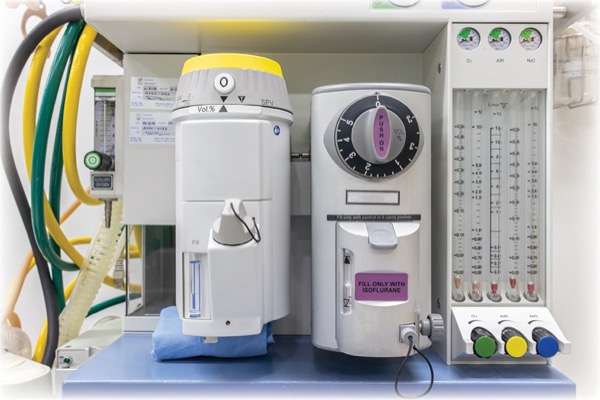
Next, Hansen worked to remove desflurane vaporizers from the ORs so anesthesiologists would have to specifically request them if needed, eventually taking desflurane off the formulary. Nitrous oxide was the next target. She and her colleagues worked to change defaults on anesthesia machines to lower fresh gas flows to reduce waste, added clinical decision support tools as prompts for clinicians, and promoted the use of intravenous anesthesia where appropriate. In 2022, they employed a software program that pulled anesthesia information from electronic health records to compile a carbon footprint performance of each anesthesiologist, which further spurred compliance as clinicians became more aware of their practices.

In total, the team went from emitting 0.32 kg of carbon dioxide equivalents per minute to 0.04 kg per minute. Continuing efforts have reduced it further to 0.027 kg per minute.

Physicians’ knowledge about anesthetic gases impacting the environment dates back some 20 years, said Dan Low, MD, an anesthesiologist at Seattle Children’s and an associate professor of anesthesiology at the University of Washington. But with events like extreme heat advisories in summer 2023, “it’s just surfacing to the level of consciousness of anesthesiologists and other clinicians,” he said.

“It’s a hearts-and-minds battle,” Low added. “It’s not about the science—no one is going to argue with you that nitrous oxide has a global warming potential, but it wasn’t being talked about. Once we started understanding we don’t have to change the quality of our care, anesthesiologists asked, ‘Can we waste less in the mode and the techniques we use?’”

Observing that the hospital was purchasing more nitrous oxide than it was using clinically led to an identification of leaks in the central pipes supplying the gas. So, the hospital is capping off the pipes and switching to portable nitrous oxide tanks that can be completely closed between uses.

Growing Project SPRUCE

At the Children’s Hospital Colorado, anesthesiologist Diane Gordon, MD, had been working on similar efforts, such as removing desflurane and promoting low-flow gas education. After meeting Hansen through a Society for Pediatric Anesthesia sustainability interest group, they banded together to expand Project SPRUCE.

image

“The whole problem really resonated with me because I have longstanding personal values about environmental stewardship that go back to my childhood and my love of the outdoors, and in keeping the Earth in as clean a state as possible,” Gordon said.

She collected baseline emissions data on her team from March to June 2023, and went live with formal reduction efforts in July. In just four months, they achieved a 50% reduction in anesthetic gas emissions across all of their Denver-area hospital sites, from 0.19 down to 0.08 kg carbon dioxide equivalents per minute. “We’re not stopping there,” Gordon said. “We’re going to keep working at all the things that we’re doing to try to see how low we can go.”

Gordon is continuing to promote low-flow anesthesia efforts and educating colleagues on minimizing nitrous oxide for pediatric mask inductions and increasing the use of total intravenous anesthesia (Paediatr Anaesth 2024;34[2]:104-107).

There are several steps anesthesiologists can take to make a difference at their own medical centers, Gordon said, including eliminating desflurane. Project SPRUCE is still accepting new members in pediatric, adult and mixed practices.

Resources

  1. The Anesthesia Patient Safety Foundation has an online course on low-flow anesthesia and has a free online simulator to teach low-flow techniques.
  2. The American Society of Anesthesiologists, in October 2023, issued a statement supporting the use and verifying the safety of low gas flows for sevoflurane.
  3. The Joint Commission recognizes participation in Project SPRUCE as one of the components for its new Sustainable Healthcare Certification, launched in January 2024.

By Karen Blum


Gordon and Hansen reported no relevant financial disclosures. Low is the chief medical officer at AdaptX Pediatric.

Related Keywords