

×
ADVERTISEMENT

OCTOBER 25, 2023

Adaptation Is Needed To Prevent Diversion In Community Pharms


Originally published by our sister publication Specialty Pharmacy Continuum


By Myles Starr


Workforce shortages, high rates of staff turnover and budget constraints all contribute to controlled substance diversion from community pharmacies (CSDCPs). In response to these challenges, ASHP recently updated its Guidelines on Preventing Diversion of Controlled Substances, which were outlined at the ASHP 2023 Summer Meetings & Exhibition, in Baltimore.

The revised guidelines aim to stop


Originally published by our sister publication Specialty Pharmacy Continuum


By Myles Starr


Workforce shortages, high rates of staff turnover and budget constraints all contribute to controlled substance diversion from community pharmacies (CSDCPs). In response to these challenges, ASHP recently updated its Guidelines on Preventing Diversion of Controlled Substances, which were outlined at the ASHP 2023 Summer Meetings & Exhibition, in Baltimore.

The revised guidelines aim to stop the flow of unprescribed drugs into communities and the attendant harms to patients being treated for pain, as well as pharmacies and their employees (Am J Health Syst Pharm 2022;79[24]:2279-2306).
Compared with previous guidelines, there is an increased focus on community pharmacies, according to Jordan Rush, PharmD, MS, the director of pharmacy for system retail and outpatient pharmacy services for UNC Health, in Durham, N.C. “Even though hospitals have been strained with labor and financial demands, similar problems have occurred in the community setting,” said Dr. Rush, who presented the changes at the ASHP meeting. “It’s critical to stay vigilant on preventing diversion in community pharmacies in order to provide high-quality care, keep the trust of patients and support the people who work in these critical nodes in the healthcare system.”

Roots of the Problem

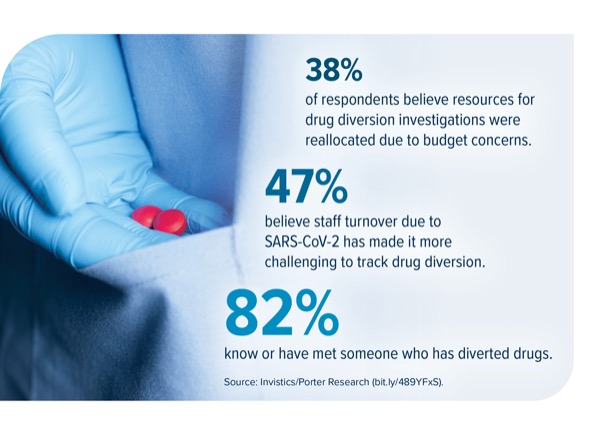
Since the COVID-19 pandemic began in 2020, a series of cascading problems have contributed to CSDCPs. Due to the increased need for healthcare workers and resulting staff shortages, current employees are often stretched thin and unable to exercise total vigilance over the complex flow of controlled substances (CSs) in their pharmacy, Dr. Rush said. A 2021 Invistics/Porter Research drug diversion survey noted that 47% of respondents said staff turnover due to SARS-CoV-2 has made it more challenging to track drug diversion, while 38% believed that resources for investigations were reallocated due to budget concerns. Moreover, 82% of healthcare professionals surveyed said “they know or have met someone who has diverted drugs.”

image

Identifying Patterns

Several recent high-profile cases and resulting settlements have outlined the patterns of diversion that are occurring in community pharmacies, the financial and health risks involved, and possible solutions. McClaren Health Care (MHC), headquartered in Grand Blanc, Mich., operates hospitals, ambulatory surgery centers and pharmacies. The Drug Enforcement Administration (DEA) accused MHC of several practices that facilitate CS diversion, including:

  • transferring CSs to a facility that was not registered with the DEA;
  • dispensing CSs without a written prescription;
  • failing to notify the DEA of CS thefts; and
  • failing to implement policies that are consistent with regulations.
image

These violations led to a $7.75 million settlement with the DEA in 2021. According to a press release from the U.S. Attorneys’ Offices (USAOs) for the Western and Eastern Districts of Michigan announcing the settlement, red flags that were ignored at MHC were:

  • patterns of prescriptions for the same type of drugs, in the same quantities, from the same prescriber;
  • prescriptions for excessive quantities of highly addictive Schedule II drugs;
  • repeated early prescription refills;
  • significant outlier drug volumes for individual patients and prescribers;
  • prescription entries in the names of fake patients; and
  • discrepancies between the cash reported and cash collected for CS prescriptions.

Similarly, Sovah Health in Virginia (SHV), entered into a non-prosecution agreement (NPA) with the USAO for the Western District of Virginia and a $4.36 million dollar civil settlement after a pharmacy technician was found to have diverted more than 11,000 Schedule II substances and 1,900 Schedule III to IV substances from 2017 to 2019, and a registered nurse was discovered to have removed fentanyl and hydromorphone from vials and replaced them with saline from January to May 2020. These diversions were enabled by the fact that no full inventory of substances was conducted and a failure to audit or enforce procedures. As part of the NPA, SHV will have to:

  • install cameras at each automated dispensing cabinet;
  • conduct a management review of blind count discrepancies;
  • report any potential theft or losses to the DEA and Virginia State Police;
  • conduct random drug testing for employees at least every six months;
  • enact progressive discipline for employees who violate CS policies and procedures;
  • conduct an annual full inventory count, including reconciliation; and
  • implement a quarterly accountability audit and annual self-evaluation for compliance with the NPA and all CS regulations by the pharmacist in charge.

At Risk: Faith in Healthcare

The blind spots and policy failures that led to diversion at MHC and SHV are threatening not only the bottom lines of community pharmacies in the form of lost inventory, suffering employee health and fines, Dr. Rush said, but jeopardize control of patients’ pain, as well as their faith in the healthcare system. As a result, the revised ASHP guidelines include recommendations to aid community pharmacies in developing their CS diversion prevention programs (CSDPPs). These recommendations emphasize internal organizational oversight and accountability, and include the following:

  • ensuring the pharmacy’s registration is up to date and annual competency training occurs;
  • maintaining proper signage;
  • implementing a procedure to identify missing pseudoephedrine;
  • a requirement that nurses and providers cannot dispose of medications themselves; and
  • proper installation of take-back receptacles.

In conjunction with these new regulations, the ASHP guidelines contain a host of security measures to make prevention of diversion in community pharmacies more robust (box).

7 Security Measures for Thwarting Diversion

  1. Adding registration requirements for drug collection sites to ensure that security protocols are followed, a chain of custody for CSs is maintained and packages are inspected for shipping integrity
  2. Installing camera surveillance, panic buttons and safe rooms
  3. Controlling access into the pharmacy and to areas where CSs are stored
  4. Using locked compartments to ensure refrigerated CS safety
  5. Adding diversion controls for accessing automation
  6. Routinely recording maintenance of key documents, including monthly counts for CSs, DEA Form 222s, complete inventory logs and discrepancy reports
  7. If suspected diversion or a discrepancy takes place, having a third party evaluate the investigation and resolution of the event

CS, controlled substances; DEA, Drug Enforcement Administration

Source: ASHP’s Guidelines on Preventing Diversion of Controlled Substances.

Dr. Rush noted that although the “guidelines are comprehensive, all steps of the medication-use process have a diversion risk, and community pharmacies have limited technology to monitor for diversion. The updated guidelines provide recommendations in these settings that can hopefully provide justification for pharmacy leaders to gain funding and support for these initiatives.”

The authors intend to keep the guidelines up to date as virtual sites of care and home infusion services proliferate, noting that human growth hormones, gabapentin, phosphodiesterase-5 inhibitors, and propofol are substances that may require further monitoring.

Larry K. Houck, JD, a director at Hyman, Phelps & McNamara P.C., who specializes in litigation related to CS diversion, commented that “healthcare facilities must invest in compliance early or pay and invest later.” He recommended that community pharmacies:

  • deploy technology and software to track and monitor CSs within their systems and identify discrepancies; and
  • hire adequate staff and provide sufficient compliance resources.

Mr. Houck concluded by noting that “facilities tailoring ASHP’s CSDPP to their specific operations, then implementing and adhering to them, will reduce their risk of controlled substance diversion.”


The sources reported no relevant financial disclosures.