

×
ADVERTISEMENT

APRIL 9, 2026

Filling the NIOSH list 'chasm' via large language models

Is Artificial Intelligence the Future Of Safe Hazardous Drug Handling?


Originally published by our sister publication Pharmacy Practice News

By Gina Shaw

As pharmacy professionals navigate the complexities of USP General Chapter <800> compliance, a critical challenge has emerged: The 2024 National Institute for Occupational Safety and Health (NIOSH) hazardous drug (HD) list was outdated before it was even published.

With hundreds of drugs approved since 2015 remaining unassessed and recent federal budget cuts making future updates unlikely, health-system


Originally published by our sister publication Pharmacy Practice News

By Gina Shaw

As pharmacy professionals navigate the complexities of USP General Chapter <800> compliance, a critical challenge has emerged: The 2024 National Institute for Occupational Safety and Health (NIOSH) hazardous drug (HD) list was outdated before it was even published.

With hundreds of drugs approved since 2015 remaining unassessed and recent federal budget cuts making future updates unlikely, health-system pharmacists need innovative solutions to protect staff and patients from HD exposures.

Artificial intelligence and large language models may be the answer, compounding experts suggest.

The NIOSH HD list released in December 2024 reviewed only the drugs that received FDA approval or new safety warnings between January 2014 and December 2015. “On the day the NIOSH list was published in December 2024, there were more than 400 drugs that were not evaluated,” said George Smith, PharmD, BCPS, a system sterile compounding services specialist at Prisma Health, during a 2025 webinar on HD compounding sponsored by Cleanovators.

The manual evaluations NIOSH has traditionally used cannot keep pace with pharmaceutical innovation, Dr. Smith argued. As a result, “we have a compliance chasm that we have to fill, for our own safety and for the safety of our pharmacy staff and the nurses that administer these medications.”

 02260308 pharmacist-online-patient-support Rene-L-peopleimages
© krisana, Rene L/peopleimages.com

Recent federal budget cuts to NIOSH and the Occupational Safety and Health Administration have made the situation even more challenging, with timely updates growing increasingly remote. “Politics aside, NIOSH is not going to be doing any more of these hazardous drug assessments on a global level like that,” Dr. Smith said. “So we need to do something now.”

He believes the pharmacy profession is “primed for artificial intelligence” (AI) to bridge this critical gap. The foundation already exists: toxicological databases, including DailyMed, the National Toxicology Program, and the International Agency for Research on Cancer, are web-based and publicly accessible. “Let’s grab that data and ask it the questions we need,” he said.

Dr. Smith also suggested that AI could be used to analyze the chemical patterns that indicate potential toxicity. To that end, he highlighted several robust toxicological databases available for AI integration, including the Environmental Protection Agency’s OncoLogic expert system for evaluating carcinogenicity and the Ecological Structure Activity Relationships predictive model, which predicts how toxicity manifests in the human body.

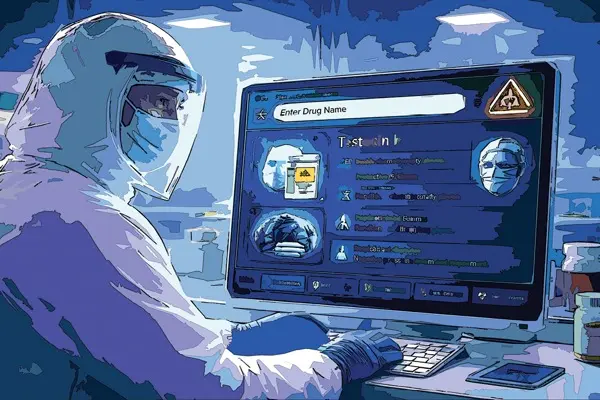
These databases could serve as “a living and breathing dynamic NIOSH list” that provides real-time hazard assessments as new drugs enter the market, Dr. Smith noted. The practical applications are potentially transformative. “Imagine having a ChatGPT kind of dashboard, where you input the drug name and get information back such as specific PPE [personal protective equipment] requirements, handling procedures, and negative pressure requirements,” he said. “If we remove the need for pharmacists and technicians to spend time reading package inserts and [researching online], we can gather this information in 10 minutes instead of 10 hours.”

Such dynamic, AI-driven analysis also complements the new emphasis on quantitative exposure assessment, as described in a separate presentation by Mark St. Marie, CIH, the national technical lead for healthcare at Vertex. “It’s important to supplement USP [Chapter] <800>’s Assessment of Risk with a true exposure assessment,” he said. “We’ve known about hazardous drug hazards since the early 70s. We have all this evidence of contamination on surfaces, but we still don’t always know exactly how those exposures occur. What we’re trying to do now is look at the processes that are creating those residues first and then map how they migrate out of the pharmacy. That makes our programs more accurate, repeatable, and defensible.”

 02260210 AI-chat-dashboard AI
Blake Dennis - McMahon Group

Although AI could potentially revolutionize hazard identification, Dr. Smith stressed that effective containment remains the cornerstone of HD safety. His discussion of advanced cleanroom design demonstrated how facilities can move beyond the minimum standards of USP <797> and <800> to create safer environments.

The traditional approach—a single anteroom leading to positive and negative buffer rooms with 30 air changes per hour—meets basic requirements but leaves room for improvement, Dr. Smith said. He advocated for dual anteroom functionality, separating hand hygiene (“wet side”) from garbing (“dry side”) to reduce microbial contamination risk while improving workflow efficiency. “You maintain a minimum of ISO 8 in the wet anteroom side, where you’ve got your biggest chance of microbial contamination because you have a sink, a water source.” After crossing the line of demarcation into the dry garbing area, he added, positive pressure flushes air outward, maintaining cleanliness.

One of Dr. Smith’s most innovative recommendations addressed a common problem: Where should staff remove contaminated PPE? Current practice typically involves doffing in the negative buffer room just before exit, but this creates particle generation that airflow patterns drive back toward the primary engineering control. As an alternative, Dr. Smith proposed a doffing room that staff would enter after they get out of the negative pressure area buffer room, where they would take off contaminated garb.

He also argued for HEPA-filtered pass-throughs between classified spaces, despite their additional cost. “I know they’re a little bit more expensive, but I think they are very effective at improving sanitation.”

For receiving and storage, Dr. Smith recommended “controlled, not classified” spaces—areas with HEPA filtration providing clean air without the full certification requirements of ISO-classified rooms, maintaining safety while reducing the burden of surface sampling, viable particle counting, and extensive documentation.

At Prisma Health, he has implemented these concepts in a cleanroom with a dual anteroom approximately 14 to 15 feet deep (reverting to single anteroom design when space constraints prevent adequate sizing), separate positive and negative buffer rooms, and a negative receiving/storage area with a powder containment hood. “It is controlled, not classified. I’ve got 12 air exchanges going through there with a differential pressure just greater than 0.01,” Dr. Smith explained. “We don’t have to worry about that upper limit because we’re not doing sterile compounding in that room.”

This cleanroom template presents an opportunity for facilities embarking on redesigns. “Take these concepts and think about them before your next meeting with architects.”

Key principles, such as dual anterooms where feasible, dedicated PPE doffing areas, and strategic use of HEPA-filtered pass-throughs can be adapted to various settings from large academic medical centers to ambulatory infusion centers, Dr. Smith suggested. “We want to think about not just meeting the standard but going beyond the standard for the safety of our pharmacy staff, our nurses, and our patients.”


The sources reported no relevant financial disclosures.