

×
ADVERTISEMENT

SEPTEMBER 2, 2025

When Screening for Intimate Partner Violence, Timing Matters

Study Finds Delayed Screening More Effective


Originally published by our sister publication General Surgery News

By Michael Vlessides
image
Jennifer Geller, MD

TUCSON, Ariz.—When it comes to identifying survivors of intimate partner violence, dedicated delayed screening is superior to early screening, a new study has concluded. Nevertheless, the authors said improving both early screening and dedicated delayed screening is necessary to ensure the detection of intimate partner violence, and they suggested using both methods to do


Originally published by our sister publication General Surgery News

By Michael Vlessides
image
Jennifer Geller, MD

TUCSON, Ariz.—When it comes to identifying survivors of intimate partner violence, dedicated delayed screening is superior to early screening, a new study has concluded. Nevertheless, the authors said improving both early screening and dedicated delayed screening is necessary to ensure the detection of intimate partner violence, and they suggested using both methods to do so.

“Intimate partner violence is a well-documented global health issue that impacts both men and women,” began Jennifer Geller, MD, who was a medical student at Rutgers Robert Wood Johnson Medical School, in New Brunswick, N.J., when the research was performed. “It is estimated that anywhere between 5% and 18% of patients who present to an acute care setting are impacted, and up to two-thirds of those who unfortunately die from intimate partner violence–related causes sought some sort of medical care in the year before their death.” As such, trauma surgeons are uniquely positioned to both screen for intimate partner violence and provide resources to survivors, added Dr. Geller, who is currently a surgical resident at Thomas Jefferson University, in Philadelphia.

And while universal patient-centered screening is recommended to help identify victims of intimate partner violence, there are many barriers to such efforts. The researchers were motivated to determine the most effective timing for intimate partner violence screening; they hypothesized that dedicated delayed screening would identify more patients at risk than early screening.

To that end, the investigators studied data from 4,527 trauma patients presenting to the Level I trauma center at Rutgers between July 2022 and October 2023. The institution’s standard practice was to administer early intimate partner violence screening, performed by a nurse as part of a broader assessment of healthcare determinants, upon the patient’s arrival to the hospital. Dedicated delayed screening, on the other hand, was a clinician-based dedicated screen implemented in July 2022 that was administered during tertiary survey following the patient’s initial workup and disposition.

image

“Our study looked to compare the frequency and detection rate of an early screening for intimate partner violence where staff asked about intimate partner violence exposure as a part of a broader social determinant of health screen on day one, and a dedicated delayed screen where a member of the trauma team sat down with the patient after that first busy day, alone and away from a potential abuser,” Dr. Geller explained.

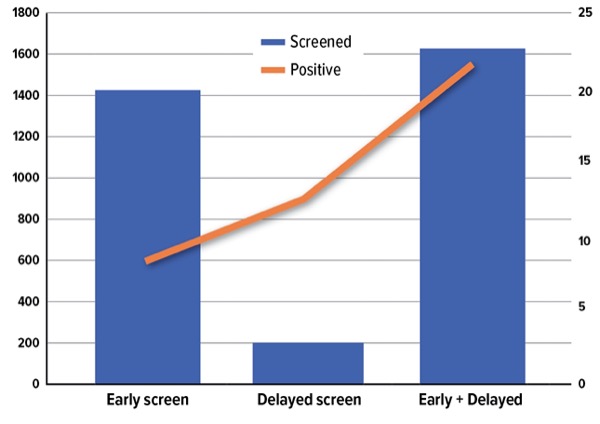
Presenting at the 2025 Annual Scientific Assembly of the Eastern Association for the Surgery of Trauma, the researchers revealed that more patients were assessed via early screening (31.7%) than by dedicated delayed screening (4.5%; P<0.001). Nevertheless, dedicated delayed screening detected intimate partner violence in 6.4% of cases, significantly more frequently than early screening (0.6%; P<0.001).

The researchers also found that patients screened by dedicated delayed screening were younger and had longer hospital lengths of stay than did those who underwent early screening (P<0.05). Of the patients who screened positive for intimate partner violence, 87.5% of those detected during early screening (7/8) were the victims of assault, compared with 23.1% of those (3/13) detected during dedicated delayed screening. Other mechanisms of injury in the delayed screening group were falls of less than 10 feet (three patients), motor vehicle collisions (three patients), motorcycle collisions (two patients), falls greater than 10 feet (one patient) and firearm injuries (one patient). In the early screening group, the lone remaining injury was a fall of less than 10 feet.

Although the researchers said the results demonstrate the value of dedicated delayed screening, they nonetheless believe that repeat screening is also a worthwhile undertaking. To that end, they said combining early screening with dedicated delayed screening may be the best way to identify, and ultimately prevent, intimate partner violence.

“Early screening has its benefits in that it’s a quick screen that can quickly identify patients in acute care settings,” Dr. Geller told General Surgery News. “Dedicated delayed screening builds onto this foundation by asking questions specific to intimate partner violence in a setting away from a potential abuser after the first busy hospital day. To integrate this into the workflow, performing dedicated delayed screening as a part of the tertiary survey of trauma patients can create consistency in the timing of the screen, and may increase how often the screen is performed.” At her institution, dedicated delayed screening questions have been integrated into the electronic medical record.

image

Figure. Early vs. dedicated delayed screening results.

Equally important to the patient’s well-being is following through once intimate partner violence has been identified. Here, Dr. Geller and her colleagues recommended the creation of an institutional infrastructure whereby these individuals are automatically referred to outside resources, such as hospital violence intervention programs, which can help ensure that survivors of intimate partner violence have support as they move forward.

“By asking patients about intimate partner violence exposure at frequent healthcare encounters, we can normalize the conversation around an often-stigmatized topic that is hard for patients to talk about,” Dr. Geller concluded. “In normalizing that conversation, patients may become more comfortable sharing their intimate partner violence experience with the clinicians who care for them in the healthcare setting, who can then provide patients with needed resources.”

Session discussant Carlos Palacio, MD, the trauma medical director at McAllen Medical Center, in Texas, said intimate partner violence is an important topic of research.

“Only a small percentage of people affected by intimate partner violence seek help,” he explained. “Given that, it’s important that we get it right, and the study shows that timing can have a big impact on the effectiveness of our screenings.

“In the end, though, I agree that performing both early and delayed screening is superior to doing just one or the other,” he added. Dr. Palacio would also like to see the findings confirmed in a larger multicenter trial.

Related Keywords