

×
ADVERTISEMENT

DECEMBER 5, 2024

2 Genes Common in RA and Osteoporosis


Originally published by our sister publication Specialty Pharmacy Continuum

By SPC News Staff

Chinese researchers employed bioinformatics tools and machine learning algorithms to identify two genes linked to rheumatoid arthritis (RA) and osteoporosis that could serve as diagnostic tools and potential targets for treatments (APL Bioeng 2024;8[4]:046107 https://doi.org/10.1063/5.0233961).

People with RA are at a higher risk for osteoporosis as a result of the bone damage caused by immune cells,


Originally published by our sister publication Specialty Pharmacy Continuum

By SPC News Staff

Chinese researchers employed bioinformatics tools and machine learning algorithms to identify two genes linked to rheumatoid arthritis (RA) and osteoporosis that could serve as diagnostic tools and potential targets for treatments (APL Bioeng 2024;8[4]:046107 https://doi.org/10.1063/5.0233961).

People with RA are at a higher risk for osteoporosis as a result of the bone damage caused by immune cells, inflammation, glucocorticoids and lower levels of physician activity, according to the International Osteoporosis Foundation.

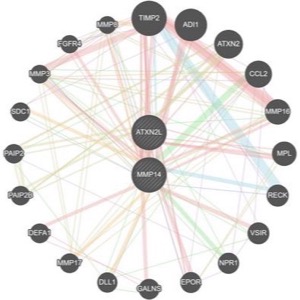
Of the many genes involved in rheumatoid arthritis and osteoporosis, researchers identified the two key genes, ATXN2L and MMP14, that are most strongly linked to both diseases. Image from Lo, et al. 


The genes are important in controlling apoptosis, which is a crucial tool immune cells use to remove malfunctioning or unneeded cells. However, sometimes, as is the case in both RA and osteoporosis, malfunctions lead to immune cells mistaking healthy cells as invaders, contributing to inflammation and destroying the joints and weakening bones. 

“In rheumatoid arthritis, excessive apoptosis of bone-forming cells contributes to joint destruction and inflammation,” said author Hao-Ju Lo, PhD, from the Department of Orthopedic Surgery, Da-Chien General Hospital, in Miaoli, Taiwan. “This same process also leads to weakened bones in osteoporosis, emphasizing the need to manage both conditions simultaneously.”

Because of its central role, the researchers from Da-Chien General Hospital, China Medical University and Chang Gung University looked for the genes involved with apoptosis that were closely linked to both diseases. Drawing from a large database of genetic information, they gathered dozens of sequenced genomes from people with RA and osteoporosis to look for similarities, using computational methods to winnow the large amount of genetic data.

“We used bioinformatics tools to analyze large gene data sets, focusing on genes active in rheumatoid arthritis and osteoporosis,” Dr. Lo said. “We applied machine learning techniques, such as Lasso and Random Forest, to refine our search, identifying two key genes—ATXN2L and MMP14—that play significant roles in both diseases.”

According to their analysis, these two genes are significantly associated with the progression of both RA and osteoporosis. ATXN2L has a role in regulating processes like apoptosis, so malfunctions in this gene are likely to trigger both diseases. MMP14 contributes to building extracellular tissue like cartilage and could be responsible for the breakdown of joint tissue that leads to RA.

“Our analysis revealed that these genes are involved in immune regulation and bone metabolism, suggesting they could be useful markers for diagnosing or treating both rheumatoid arthritis and osteoporosis,” Dr. Lo said.

The researchers plan to continue this research in the hopes they can develop personalized therapies.


Related Keywords