

×
ADVERTISEMENT

DECEMBER 18, 2023

New Guideline May Decrease Cross-Contamination With Ultrasound Probe Use


Originally published by our sister publication Anesthesiology News

PARIS—Given the potential for bacterial contamination, a Boston research team has come up with an institutional guideline for cleaning and disinfecting the surface of ultrasound probes. Adherence to the guideline, the clinicians said, should help ensure effective disinfection while minimizing the risk for cross-contamination.

“There were multiple reasons why we developed these guidelines,” said co-author Adriana


Originally published by our sister publication Anesthesiology News

PARIS—Given the potential for bacterial contamination, a Boston research team has come up with an institutional guideline for cleaning and disinfecting the surface of ultrasound probes. Adherence to the guideline, the clinicians said, should help ensure effective disinfection while minimizing the risk for cross-contamination.

“There were multiple reasons why we developed these guidelines,” said co-author Adriana M. Posada Londono, MD, an attending anesthesiologist at Massachusetts General Hospital, in Boston. “For one thing, ultrasound use has increased exponentially in all areas of medicine and will continue to grow. In addition, new handheld devices owned by clinicians are sometimes not subject to any hospital control. Finally, the probes are not single use and there are data to show that they can have bacterial contamination.”
There is also a lack of standardized guidelines for ultrasound probe cleaning and disinfection; conflicting instructions between probe manufacturers; and a general lack of regulation from regulatory agencies and professional societies. Given these reasons, the researchers were motivated to standardize the institution’s processes for cleaning and disinfecting ultrasound probes, with an eye toward improving safety for both patients and providers.

They performed a comprehensive review of the literature, manufacturers’ instructions for use (IFUs), regulatory guidelines (FDA, CDC, The Joint Commission), and a statement by the American Institute of Ultrasound in Medicine (AIUM) (Ann Emerg Med 2018;72[4]:e45-e47) to identify current best practices as well as potential gaps in knowledge. From there, an interdisciplinary task force—comprising anesthesiologists, infection control specialists, biomedical engineers and sterile processing experts—developed the guideline.

image

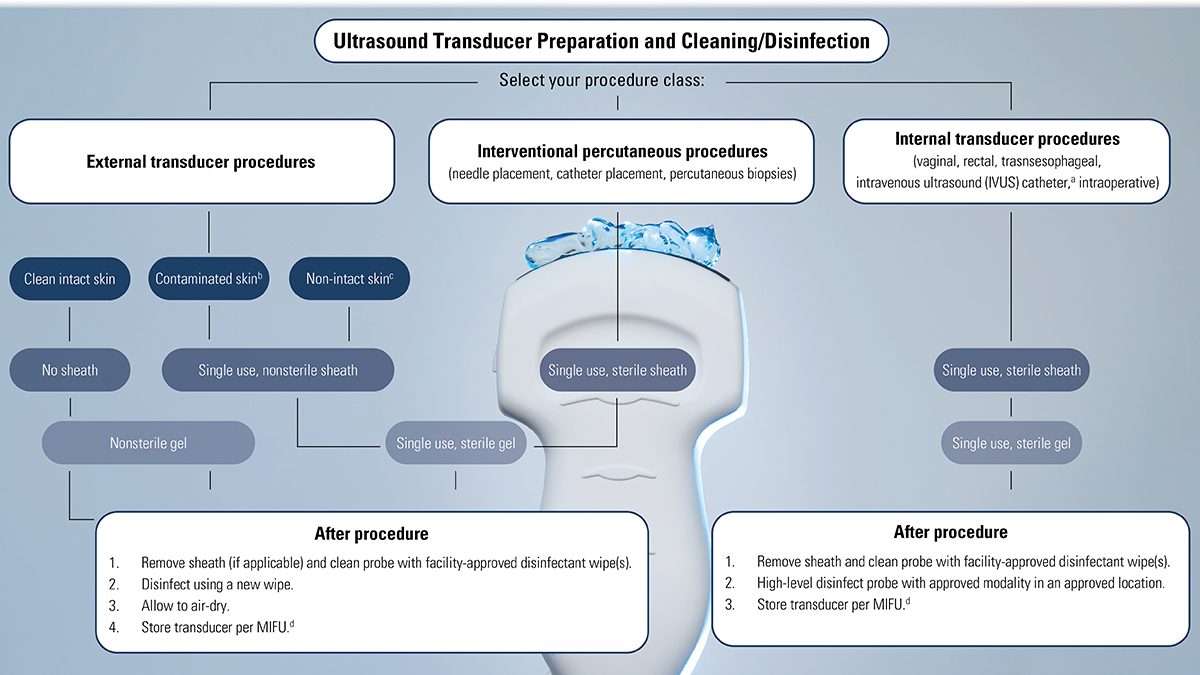
The step-by-step guideline encompasses a series of appropriate cleaning techniques, disinfectant selection and quality assurance measures. The appropriate protocol is first determined by the procedure class, which the researchers defined as external transducer procedures, interventional percutaneous procedures or internal transducer procedures. Next, clinicians are guided to both preprocedure and postprocedure protocols.

With the development of the protocol, the next step is to ensure its adoption across the institution, the researchers said.

image
a IVUS catheters are single use; no cleaning is required.
b Contaminated skin: skin soiled with blood or bodily fluids.
c Non-intact skin: includes areas of the skin that have been opened by cuts, abrasions, dermatitis, chapped skin.
d Manufacturer’s Instructions for Use.
Guidelines for Cleaning and Preparing External- and Internal-Use Ultrasound Transducers and Equipment Between Patients as Well as Safe Handling and Use of Ultrasound Coupling Gel (aium.org)
(modifications made for purposes of institutional application).

“We will collaborate with the different stakeholder leaders to implement the guidance,” said co-author Wilton Levine, MD, the medical director of perioperative services at the institution. This will be particularly important in departments where surface ultrasound is heavily used, such as vascular medicine, obstetrics and gynecology, and emergency medicine.

Meanwhile, other healthcare institutions may also find it useful to create their own cleaning and disinfection flowchart, or use the current one.

“We have done exhaustive research looking into the Spaulding classification, multiple IFUs, the role of the FDA, Joint Commission, Centers for Disease Control and Prevention, and AIUM to release this guideline,” commented Posada and co-author Amy Courtney, RN. “The framework can be used by other organizations.

“That said, each organization must review their transducer manufacturer’s IFUs for specific guidance,” they added. “These IFUs list the minimal level of disinfection required and types of disinfectant products approved for use on the devices used in their organization.”

Regardless of other institutions’ choice to create their own guidelines or adopt these, the authors believe that cleaning and disinfecting surface ultrasound probes is essential to help address the inconsistencies and conflicts inherent in existing recommendations. They hope the guideline will serve as a valuable resource for healthcare professionals by ensuring a standardized approach to cleaning and disinfection practices, thereby reducing the risk for healthcare-associated infections and improving patient safety.

For Philipp Gerner, MD, the research is an important step toward providing some clarity on the level of sterility needed to minimize infection risk based on the available data.

“I would love to see further research to provide clarification on which procedures could potentially fall into the ‘external probe’ category,” said Gerner, a fellow in regional anesthesia at Brigham and Women’s Hospital, in Boston. “Led by environmental concerns, there is an argument to be made that some procedures—for example, single-shot nerve blocks—have a skin puncture site far enough from the ultrasound transducer that they could safely be performed without ultrasound probe covers, although clinical and microbiological studies are needed before we can recommend a specific technique.”

By Michael Vlessides


The research was presented at the 6th annual World Congress on Regional Anaesthesia and Pain Medicine. The sources reported no relevant financial disclosures.

Related Keywords