×
ADVERTISEMENT

DECEMBER 20, 2023

From American Physician To Anesthetizing Animals In the African Savanna

Enter the Wild


Originally published by our sister publication Anesthesiology News

By Gary Roark, MD
Riverside Regional Medical Center
Newport News, Va.


Have you ever wondered how wild animals like zebras or elephants are anesthetized? Well, I had a crash course in doing so.

So how does an American physician, an anesthesiologist, get involved in giving anesthesia to some of the wild animals of the African savanna? Not exactly a well-trod professional career path, but it came about as a result of doing some
Originally published by our sister publication Anesthesiology News

By Gary Roark, MD
Riverside Regional Medical Center
Newport News, Va.


Have you ever wondered how wild animals like zebras or elephants are anesthetized? Well, I had a crash course in doing so.

So how does an American physician, an anesthesiologist, get involved in giving anesthesia to some of the wild animals of the African savanna? Not exactly a well-trod professional career path, but it came about as a result of doing some volunteer humanitarian medical relief in several African nations. A few years ago, my family decided to travel together while I volunteered to provide and teach anesthesia in places where there are few physicians. In earlier years, I had gone overseas without family for some short-term relief trips to the remote areas of Jamaica and Ecuador. But for the next effort, we decided to go as a family, since our kids were now a bit older and excited about the prospects. And what the heck? Originally it was supposed to be for a few weeks and to visit some friends who lived on the coast of the Indian Ocean. But after looking over the opportunity, we decided to stay for a year. We ended up living overseas for about six years in total, while I provided anesthesia services and taught in Kenya and Malawi. Later, we moved to Niger to start up a new charitable hospital in the capital, Niamey. The rewards far surpassed anything we ever expected.
Each of those locations has its own stories. But how on earth did I come about giving anesthesia to wild animals, to capture them to be moved from one game park in Malawi to another on the outskirts of Blantyre, the former capital? Well, one morning after a church service in Blantyre, where we were living at the time, I was having a cup of coffee with a pleasant Welshman named Wiktor. He had moved to Malawi a few years earlier with his family, and had set up a lodge and retreat center, Fisherman’s Rest, on his property that overlooked the Great Rift Valley. He had his game park fenced in and hired the locals to provide jobs for their families. Now he was ready to bring in some non-predator African animals that his visitors could enjoy while staying at his lodge. He had already obtained permission from the Malawi Wildlife Service to translocate a specific number of deer-like ungulates: impala, bushbuck and nyala, a much larger, striped deer native to southern Africa.

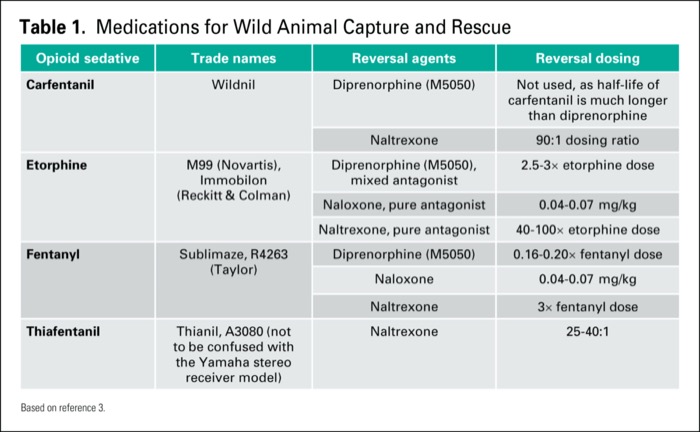
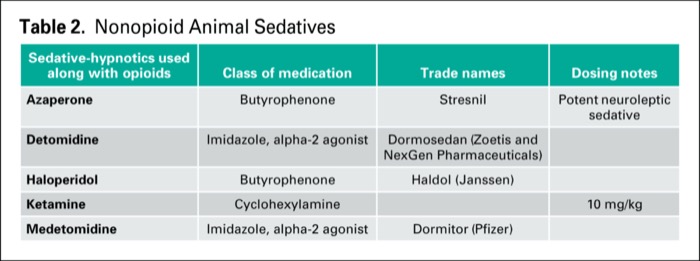
So as an anesthesiologist, I was curious how he would sedate the animals, what agents he would use and how he’d go about it. Wiktor explained that animals are often darted with a mixture of two agents. The first was a potent opioid, called etorphine, known as M99 (Novartis), also known as Immobilon (Reckitt & Colman). The second medication in his two-drug combination was a sedative butyrophenone: azaperone. See Table 1 for some examples of opioid sedatives and reversal agents used for tranquilizing animals. Table 2 lists some nonopioid animal sedatives. Wiktor needed support and medical staff, as he was rightly concerned about the risks for exposure to these high-potency opioids. Even just a fraction of a drop on a mucous membrane of a human can be serious. So, I was his safety officer and backup medical coverage in case of any untoward medical issues.

image
Table 1. Medications for Wild Animal Capture and Rescue
Opioid sedativeTrade namesReversal agentsReversal dosing
CarfentanilWildnilDiprenorphine (M5050)Not used, as half-life of carfentanil is much longer than diprenorphine
Naltrexone90:1 dosing ratio
EtorphineM99 (Novartis), Immobilon (Reckitt & Colman)Diprenorphine (M5050), mixed antagonist2.5-3× etorphine dose
Naloxone, pure antagonist0.04-0.07 mg/kg
Naltrexone, pure antagonist40-100× etorphine dose
FentanylSublimaze, R4263 (Taylor)Diprenorphine (M5050)0.16-0.20× fentanyl dose
Naloxone0.04-0.07 mg/kg
Naltrexone3× fentanyl dose
ThiafentanilThianil, A3080 (not to be confused with the Yamaha stereo receiver model)Naltrexone25-40:1
Based on reference 3.
image
Table 2. Nonopioid Animal Sedatives
Sedative-hypnotics used along with opioidsClass of medicationTrade namesDosing notes
AzaperoneButyrophenoneStresnilPotent neuroleptic sedative
DetomidineImidazole, alpha-2 agonistDormosedan (Zoetis and NexGen Pharmaceuticals) 
HaloperidolButyrophenoneHaldol (Janssen) 
KetamineCyclohexylamine 10 mg/kg
MedetomidineImidazole, alpha-2 agonistDormitor (Pfizer) 

When the animal is first darted, Wiktor explained, you must allow time for the sedative to take effect. If you rush in to take down the animal before it is adequately sedated, the wild animal will flee and hide. The stress to the animal can cause hyperthermia and rhabdomyolysis, and can be fatal. So after darting it, the team would back off to a safer, less threatening distance and watch as the animal became more sedated. The darted animal would be the one that would start arching its back, prancing around, acting a bit strange and more disoriented, trying to stave off the effects of these anesthetics. We learned that as the sedated animal would exhibit more symptoms, the rest of the herd would move on, leaving the sedated animal alone.

As the animal became more encumbered by the sedative and opioid, it would become vulnerable to predators, so it was vital for our team to move in and take down the animal if not already lying down. Wrestling a sedated wild animal was much easier when the creature had a “tranquilizer” coursing through its veins. But one must be careful, as these animals have dangerous horns, not to mention a devastating kick, even if adequately tranquilized. An impala, for example, can jump 30 feet in distance and up to 10 feet high. To witness the spectacle of a large migrating herd of impala leaping and bounding in front of you, higher overhead than your truck, is an amazing sight.

With the animal now sedated on the ground, the respiratory depression from the opioid becomes concerning, so a reversal is needed. Finding a vein on a large animal to give the opioid reversal and a longer-acting sedative is not difficult, as these animals have large veins the size of our little finger. The eyes are covered with a soft cloth to reduce the visual stimulation of the several people around them. The animal is cooled with water and shading, and simultaneously, the vital signs are checked and reversal is administered. Any antibiotics are given as well as any other basic care, if needed. One animal had a large wound that required suturing for closure, and antibiotics to reduce the risk for infection.

image

One can use naloxone or naltrexone to reverse the opioid, avoiding deeper respiratory depression. However, Wiktor had chosen diprenorphine (M5050), a mixed opioid agonist-antagonist. So rather than a complete reversal, as would be needed in the event of a human exposure, the mixed agonist would still allow continued sedation of the animal, for a partial reversal. As a safety precaution, Wiktor managed the potent opioids, and I carried both human and animal opioid reversal agents. We established this firewall, in case a tiny droplet of the potent opioid narcotic splashed onto Wiktor during the dart preparation, firing of the tranquilizer, or dart removal and animal care for transport to the new boma (game park, in African lingo). We created this protocol for safety concerns early on during the dry runs and planning phases for this wild animal capture.

After doing some practice runs and testing out the tracking device on the tranquilizer darts, we were ready. We arose early on the first day to catch the animals in the cool of the morning, hopefully before they’d had their first cup of morning coffee and may be a bit sleepier. Animals were harder to find during the heat of midday, so mornings were optimal. We hopped in our four-wheel drive trucks, and Wiktor and I were in the lead truck that had a sunroof. We found it was easier for Wiktor to stand up in the sunroof opening when the vehicle was within 25 to 30 yards of the target, to dart the animals more easily.

We learned early on, after we first moved to Africa, that our weekends away at the many wild animal game park safaris were a fantastic benefit of doing relief work in another part of the world. We also learned that our young kids, a daughter aged 15 and son aged 12 years, were the best spotters, and their eagle eyes often saw wild game, such as lions or cheetahs, long before my eyes could detect such animal behavior or movement. As such, they were perched in my truck to serve as “I Spy” agents!

We were way off the typical safari dirt roads that course throughout African game parks. We officially had permission to drive off the pathways, far off into the bush, to dart some wild animals. Although the diesel engine hummed and rumbled, it was not enough to disturb the many impala in front of us. Surprisingly, impala are not so skittish around vehicles, but if we were to approach them on foot, they would get spooked more easily. We were stalking a herd of impala, and this one looked like a bachelor herd, with many young male deer. The impala are sexually dimorphic, so all these had the lyre-shaped horns characteristic of the male impala. This group of males could be readily distinguished from a more traditional “harem” with one dominant male and many reproductive females.

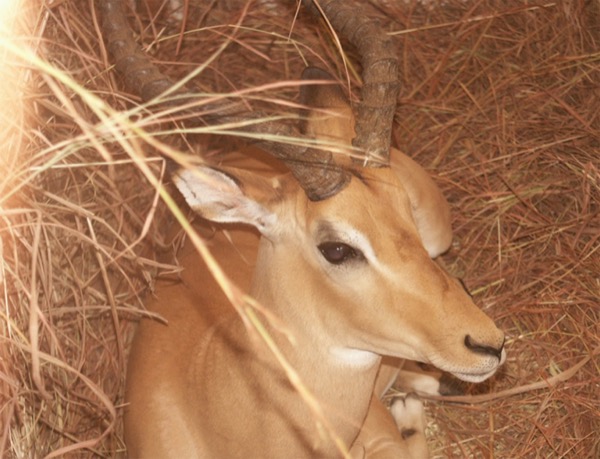
Our first animal was a male impala adult that Wiktor darted with 1 mg of etorphine plus 50 mg of azaperone—induction doses, shall we say. The 3/4-inch barbed dart stuck in the ungulate’s left flank and removal was easy. The dart went into the animal at 6:33 a.m., and Wiktor was able to wrestle the animal to the ground by grabbing his horns at 7:05 a.m. I administered 10 mg of haloperidol intramuscularly at 7:07 a.m. followed by 2.4 mg of IV diprenorphine following sterile skin and fur prep. Normal respirations resumed, and the animal was afebrile, to assess for hyperthermia from overheating and stimulation after sedation. A portable fingertip pulse oximeter was applied to the ear, which displayed 95% saturation throughout, although human pulse oximetry has yet to be validated in the impala population.

image
Captured male impala recovering in mobile transport.

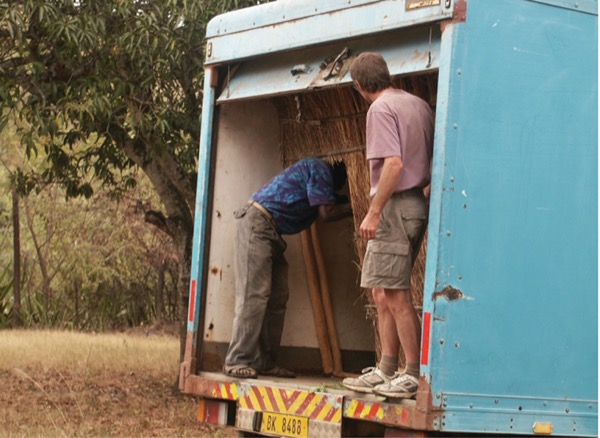
Respiratory rate was 36 breaths per minute with a pulse of 88 beats per minute. The animal was moved onto a tarp, then into the enclosed box truck serving as a mobile PACU, padded generously with straw, all within 10 minutes.

Our second animal that morning was a female impala, later found to be in heat. Tranquilizer dosing was similar since this animal was comparable in estimated size as the first. The dart went into the doe at 8:30 a.m., and the haloperidol was administered at 8:50 a.m. with the M5050 reversal given thereafter, to avoid complete opioid reversal before additional sedative could be given. Because azaperone has a known pharmacologic duration of only two to four hours, we used the longer-acting haloperidol to sedate the animal for the 90-minute drive back to Wiktor’s new home for the animals.

image
Mobile animal recovery room/PACU.

For the second animal, the dart had fallen out, but we found that the animal still received an adequate dose of the intramuscular sedative. Each dart has a tracking device embedded within it, to allow remote tracking in the event the animal escapes into a thicket of trees. But our team first found the empty dart on the ground, where it had fallen out of the animal’s flank. Our team then had to find the animal before complete respiratory suppression, so we paired up and started circling into wider and wider paths to find the doe. Each team member carried a walkie-talkie to stay in contact. This was not at all what we had planned, as a walking safari deep in the African wilds has its own risks. Nevertheless, soon my 15-year-old daughter came across the impala doe on the ground, and since I had explained the effects of respiratory depression as the mechanism of sedation, she knew to stimulate the impala by tweaking an ear and giving a sternal rub on the animal. “It was just like you said, Dad! She took a deep gasping breath when I did that!” (And I can still see the excitement on her smiling face, and a sense of pride warmed my heart.) We arrived shortly thereafter to assist in recovering the patient.

Vital signs showed initial pulse oximetry of 65% with agonal respirations. Within one minute of giving the IV reversal, however, saturation had risen to 91%, with a respiratory rate of 34 breaths per minute and pulse of 105 beats per minute. Another minute later, saturation was 97% and pulse 79 beats per minute, with a respiratory rate still at 34 breaths per minute. Although the animal was actually found and reversed in less time than the first, which had not suffered any respiratory compromise, a discussion ensued about dosing and intersex differences in these animals. The veterinary literature suggested an elevated rate of animal morbidity and mortality (23% and 45%, respectively) on prior impala studies,1,2 but it may also reflect baseline animal health or other variables. Since the Malawi Wildlife Service was entrusting their valued resources to our care, we strove for the utmost safety and due diligence. It may also be simply due to the rough body weights that are eyeballed and estimated for medication dosing and baseline health. After adequate “chemical restraint,” this animal was loaded into the other half of the box truck for transport to its new home, where it was fervently hoped it would develop a romantic and productive attachment to the previously captured male impala.

We took the rest of the day off to unwind and review our dosing and safety issues. Wiktor took the time off to recalibrate his rifle and the darting procedure, based on what he had learned that morning. His rifle propels the 4-inch dart about the size of a No. 2 pencil into the animal where it is supposed to lodge due to the reverse barbs on the end of the 12-gauge 3/4-inch–long needle. When the dart makes impact intramuscularly into the animal, a small charge is detonated that then injects 2 mL of the sedative mix of etorphine-azaperone into the animal. Wiktor found that when the needle was dipped into petroleum jelly to keep the sedative solution from dribbling out of the dart when inverted (a standard practice), even a small amount of petroleum jelly on the outside of the dart needle affected its trajectory. So with this newfound information, Wiktor was much more confident that his gunnery skills were not in question but could be used to great effect.

After a great dinner by a roaring bonfire at the Lengwe Park Lodge and a good night’s sleep in the rustic accommodations, we returned to the bush the next morning to capture a second impala female. So out we went the next cloudy cool morning in our team of four-wheel drive vehicles. For this third animal, however, the dart penetrated the animal’s left psoas and paraspinal muscles with a 2-inch gash. The animal’s respiratory rate rose from 14 to 24 breaths per minute following reversal with similar doses to the other impala. The patient was afebrile and pulse rate was 88 beats per minute. We were not able to obtain pulse oximetry for unknown reasons in this female. Due to the large laceration at needle entry, I administered penicillin and ivermectin, the latter not because we suspected COVID-19 infection but since it was an appropriate antiparasitic medication for this animal, as it appeared to have a larger burden of parasites than our first two patients. Absorbable suture was used to close the wound, as it was unlikely this patient would comply with suture removal.

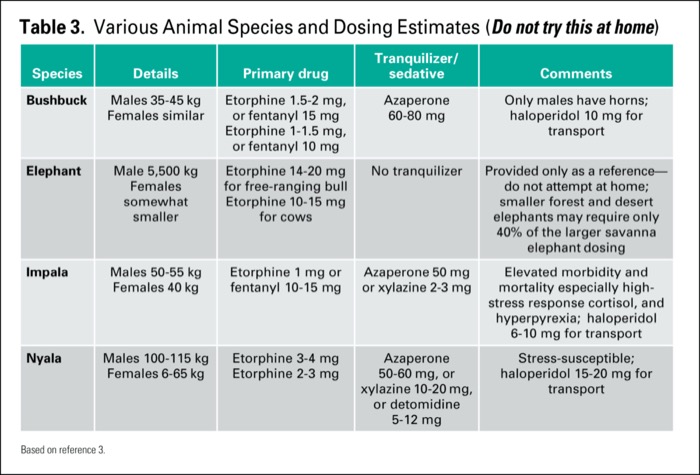
Wiktor had chosen to next capture a nyala antelope, a larger species of deer often with distinctive white stripes down its side. Since this fourth animal was a young female adult, Wiktor chose a similar dose to the impala doses, and the animal was successfully darted, reversed and moved to the transport truck within 10 and 20 minutes, respectively. Vital signs displayed a pulse rate of 126 beats per minute, 92% oxygen saturation and respiratory rate of 16 breaths per minute initially. What was most impressive about this animal was the massive size of a nyala compared with an impala. See Table 3 for approximate weights and doses for anesthetizing some wild fauna.

image
Table 3. Various Animal Species and Dosing Estimates (Do not try this at home)
SpeciesDetails Primary drugTranquilizer/
sedative
Comments
Bushbuck Males 35-45 kg Females similarEtorphine 1.5-2 mg, or fentanyl 15 mg Etorphine 1-1.5 mg, or fentanyl 10 mgAzaperone 60-80 mgOnly males have horns; haloperidol 10 mg for transport
Elephant Male 5,500 kg Females somewhat smallerEtorphine 14-20 mg for free-ranging bull Etorphine 10-15 mg for cowsNo tranquilizerProvided only as a reference—do not attempt at home; smaller forest and desert elephants may require only 40% of the larger savanna elephant dosing
Impala Males 50-55 kg Females 40 kgEtorphine 1 mg or fentanyl 10-15 mgAzaperone 50 mg or xylazine 2-3 mgElevated morbidity and mortality especially high-stress response cortisol, and hyperpyrexia; haloperidol 6-10 mg for transport
Nyala Males 100-115 kg Females 6-65 kgEtorphine 3-4 mg Etorphine 2-3 mgAzaperone 50-60 mg, or xylazine 10-20 mg, or detomidine 5-12 mgStress-susceptible; haloperidol 15-20 mg for transport
Based on reference 3.

Wiktor resumed darting and capturing more impala, nyala and bushbuck animals as he had planned, and they still thrive at the Fisherman’s Rest Lodge and Nature Reserve outside Blantyre, Malawi.4 Visitors from all over the world stay in the lodge, which has an infinity pool with spectacular views of the Great Rift Valley below, and with marvelous African sunsets in a serene verdant setting. Our part of the team, my family, continued in Malawi another year, and then returned to the United States, with some fond memories of our times serving in Africa.


Editor’s note: No animals were harmed in the writing of this article.

References

  1. Chemical capture of impala (Aepyceros melampus): a review of factors contributing to morbidity and mortality. Vet Anaesth Analg. 2017;44(5):991-1006.
  2. Hyperthermia in captured impala (Aepyceros melampus): a fright not flight response. J Wildl Dis. 2008;44(2):404-416.
  3. Chemical and Physical Restraint of Wild Animals: A Training and Field Manual for African Species. Zimbabwe Veterinary Association; 2004.
  4. Fisherman’s Rest Lodge and Nature Reserve Malawi. Accessed August 18, 2023. www.fishermansrest.net

Related Keywords