
×
ADVERTISEMENT

SEPTEMBER 19, 2023

Former SAMBA Presidents Tackle Controversies and Offer Clinical Advice


Originally published by our sister publication Anesthesiology News

PHOENIX—A series of controversial topics, including the use of methadone for post-op pain, prevention of dangerous airway fires, optimal timing for elective surgery in stroke patients and surgical timing for those on dialysis, formed the basis for the session, which took place during the Society for Ambulatory Anesthesia 2023 annual meeting.

The session allowed the presenters—all former society presidents—to dive


Originally published by our sister publication Anesthesiology News

PHOENIX—A series of controversial topics, including the use of methadone for post-op pain, prevention of dangerous airway fires, optimal timing for elective surgery in stroke patients and surgical timing for those on dialysis, formed the basis for the session, which took place during the Society for Ambulatory Anesthesia 2023 annual meeting.

The session allowed the presenters—all former society presidents—to dive into issues that they believed demanded attention, and could benefit from dedicated discussion.

“The session leverages the many years of experience of former presidents to discuss important topics in ambulatory anesthesia affecting both the current practice and future trends,” Michael T. Walsh, MD, an assistant professor of anesthesiology at Mayo Clinic in Rochester, Minn., told Anesthesiology News.

Methadone for Postoperative Pain Care

Could methadone be the answer for rethinking how to approach postoperative pain for ambulatory surgical patients?

In the initial presentation, Walsh proposed that it may be, saying now is an opportune time for thinking differently regarding pain care for these patients.

image

Why is this the case?

“One of the problems is that there are too many people still with post-op pain,” he said. “We all know that one of the most common reasons why patients are admitted to the hospital after ambulatory surgery is post-op pain. We also know the biggest risk factor for chronic postsurgical pain is untreated acute post-op pain.

“That is a problem and something we need to look at,” he noted.

Additionally, Walsh hypothesized the issue is likely to get worse, in large part due to the healthcare staffing shortages that have resulted from the COVID-19 pandemic.

“There are too few healthcare workers post-pandemic,” he said. “What this is going to do is push more and more patients to outpatient settings.”

The rate-limiting step for this development, Walsh said, is going to be how pain is treated.

Methadone has advantages as an analgesic for these patients, such as being a strong mu-opioid receptor agonist with incomplete cross-tolerance with other opioids. Intravenous formulations of the drug have a relatively rapid onset of eight minutes, and the long half-life of one to two days results in a lengthy drug duration.

A systematic review and meta-analysis of studies that used methadone in surgical inpatients had promising results, finding excellent pain relief, improved patient satisfaction, decreased post-op opioid use and no difference in side effects. The only study focusing on outpatients (a pilot study by Evan D. Kharasch, MD, PhD, and his group from Washington University in St. Louis) demonstrated promising results (Anesth Analg 2019;128[4]:802-810).

img-button

However, Walsh noted, the number of patients included in these studies was small, stressing the need for additional research.

While the use of methadone is promising for surgical patients, larger studies—particularly those focused on ambulatory settings—are needed in order to confirm whether it may be useful as a primary analgesic strategy.

Safety Key in Preventing Airway Fires

image
Basem Abdelmalak, MD

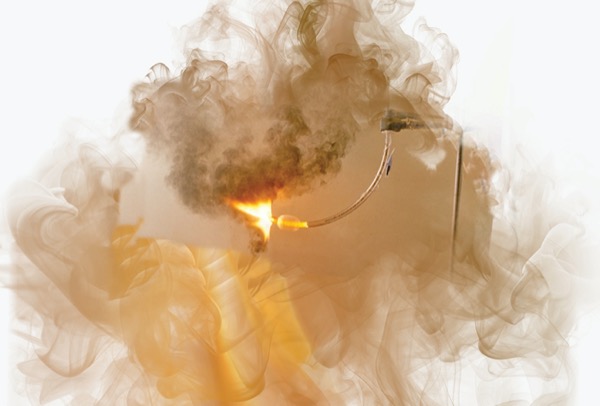
Avoiding airway fires during surgery requires detailed understanding of the conditions that may lead to fires, as well as close communication between the anesthesiologist and surgical team, according to the second presentation, given by Basem Abdelmalak, MD, a professor of anesthesiology at Cleveland Clinic.

“The most important thing to remember is the three arms of the fire triangle need to be present for a fire to occur,” he said.

During surgery, these include 1) an oxidizing agent, such as oxygen or nitrous oxide; 2) a heat source, such as a laser, cautery or even a heat-generating light source; and 3) fuel, such as an endotracheal tube or drapes.

“If all three are present, that’s bad news,” he continued.

Thankfully, multiple safety measures exist that can greatly minimize the risk for these fires.

Abdelmalak recommends limiting the presence of oxidizers via steps, including eliminating the use of nitrous oxide, and limiting the fraction of inspired oxygen to less than 40%, or better yet 35% or 30% (the lowest tolerated concentration).

The use of newer, laser-resistant endotracheal tubes also may be beneficial. However, he emphasized the term “resistant” is key, as 100% laser-safe endotracheal tubes do not exist. Methylene blue or other biocompatible and highly visible dye may be used in saline-filled cuffs in order to make any leaks easy to spot promptly.

“If there is a rupture from a laser, dye makes it easy to identify and address right away,” Abdelmalak said.

However, he noted that it’s important to remember that the addition of fluid to the cuff system may prolong the process of cuff deflation.

Studies have looked into the use of transnasal humidified rapid-insufflation ventilatory exchange for laryngeal surgery, and the technique shows promise (Laryngoscope 2021;131[3]:587-591; Anaesthesia 2017;72[6]:781-783).

“There is some evidence from a retrospective study showing that this can be done safely,” he said (Otolaryngol Head Neck Surg 2023. doi: 10.1002/ohn.324). “This makes sense because we have oxygen, we have laser, but we don’t have anything to catch on fire.”

However, additional fire safety data with the use of this technique are still needed.

If an airway fire occurs, it’s important to take steps quickly to stop the causing agent, discontinue ventilation and disconnect the circuit.

While the American Society of Anesthesiologists has a publication regarding how to manage airway fires, Abdelmalak recommends one key change.

“The document says, ‘Remove the tracheal tube and then stop flow of all airway gasses,’” he said. “I would reverse the order. If you pull out the tube and the oxygen is still going, you are pulling out a torch” (Anesthesiology 2013;118[2]:271-290).

Throughout, communication with the surgical team on how to keep the patient safe and avoid a fire is key.

“Just remember, you always need to be prepared and alert, as preventive measures may not guarantee that fire will not occur, but they will lower the risk of having fires,” he concluded.

Dialysis Timing Important When Planning Surgery

image
BobbieJean Sweitzer, MD

The third presentation, given by BobbieJean Sweitzer, MD, the systems director of perioperative medicine at Inova Health, in Fairfax, Va., focused on the importance of analyzing the timing of dialysis and surgery in order to reduce risks posed to patients with kidney problems.

Sweitzer noted that surgical risk calculators, such as the American College of Surgeons National Surgical Quality Improvement Program, include only a few questions, nearly all of which focus on patient history. However, there are two questions related to kidney health: whether the patient is on dialysis and whether they have acute renal failure.

“Both indicate significantly high-risk conditions that factor in the calculation of risk for that patient,” she said. “In fact, it is estimated that patients on dialysis have a more than 10% risk of dying in any given year.”

Additionally, the Revised Cardiac Risk Index for preoperative risk notes that preoperative serum creatinine levels greater than 2.0 mg/dL indicate an increased possibility for a major adverse cardiovascular event.

So why do we dialyze patients outside their homes only three times per week?

Cost is the leading factor, followed by availability of space needed to perform dialysis services. However, this results in outpatient dialysis that ends up being performed far less frequently than at-home treatments.

“Patients who dialyze at home typically do so a minimum of six days a week and have perhaps twice as long life expectancies as those who do so outside the home just three days a week,” Sweitzer said. “We really should be dialyzing patients more than three times a week.”

Barring such an increase, focus should be put on properly timing dialysis in order to minimize patient risk.

“We know from medical literature that patients are much more likely to die on the day between the longest break between dialysis days,” Sweitzer said.

With three-day-per-week timing, most dialysis days are only a day apart. However, at least once a week there is a two-day gap, particularly as dialysis is not performed on Sundays.

A recent study found that a two-day interval from hemodialysis to surgical procedure resulted in a higher mortality risk than a one-day interval, and the risk increased significantly when a three-day interval occurred (JAMA 2022;328[18]:1837-1848).

This, Sweitzer said, highlights the importance of patients being dialyzed the day before surgery.

While the study also included a small number of patients who received dialysis on the same day as their surgery, Sweitzer discounted that approach.

“That is not something we generally recommend,” she said. “Patients have a lot of fluid and electrolyte shifts, and the second most common day to die is on the day of dialysis.”

Overall, she stressed the importance of having surgical restrictions in place that recommend patients only have surgery if they have been dialyzed the day before the procedure, and have been receiving dialysis on a regular schedule.

“You don’t have to change surgery days; you can change dialysis days instead,” she said. “Monday is the only day you can’t do surgery because nobody does dialysis on Sunday. This gives the surgeon six other days to operate.”

Elective Surgery After Stroke—Is There a Magic Number?

image
Girish P. Joshi, MD

The final presentation focused on a topic that has caused significant confusion over the years: What is the ideal time frame to wait for elective surgery in patients who’ve had a stroke?

“We know that previous stroke increases complications with significant increase in mortality,” said Girish P. Joshi, MD, a professor of anesthesiology and pain management at The University of Texas Southwestern Medical Center, in Dallas.

Historically, optimal timing for having a patient undergo elective surgery after stroke has been three months, he said. “There is very poor data, but that was based on typical experience and is what we followed for years.”

In 2014, a large Danish cohort study that looked at patients at least 20 years of age determined that the risk for postoperative adverse outcomes after stroke was highest within the first three months after surgery (JAMA 2014;312[3]:269-277).

After nine months, the associated risk had leveled off, but was still higher than in patients without stroke.

Based on this, the authors concluded that a nine-month wait time was ideal.

In 2022, a very large study of over 5 million Medicare patients undergoing elective nonneurologic, noncardiac surgeries was conducted; 0.9% of the patients had previous stroke (JAMA Surg 2022;157[8]:e222236).

The study found that significant complications were highest within the first 30 days after stroke. Between 30 and 60 days there was some difference, but it was not statistically significant. Additionally, the odds of stroke between 61 and 90 days were no different from those later, at 181 to 360 days.

“The conclusion of these authors was that the safe time to elective surgical procedure after a neurological event is three months,” Joshi said.

Due to this, Joshi believes robust enough data now exist to back three months as the ideal window to postpone elective surgery in most post-stroke patients.

“Now we come back to the same cycle of three months, which we’ve been saying for years,” he said. “Three months is the magic number.”

He noted, however, that optimizing risk factors is of the utmost importance for patients with hypertension, diabetes mellitus or chronic renal failure, as well as those on anticoagulant or antiplatelet therapy.

“There is a high correlation between inappropriate management of these drugs and post-op complications,” he said. “Therefore we have to be extra cautious in this patient population.”

—By Ethan Covey


Sweitzer reported no relevant financial disclosures.

Abdelmalak is the co-editor of Anesthesia for Otolaryngology, Clinical Airway Management: An Illustrated Case Based Approach (Cambridge University Press, 2017) and a speaker for Mindray. Joshi is a consultant to Baxter International Inc.

Related Keywords