

×
ADVERTISEMENT

SEPTEMBER 25, 2024

Percutaneous Approaches to Gallstones Expand Horizons for Surgeons


Originally published by our sister publication General Surgery News

By Michael Vlessides
image
Ahsun Riaz, MD

CLEVELAND—Surgery is not the only therapeutic option available to treat gallstones, according to an expert in the field. As Ahsun Riaz, MD, discussed, percutaneous approaches can be used in a specific subset of patients in whom surgery is neither safe nor viable.

“The thing we’ve recognized at Northwestern is that percutaneous cholecystostomies are not definitive


Originally published by our sister publication General Surgery News

By Michael Vlessides

CLEVELAND—Surgery is not the only therapeutic option available to treat gallstones, according to an expert in the field. As Ahsun Riaz, MD, discussed, percutaneous approaches can be used in a specific subset of patients in whom surgery is neither safe nor viable.

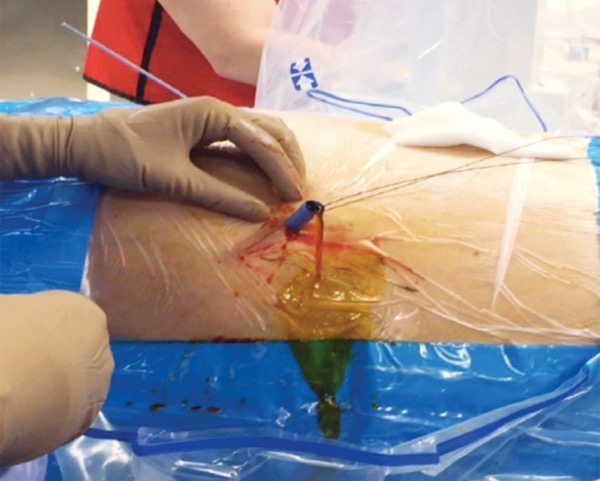
“The thing we’ve recognized at Northwestern is that percutaneous cholecystostomies are not definitive treatments,” said Dr. Riaz, an associate professor of radiology at Northwestern University Feinberg School of Medicine, in Chicago. “So, if they can get surgery, they should get surgery. But if they can’t get surgery, there should be something else to make sure that these patients don’t live with drains for the rest of their lives. Because drains leak, they cause pain, and they have psychological and physical impacts.”

This, Dr. Riaz said, likely explains the 567% increase in percutaneous cholecystostomy rates observed between 1994 and 2009 (J Am Coll Radiol 2012;9[7]:474-479), compared with a 3% increase in the rate of laparoscopic cholecystectomies during the same period.

At his institution, protocol dictates that suitable candidates undergo surgery as necessary. Those who are not surgical candidates are categorized as either “never surgical candidates” or “not surgical candidates.” Never candidates receive a lumen-apposing metal stent (LAMS) or undergo percutaneous cholecystostomy.

image

“But if they’re not surgical candidates and have a somewhat reversible condition where they can potentially be surgical candidates, they should get a percutaneous cholecystostomy because it’s much easier to do surgery after this procedure compared to a person who’s already had a LAMS,” Dr. Riaz said at the 2024 annual meeting of the Society of American Gastrointestinal and Endoscopic Surgeons.

For calculous cholecystitis, Dr. Riaz recommends dual cholecystoduodenal stenting, where a stent is placed from the gallbladder into the duodenum. Using double stents allows passage of the bile and reduces the risk for occlusion.

Data from his institution support this approach (J Vasc Interv Radiol 2023;34[4]:669-676). In the study, percutaneous cystic duct interventions were attempted in 17 patients deemed unfit for surgery who had previously undergone percutaneous cholecystostomies for acute calculous cholecystitis. Fifteen procedures to cross the cystic duct were technically successful; 13 patients underwent successful placement of dual cholecystoduodenal stents. The one-year patency rate in the group was 77%.

For patients in whom the cystic duct cannot be crossed, Dr. Riaz and his colleagues employ a system in which they inflate the gallbladder from the skin side and use ultrasound guidance to place a LAMS.

“The whole reason to do this is to get patients drain-free,” he said.

This technique was supported in a 2020 study of 80 consecutive patients with acute calculous cholecystitis at high risk for cholecystectomy (Gut 2020;69[6]:1085-1091). The participants underwent either endoscopic ultrasound–guided gallbladder drainage or percutaneous cholecystostomy. The investigation found that the ultrasound-guided approach significantly reduced a number of adverse end points, including one-year adverse events, re-interventions after 30 days, unplanned readmissions and recurrent cholecystitis.

“It’s important to understand that adverse events such as leakage from the skin and pain are going to be much higher with percutaneous cholecystostomy,” Dr. Riaz added. “So, if you have a patient that is a LAMS candidate, they should get LAMS because they won’t have those complications.”

No procedure is without the possibility of complication, and cholecystoduodenal stenting is no different. To address the possibility of pancreatitis, Dr. Riaz and his colleagues have started administering prophylactic rectal indomethacin (Lancet 2016;387[10035]:2293-2301) and Ringer’s lactate (Eur J Gastroenterol Hepatol 2022;34[7]:751-756). Another potential complication is perforation of the gallbladder, so Dr. Riaz urged care when insufflating the gallbladder, particularly in patients with perforated cholecystitis.

Finally, Dr. Riaz noted that percutaneous approaches can also be used for gallstones that are unrelated to the gallbladder. He and his colleagues have used such approaches in patients with post–liver transplant hepatolithiasis to remove gallstones and ablate benign strictures at the hepaticojejunostomy. Percutaneous approaches can be used in patients with recurrent abscesses after cholecystectomy.

“I think it’s important to get your interventional radiology colleagues involved so that they can target this abscess with the intent to go in with the camera and take the stones out,” he noted.

Session co-moderator Eleanor C. Fung, MD, a clinical assistant professor of surgery at the University at Buffalo Jacobs School of Medicine & Biomedical Sciences, in New York, agreed that when it comes to gallstones, surgery is just one therapeutic option.

“Traditionally people always think about surgery when they encounter gallstones,” she told General Surgery News. “But there are many new therapeutic approaches that we’ve encountered over the years, so the purpose of the session was to open people’s eyes to these percutaneous and endoscopic approaches.”

Percutaneous approaches are best utilized in patients who are not candidates for surgery, particularly those with multiple comorbidities and those who may not tolerate general anesthesia well. On the other hand, younger, fitter patients usually undergo surgery.

“But now that our patient population is getting older, we’ve had to think of new ways to do things,” Dr. Fung said. Either way, Dr. Fung noted that surgeons taking a percutaneous approach to gallstones need to work hand in hand with their interventional radiology colleagues to ensure success.


Dr. Riaz reported a financial relationship with Boston Scientific.

Related Keywords