

×
ADVERTISEMENT

NOVEMBER 6, 2023

Can Climbing Stairs Help Alleviate Back Pain?

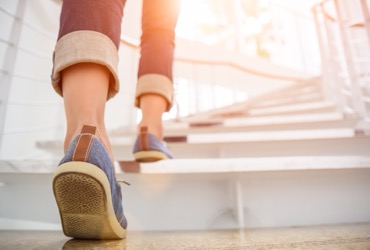
Recent data indicate that climbing stairs is significantly associated with reducing chronic low back pain (LBP) in women. However, the same cannot be said for men.

“We hypothesized a role for sexual dimorphism in the lumbosacral region, or differences in male and female participation in housework, as possible explanations for this,” study author Amy Amabile, PhD, MPT, an associate professor of biomedical education and data science at Temple University, in Philadelphia, told Pain

Recent data indicate that climbing stairs is significantly associated with reducing chronic low back pain (LBP) in women. However, the same cannot be said for men.

“We hypothesized a role for sexual dimorphism in the lumbosacral region, or differences in male and female participation in housework, as possible explanations for this,” study author Amy Amabile, PhD, MPT, an associate professor of biomedical education and data science at Temple University, in Philadelphia, told Pain Medicine News.

A total of 248 participants (male, n=97) completed a survey on medical history, physical activity, workplace and LBP metrics over a one-year period (PLoS ONE 2023;18[10]:e0292489. doi:10.1371/journal.pone.0292489). Among all participants, non-LBP respondents reported a mean of 51.62 flights of stairs climbed per week and LBP respondents reported 37.82 flights climbed per week (P=0.077).
When participants were categorized by sex, women had a more statistically significant association of stair climbing with an absence of LBP (mean number of flights of stairs climbed among female respondents without LBP, 61.51; among those with LBP, 35.61; P=0.031). Chronic LBP in women had an even stronger inverse association with climbing stairs (P=0.009).

Researchers cautioned that their reliance on self-reporting could introduce inaccuracy to their data. Furthermore, due to the study design, there was a potential for reverse causation, a situation in which experiencing LBP caused individuals to limit stair climbing to avoid back pain.

Amabile noted that a study of patients with nonspecific LBP, “with a posterior derangement type presentation,” who are randomly assigned to interventions using McKenzie Medical Diagnosis and Therapy (MDT) and combined with gluteus maximus strengthening could help further elucidate how strengthening the gluteus maximus affects LBP in both men and women.

“Since our work was not designed to show causation with regard to LBP and stair climbing, routinely recommending stairs as part of LBP prevention or treatment would be premature,” Amabile concluded.

—Myles Starr

Amabile reported no relevant financial disclosures.

Related Keywords