

×
ADVERTISEMENT

JUNE 4, 2024

Study in Oncologic Surgery Patients Confirms Opioid-Sparing Effects of Clinical Hypnosis

Clinical hypnosis for pain management can help reduce opioid consumption after surgery, according to a study in adults undergoing major oncologic surgery. The study, published in the Journal of Pain Research, suggests that clinical hypnosis may be a viable opioid-sparing adjunct treatment for pain, at least in certain patients.

“There have been studies showing that clinical hypnosis is effective for pain relief in the days after surgery, but little research into how it affects opioid

Clinical hypnosis for pain management can help reduce opioid consumption after surgery, according to a study in adults undergoing major oncologic surgery. The study, published in the Journal of Pain Research, suggests that clinical hypnosis may be a viable opioid-sparing adjunct treatment for pain, at least in certain patients.

“There have been studies showing that clinical hypnosis is effective for pain relief in the days after surgery, but little research into how it affects opioid use,” said study co-author Joel Katz, PhD, a Distinguished Research Professor of Psychology and Canada Research Chair in Health Psychology at York University, in Toronto, where he leads the Human Pain Mechanisms Lab. “Our thinking was that by reducing opioid consumption in the days after surgery—and not at the expense of increased pain intensity—we’d give patients a head start and ultimately help to get them weaned off opioids earlier and on track for an earlier, less painful recovery.”

Katz and his co-authors randomized 92 participants to undergo clinical hypnosis, both pre- and postoperatively (n=45), or treatment as usual (n=47). The participants, adults 18 years of age and older (mean, 57.6 years; SD=10.9 years), were recruited from the Toronto General Hospital preadmission surgery and surgical oncology clinics approximately one to three weeks prior to major oncologic surgery. A slight majority (53.6%) of participants were female. Only two participants, one in each group, were taking opioids before surgery. The mean duration of surgery was 260 minutes (SD=150.2 minutes) and the average hospital length of stay was 4.9 days (SD=5.3 days).

Participants in the clinical hypnosis group completed an in-person session of clinical hypnosis one to two weeks before surgery, and a second session in-hospital one to three days after surgery, in addition to standard perioperative care.

image

The scripts used for the hypnosis sessions were developed by Aliza Weinrib, a study co-author and pain psychologist with the Transitional Pain Service (TPS) at Toronto General, based on the clinical literature. They incorporated principles of acceptance and commitment therapy, an empirically based psychological intervention that fosters acceptance and mindfulness—of acute pain, in this application—as well as pain intensity reduction techniques using direct and indirect suggestion, to alter psychological state and behavior.

All hypnosis was provided by TPS-trained practitioners certified in clinical hypnosis. Additionally, participants in the hypnosis group were provided with audio recordings of hypnosis scripts to be used during both hospitalization and at home following discharge, and were encouraged to listen to them daily.

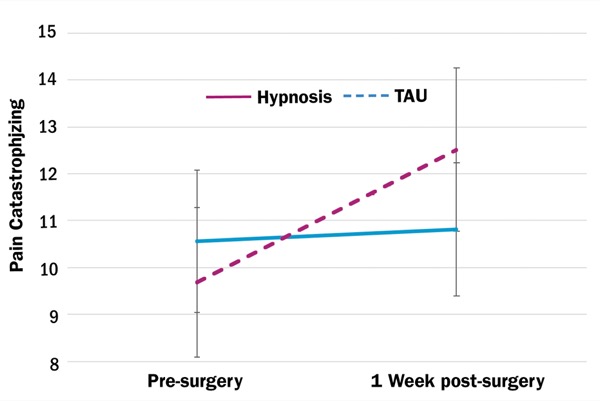
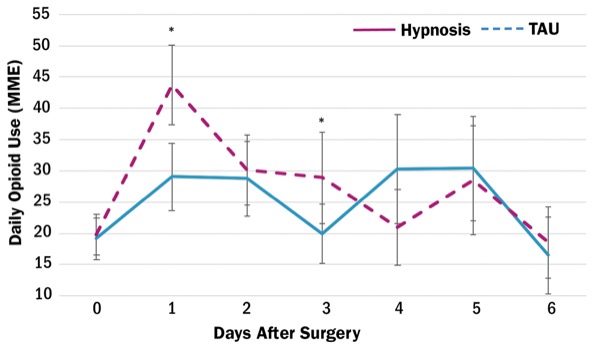
While opioid use on average decreased among all participants in the first week following surgery (Figure 1), those who received hypnosis consumed significantly fewer opioids on the first (mean difference [MD], 15.6 morphine milligram equivalents [MME]; P=0.01) and fourth (MD, 13.9 MME; P=0.04) days after surgery (Figure 2). However, MME dispensed in the month following surgery did not differ between groups. Likewise, no significant differences were found between groups for pain intensity, pain interference, sleep impairment, depressed mood or anxiety. Notably, pain catastrophizing was lower immediately following surgery (P=0.048) and remained relatively stable over the week after surgery in the clinical hypnosis group, with a mean decrease of 1.23 versus a mean increase of 2.83 in the usual-treatment group.

image
Figure 1. Postoperative opioid use after 1 week.
image
Figure 2. Postoperative opioid use by day after 1 week.
MME, morphine milligram equivalent; TAU, treatment as usual.

The findings point to the efficacy of clinical hypnosis as an opioid-sparing adjunct treatment for pain, Katz said, although he noted the observed effect in this study was not as strong as he had hoped.

“Most patients and physicians would like to avoid opioids as much as possible, as long as other effective ways of managing pain are available,” he said. “Clinical hypnosis is one such low-cost, effective intervention to help reduce opioid consumption in the days after surgery.

“But frankly, I was surprised that the effects of clinical hypnosis were not more pronounced. We had expected to see a more consistent reduction in daily opioid use in those patients, and that their pain would have been lower than [in] the patients who received standard care without the hypnosis.

“In hindsight, my sense is that we are dealing with a dosing effect, in that patients received only two sessions of hypnosis, including only one after surgery when they were in pain,” Katz said. “Had we provided a more intensive treatment regimen—with daily hypnosis sessions, say—we might have seen more striking results.”

Another, perhaps complementary, possibility was suggested by Eric Willmarth, PhD, the chair of the Department of Applied Psychophysiology at the Saybrook University College of Integrative Medicine and Health Sciences, in Pasadena, Calif., who was not involved with the study.

“I thought this study was very well done, with a rigorous methodology, and the findings didn’t really surprise me,” Willmarth said. “But one variable they didn’t address is hypnotic ability. Not all patients have the same hypnotic ability. If you get a group of people with higher hypnotic ability, meaning that they’re more susceptible to being hypnotized, then you’ll see a larger effect. And of course the reverse is also true.

"A study like this will elicit different responses from people with different natural ability, independent of the treatment regimen.”

He said there are multiple formal ways to assess hypnotic ability, including the Stanford Hypnotic Susceptibility Scales, the Harvard Group Scale of Hypnotic Susceptibility, and the Elkins Hypnotizability Scale, which he noted is a practical option due to its shorter length.

Willmarth also emphasized that the power of suggestion is operative at all times, not only during hypnosis sessions.

“Physicians have a lot of clout with their patients, and they make suggestions all the time that can have a positive or a negative effect—maybe much more than they realize. If you say, offhand, ‘Oh no, you have the back of an 80-year-old,’ you may forget it in five minutes, but the patient will remember it five years later,” he said. “So, it behooves physicians to make positive statements that will improve rather than harm the patient’s self-concept.”

Willmarth said he wanted to see more studies in this vein. “In integrative medicine circles, the benefits of clinical hypnosis are well known, but I’d like to see more studies published elsewhere, so more people can become aware of complementary, potentially opioid-sparing treatment approaches for acute and chronic pain.”

For his part, Katz and his co-authors have more studies in the works. “One of the things we’ve been planning to do is pilot a more intensive study, increasing the ‘dose’ of clinical hypnosis in the days after surgery. We’re also about to begin another hypnosis study in people with Ehlers-Danlos syndrome who experience distressing gastrointestinal symptoms, like nausea, vomiting and bloating, to see if we can help to improve those symptoms and help these patients enjoy life to a greater extent.”

—Ajai Srinivas

Related Keywords