

×
ADVERTISEMENT

AUGUST 2, 2024

Anesthesia’s Mad Scientist? Louise G. Robinovitch, MD

Meet a pioneer of ‘electric sleep’ in modern medicine


Originally published by our sister publication Anesthesiology News

By A.J. Wright, MLS

A few years ago, I ran across an article on the Gizmodo website by Jess Nevins, a librarian and prolific author on popular culture topics, “From Alexander Pope to ‘Splice.’” The subtitle caught my eye: “A Short History of the Female Mad Scientist.” Most of his examples were from fiction, film and television, but one happened to be a real person, Louise G. Robinovitch, MD, who
Originally published by our sister publication Anesthesiology News

By A.J. Wright, MLS

A few years ago, I ran across an article on the Gizmodo website by Jess Nevins, a librarian and prolific author on popular culture topics, “From Alexander Pope to ‘Splice.’” The subtitle caught my eye: “A Short History of the Female Mad Scientist.” Most of his examples were from fiction, film and television, but one happened to be a real person, Louise G. Robinovitch, MD, who used electrical currents to create analgesia and anesthesia for surgery, revive an apparently dead woman and resurrect a rabbit.

Little did I know the long rabbit holes waiting for me as I started to research this fascinating person.

First, there is her name. Nevins’ article reported her birth name as Luisa Rabinowitch but provided no source. In G.F. Alsop’s 1950 history of the Woman’s Medical College of Pennsylvania, he discusses a Lydia Rabinovitch who taught at the college in the 1890s. Fortunately, with some assistance from a German archive, I determined that this physician was Lydia Rabinowitsch, a Russian-German microbiologist who spent most of her career in Berlin.

The subject of this article can be found as Rabinovitch, as on Wikipedia, and in much press coverage during her life, or Robinovitch, as in Nevins’ piece or publications by Robinovitch herself. I’ve used these two spellings here, giving whichever one is used in the source being discussed.

image
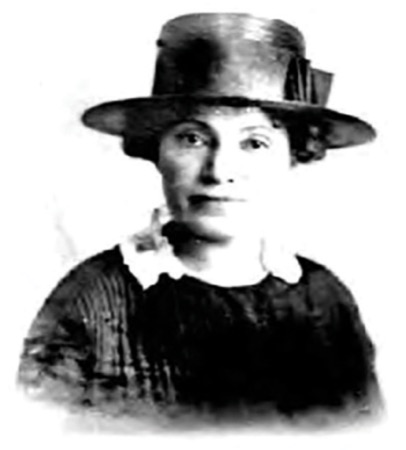
Louise G. Rabinovitch, MD
Image source: U.S. passport application ca. 1921 via Wikipedia

Early in the research process, I dove into resources at Ancestry.com. Our subject is listed as Louise G. Robinovitch in the 1940 U.S. census, although there is a “user correction” substituting an “a” for that first “o” in her surname. The census gave her estimated birth year as 1868 and birthplace as Werania, now Ukraine. She became a naturalized U.S. citizen in February 1895, and her birth date in those records is Dec. 29, 1869. Her former nationality was “Emperor of Russia,” and she arrived in the United States in April 1887.

Work in Mental Health

I’ve attempted to trace Rabinovitch’s movements, which were complicated. A Philadelphia Inquirer article published March 15, 1889, includes Rabinovitch in the class of new graduates from the Woman’s Medical College in Pennsylvania.

In 1894, the New York City Directory listed Rabinovitch as a physician. The 1906 edition (using an “o”) also included her and gave an address: 28 West 126th Street in Harlem.

During the 1890s, she was a resident physician at Philadelphia Hospital and then became an assistant physician at the insane asylums on Blackwell’s and Ward’s islands in New York City. A Chicago Tribune article from June 9, 1894, described Robinovitch’s testimony to the New York State Lunacy Commission about conditions at the Ward’s Island facility.

That testimony lasted five hours over the span of two days, addressing human and medical issues. Robinovitch noted the asylum had only two trained nurses, and chemical restraint with morphine and chloral hydrate was widely used.

At some point, Rabinovitch decided to expand her medical education. Ship arrival and departure records provided by Ancestry.com show her arrivals in the United States from France in August 1904 and January 1909. In 1906, she completed a dissertation on “electric sleep” at the Ecole de Medecine de Nantes, in France, after working in the laboratory of two electricity researchers at the medical school, French biologist StÉphane Leduc (1853-1939) and his assistant, A. Rouxeau. In the years to come, she would further develop this work.

In July 1921, she resided in Greenwich, Conn., on a U.S. passport issued to her as “Robinovitch.” The application noted she was 51 years of age, giving the same birth date as the naturalization record. By that 1940 census she had moved to 25 Pierrepont Street, a rental in Brooklyn, N.Y. She was single and her occupation listed as “chemist.”

Between that passport date and the census, I have found no information on her whereabouts or work—with one exception. Robinovitch attempted to patent Woolf’s Hypozone, a germicide and disinfectant. However, on June 14, 1937, the U.S. Patent Office ruled in favor of another applicant, Milton M. Warner. Robinovitch was just a minority stockholder in the firm, which did not have the patent or trademark rights.

Analgesia With Electricity

Before the work of Leduc, Rouxeau and Rabinovitch, only a few attempts had been made to achieve analgesia with electricity. The first such instance was reported by English physician Benjamin W. Richardson in 1858 in London’s Medical Times and Gazette and reprinted that same year in the Atlanta Medical and Surgical Journal. Richardson described his 1853 experiment on a small dog to study the effect of electricity “on the blood in the living animal body.” He shocked the dog, which fell as if dead. Richardson then opened a vein, drew some blood for study and sutured up the wound.

image
image
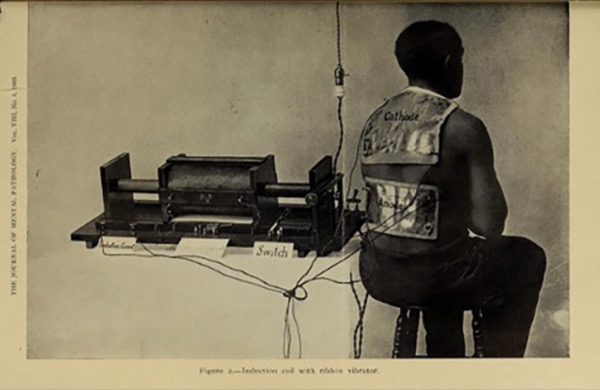
Journal of Mental Pathology Volume 8, Number 4, 1909.
Image source: Library of Congress database Chronicling America

By the time he finished, the dog was awakening, with not “the slightest evidence of suffering,” Richardson had declared. “This was probably the first instance in which any operation was performed without pain, by means of electricity.” He then proceeded to perform various experiments upon his own fingers and hands but concludes that “the electric current cannot … be made practicable for the production of local anaesthesia” given current knowledge and equipment.

The last publication I located by Rabinovitch was her chapter “Electric Analgesia, Sleep and Resuscitation” in James Gwathmey’s 1914 textbook Anesthesia. In that work, she gives a brief historical review citing efforts by D’Arsonval in 1890, by Hutchinson in 1892 and in 1901 by Mariette Pompilian. She does not mention Richardson.

D’Arsonval had determined that a range of high-frequency electrical current “caused a certain degree of anesthesia.” Hutchinson found that induction currents often interrupted by a ribbon vibrator of his invention caused anesthesia. Pompilian had designed a rotating wheel to interrupt induction currents and create anesthesia in frogs.

Electric Sleep

In 1902, Leduc and Rouxeau were the first to study low-intensity electrical stimulation of the brain. Their method involved direct currents interrupted by a revolving wheel they also had invented. The procedure was called “electric sleep,” since it was thought to induce sleep. Leduc served as the experimental human subject for electric sleep—perhaps the first. Rouxeau and Malherbe, another researcher in the lab, applied the current, which was not increased far enough to create complete anesthesia.

Further research in this area would not resume in earnest until the 1930s and 1940s with electronarcosis and electroconvulsive shock therapy. The FDA changed “electrosleep” to CES, cranial electrotherapy stimulation, in 1978. In recent decades, more than 150 human and animal studies have examined its therapeutic use in anxiety, insomnia, depression, stress, drug addiction and pain relief.

In 1906, Robinovitch published her dissertation, “Sommeil Electrique,” or “Electric Sleep,” at the Nantes medical school. Press reports began to appear in 1908 that breathlessly touted her research on electric sleep, analgesia and anesthesia. Rabinovitch and her colleague V. Magnan conducted many electric sleep experiments on rabbits and dogs in Paris.

image
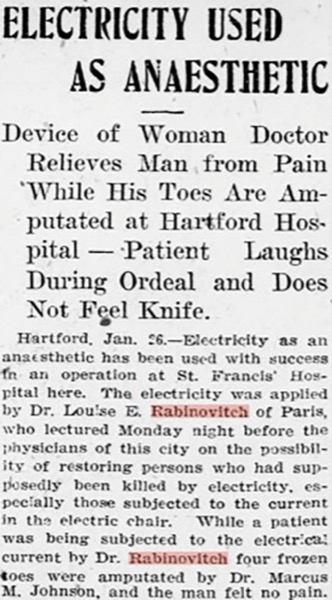
Bridgeport [Conn.] Evening Farmer.
January 26, 1910.
Image source: Library of Congress database Chronicling America

In rabbit experiments in Nantes and Rome, Robinovitch found electric sleep to be more profound and tranquil in the French city. At first, she suspected different breeds of rabbits, but then realized fluctuations in current intensity in Rome were due to the public main supply as the source of electricity. In Nantes, the source had been storage batteries that provided a consistent current.

On March 6, 1908, a Nebraska newspaper printed a story from Paris that reported Robinovitch’s successful use in France and Germany of “electric anesthesia in cases where chloroform and ether generally had been used.” The story also noted Robinovitch had received a grant “from the Paris authorities” permitting her to use her technique “on a large scale in local insane asylums.” As if seeing at least some of the future, the report concluded, “Under the influence of electric anesthesia, the patient may be kept asleep for many hours, while the blood pressure remains normal. No evil aftereffects result. The system is also successfully used in the treatment of nervous diseases, delirious tremens and other forms of acute mania.”

The following month, in its Sept. 27 issue, The New York Times weighed in with a long article that quoted Rabinovitch as she described killing a dog with chloroform and then resuscitating it with electrical current. The reporter watched as Rabinovitch put a rabbit into electric sleep; after its revival the animal “hopped away contentedly.”

“The doctor is confident that all her experiments can be put into practice on human beings,” the reporter noted. Animals under electric sleep do not react to any stimulus; awakening happens quickly and with “no after sickness or stupor” once the current has been turned off.

In 1910, press coverage returned, as Robinovich demonstrated her apparatus before the Hartford Medical Society in Connecticut. On Jan. 24, she electrocuted a rabbit and permitted one of the physicians present to examine it to ensure there was no heartbeat. Robinovich then reversed the current and brought the animal back to life and it proceeded to hop about the hall.

This event was reported by surgeon Marcus Johnson in the Medical Record of April 23, 1910. He also described Robinovitch’s application of electricity for local anesthesia during an operation the next day at St. Francis Hospital “for the first time in the annals of surgery” on a human patient. The patient, John C., had suffered frostbite on both feet, and toes from each foot were amputated. During the 45 minutes of the operation, the patient joked with Robinovitch and others, claiming he felt no pain.

To achieve local anesthesia for these amputations, Rabinovitch placed electrodes on peripheral nerves of each leg. She provided anesthesia for similar operations on another man and a woman, probably using a current of 4 mA and 54 volts. Later, she achieved anesthesia for a leg amputation using up to 18 mA. The patients had no complaint other than the “tingling sensation” of the strong current.

In the Gwathmey chapter, Rabinovitch describes her other work with electricity. Electric sleep was used for insomnia patients, and she includes extensive discussion of resuscitation experiments with dogs.

Remaining in Mystery

In addition to her vast work with electricity, Rabinovitch spoke and published widely on other topics. In 1892 and 1896, she published papers in the New York Medical Journal about fevers in patients with typhoid meningitis. A 1901 article described what today is termed fetal alcohol syndrome. In 1907, she delivered a paper at a psychiatry congress in Amsterdam contending that birth order did not determine intelligence.

Robinovitch also served as the editor of the Journal of Mental Pathology, published from 1901 until 1909. Some of her articles were published in its pages, including three in 1901 alone. Her topics ranged from morbid obsessions to epilepsy to “idiot and imbecile children.”

Many questions about the life and work of Rabinovitch remain. Nevins gives a death year of 1941, but I’ve found nothing related to her passing. I have found no reference to marriage, and I’ve found nothing about her after the 1914 chapter in Gwathmey’s textbook.

Why did Rabinovitch go to medical school in Philadelphia, which she apparently entered almost as soon as she arrived in the United States? As a new immigrant, how did she pay for it? Why did she go to Nantes for a second medical degree and to study electricity in Leduc’s laboratory? Heading to Europe for a second medical degree was common among physicians of that time who sought further training beyond that in the United States—but they had to be able to afford it.

Rabinovitch is a fascinating figure whose life deserves more research. Rather than being a “mad scientist,” I think she was a pioneer who would be fascinated with the use of electricity in modern medicine.


Wright is a retired clinical librarian, Department of Anesthesiology, The University of Alabama at Birmingham.

Related Keywords
history