×
ADVERTISEMENT

DECEMBER 31, 2024

Novel Tool Predicts ICU Patients in Need of Palliative Care


Originally published by our sister publication Anesthesiology News

image
Maximilian S. Schaefer, MD

The development of a novel scoring system may make it easier to identify ICU patients who need palliative care (PC). According to a recent study, the PC-ICU score has good discriminative ability, and an abbreviated version of the score—which clinicians may find easier to use—demonstrated comparable performance.

“Palliative care is not just about end-of-life care, but can also improve



Originally published by our sister publication Anesthesiology News

image
Maximilian S. Schaefer, MD

The development of a novel scoring system may make it easier to identify ICU patients who need palliative care (PC). According to a recent study, the PC-ICU score has good discriminative ability, and an abbreviated version of the score—which clinicians may find easier to use—demonstrated comparable performance.

“Palliative care is not just about end-of-life care, but can also improve patient care as well as communication and satisfaction with patients’ families,” said senior author Maximilian S. Schaefer, MD, an associate professor of anesthesia and the director of the Center for Anesthesia Research Excellence at Beth Israel Deaconess Medical Center, Harvard Medical School, in Boston. “This is especially important in the ICU, where many decisions need to be made in terms of supportive care, which may not always seek to extend the patient’s life but simply make it better.
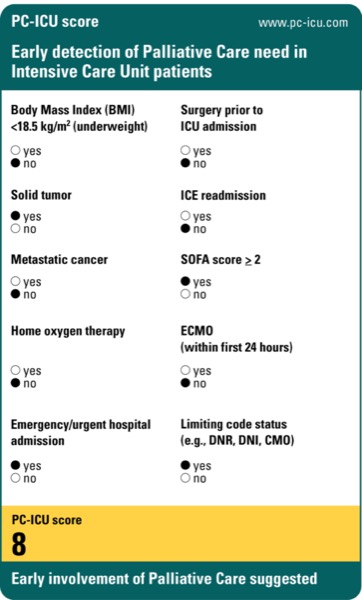
“Studies have shown that patients and their families in the ICU benefit from palliative care involvement at an early stage,” he continued. “So our goal was to give hospitals and physicians a tool to identify those requiring palliative care treatment to both facilitate early involvement and save resources.”

The investigators studied a cohort of 60,091 hospitalized patients who were admitted to the institution’s ICU between 2011 and 2022. They then performed a literature review to identify factors that might predict PC during patients’ ICU stay. These included both pre-ICU and ICU-related factors, as well as physical, psychosocial and spiritual dimensions.

image

“These factors are available upon ICU admission, so physicians can use this tool at the moment the patient is admitted to the ICU,” said first author Theresa Tenge, MD, a research fellow at Beth Israel Deaconess.

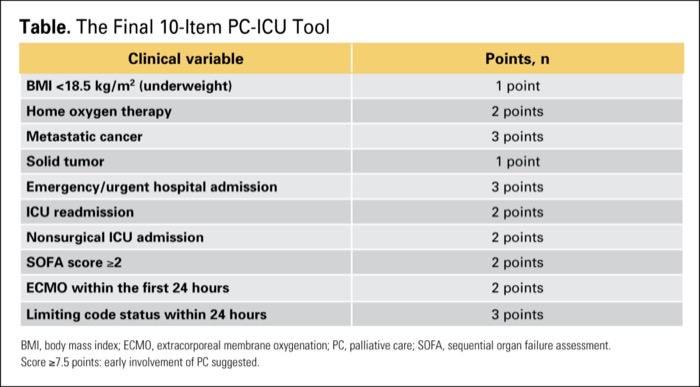
Predictors were selected through an adaptive lasso logistic regression with cross-validation, after which a 43-item score was developed. Next, the researchers created a shorter version of the tool, which used the 10 strongest predictors of PC needed (Table). The performance of each model was assessed by the area under the receiver operating characteristic curve (AUROC) and compared using the DeLong test.

image
Table. The Final 10-Item PC-ICU Tool
Clinical variablePoints, n
BMI <18.5 kg/m2 (underweight)1 point
Home oxygen therapy2 points
Metastatic cancer3 points
Solid tumor1 point
Emergency/urgent hospital admission3 points
ICU readmission2 points
Nonsurgical ICU admission2 points
SOFA score =22 points
ECMO within the first 24 hours2 points
Limiting code status within 24 hours3 points
BMI, body mass index; ECMO, extracorporeal membrane oxygenation; PC, palliative care; SOFA, sequential organ failure assessment. Score =7.5 points: early involvement of PC suggested.

“We wanted to create a simple and accurate tool, so we selected the 10 most weighting factors from the comprehensive score,” Tenge explained. “It’s easy to use and everybody can understand it.”

Presenting at the 2024 annual meeting of the International Anesthesia Research Society, the investigators reported that 3,294 patients (5.5%) received PC during their ICU stay. Of the two scoring systems, possible point values ranged from 0.2 to 9.8 for the 43-item tool and from 0 to 17 for the shortened version, with a median of 4.1 points for the full score and 7 for the short score.

A comparison of values and predictive abilities showed good alignment between the full and shortened versions of the scores. Furthermore, both scores demonstrated good discrimination, with an AUROC of 0.85 for the full score and 0.81 for the short one. The cutoff points for the full and short scores were 4.8 and 7.5, respectively.

image

“We are currently in the external validation phase to prove that this is an accurate tool for all ICU patients,” Tenge told Anesthesiology News.

As Schaefer discussed, the development of the prediction tool helps establish structures that institutionalize the integration of PC into the ICU setting.

“At the same time,” he said, “it also educates providers and patients regarding what palliative care is all about. Palliative care can support patients and their families, and can supplement intensive care.”

According to Victoria Metaxa, PhD, an ICU consultant with King’s College Hospital, in London, evidence suggests that a considerable number of ICU patients present or develop PC needs during their ICU stay.

image

“A few important considerations come to mind when developing new screening criteria,” Metaxa noted. “First, there is no accepted definition of palliative care need, nor is there a consensus regarding the best outcome to measure the effectiveness of various trigger criteria. Therefore, patient-centered outcomes should be chosen when designing such studies.

“Second, previously suggested palliative care triggers had low sensitivity, suggesting that some patients may be missed,” she added. “For example, these triggers do not include complex pain and symptom management or conflict resolution, which may also benefit from palliative care team input.” Finally, Metaxa noted that palliative care specialists may not be available in every country, so triggers may not be applicable to systems without dedicated teams.

“Even with these considerations, however, the work by Schaefer and colleagues is a step in the right direction, increasing awareness and promoting the integration of palliative care in critical care,” Metaxa said.

By Michael Vlessides


Metaxa, Schaefer and Tenge reported no relevant financial disclosures. The abstract was honored as one of the best presented at the meeting.

Related Keywords