

×
ADVERTISEMENT

NOVEMBER 8, 2024

Ultrasound Battery Use Carries Big Environmental Impact


Originally published by our sister publication Anesthesiology News

image
Connor Singrey, MD

SAN DIEGO—A new analysis has concluded that simple changes in practice patterns can significantly reduce the environmental impact of medical ultrasound use by anesthesiologists.

Researchers at Weill Cornell Medicine found that turning off the machine between uses and altering manufacturers’ settings regarding sleep and power-off modes would not only minimize energy use in real time but would likely

Originally published by our sister publication Anesthesiology News

image
Connor Singrey, MD

SAN DIEGO—A new analysis has concluded that simple changes in practice patterns can significantly reduce the environmental impact of medical ultrasound use by anesthesiologists.

Researchers at Weill Cornell Medicine found that turning off the machine between uses and altering manufacturers’ settings regarding sleep and power-off modes would not only minimize energy use in real time but would likely extend the life of the machine’s rechargeable batteries. The production and disposability of ultrasound batteries have much more significant environmental impacts.

“Obviously ultrasounds are increasingly prevalent, but there’s no free lunch in medicine, especially when it comes to the environment,” said Connor Singrey, MD, a resident at Weill Cornell Medicine, in New York City.

As Singrey explained, emissions unique to ultrasound use come in different forms: Scope 2 emissions are defined as carbon emissions due to purchased electricity, while scope 3 emissions are the carbon emissions that accompany the purchase, use and disposal of products, such as rechargeable batteries. In the current investigation, Singrey and his colleagues sought to not only quantify scope 2 and 3 emissions related to ultrasound electrical waste at the institution but also identify opportunities to reduce the hidden environmental impacts of such emissions.

To do so, they turned to the manufacturers’ information regarding the electrical output, battery characteristics and screen power settings of each ultrasound machine used in their anesthesiology department. They used that information and carbon emissions data to assess theoretical electricity use and associated carbon emissions for different scenarios of ultrasound.

image

Each machine studied had a 10.8-volt and 5,200- to 5,800-mAh (milliampere-hour) lithium-ion battery, which equates to a draw of up to 75 watts when in use. When connected to a wall outlet, the machines preferentially use AC power and simultaneously charge their batteries. However, when the ultrasound devices are unattended for five to 10 minutes, they automatically revert to a sleep mode, ultimately shutting off completely after 15 to 30 minutes. Finally, the typical lifespan of a lithium-ion battery ranges from 300 to 700 cycles, depending on its pattern of use and composition.

In a presentation at the 2024 annual spring meeting of the American Society of Regional Anesthesia and Pain Medicine (abstract 5465), Singrey reported that although the daily active use of ultrasound machines at the institution was brief, the machines commonly ran on battery or AC power both before and after use. Similarly, the sleep mode and power-off settings were defaulted to the maximum 10- and 30-minute intervals, respectively, which added to their electricity use.

Assuming an average of two hours of downtime per ultrasound per day (approximately 20 minutes per hour over a six-hour block day), the analysis revealed that more than 54 kWh (kilowatt-hours) would be lost to nonproductive ultrasound time per year. Given that an average of 0.39 kg of carbon dioxide is emitted for each kilowatt-hour of electricity in the United States, 54 kWh would contribute to approximately 21 kg of carbon emissions per machine.

“That number may sound impressive, but it’s not,” Singrey explained. “It’s like 26 miles in a car. But the money is in the scope 3 emissions.”

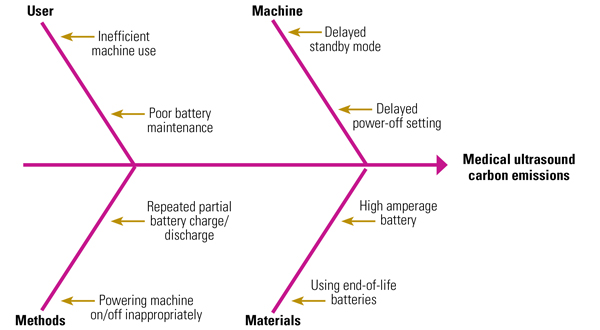
Indeed, the biggest impact of ultrasound use uncovered by the analysis was here, in the unnecessary degradation of the machines’ lithium-ion batteries. In this case, a wasted charge consumes some proportion of the battery’s lifetime cycle, a phenomenon that ultimately leads to earlier disposal and replacement (Figure 1). In the same vein, temperature also may affect battery life. Although this impact is most significant at temperature extremes, minor losses in efficiency can occur with deviation from a battery’s ideal temperature of –25° C.

image

Figure 1. Medical ultrasound cause and effect diagram.

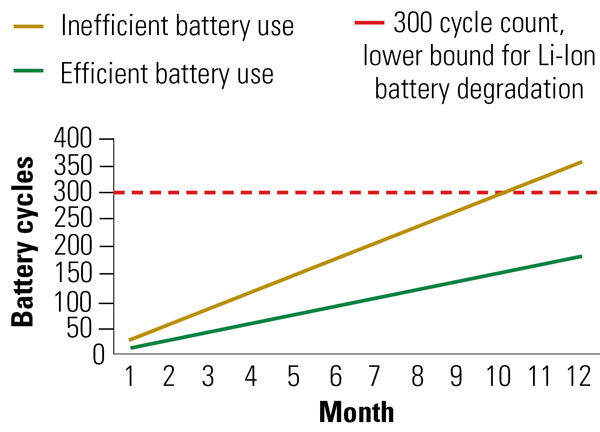
Given the researchers’ assumption that each machine would be on two hours of daily standby time, almost one entire battery cycle would be lost every day. Over the course of a year, several hundred wasted battery cycles could occur, making a significant dent in a battery’s typical life of 300 to 700 cycles (Figure 2).

image

Figure 2. Accumulated battery cycles with variable use.

“The point is you only have so many cycles on the battery,” Singrey noted. “You charge it and you deplete it; that’s a cycle—just like your iPhone degrades over time. You’ve probably noticed that your older ultrasounds die if they’re not plugged in constantly. It’s a universal issue.”

Batteries that die prematurely ultimately end up in the landfill and need to be replaced. This not only bears a financial impact for the institution but also creates additional hazardous landfill waste, potentially contributing to the leaching of toxic material into groundwater.

In light of these findings, the researchers said anesthesiologists can improve the situation by adjusting sleep and power-off settings on ultrasound machines to the minimum allowed by the manufacturers, which would limit its power consumption regardless of usage patterns. Educating clinicians and staff to only turn machines on and off immediately before and after use could also have a palpable impact.

“Limiting waste is important,” Singrey said. “The electricity doesn’t matter all that much, but preventing battery waste is key. Used properly, an ultrasound battery might last two or three years. Used improperly, maybe only six months to a year.”

Session moderator T. Kyle Harrison, MD, a clinical professor of anesthesiology, perioperative and pain medicine at Stanford University, in California, asked whether there were other ultrasound-related instances where anesthesiologists could reduce their environmental impact.

“Many of the disposables used with ultrasound increase greenhouse gas emissions,” he said. “Have you looked at that?”

“For this analysis we focused on the batteries,” Singrey replied. “I agree it’s not ideal if you’re throwing plastic in the trash, but you also have to have sterility. You don’t want to cause infections because I’m sure an extra day in the hospital creates much more waste than Tegaderm [transparent dressing, Nexcare] or a sleeve.”

—By Michael Vlessides


Singrey and Harrison reported no relevant financial disclosures. The senior authors of the study—Elizabeth Fouts-Palmer, MD, Vivian Ip, MD, and Deirdre Kelleher, MD—are all officers in ASRA Pain Medicine’s Green Anesthesia special interest group.

Related Keywords