
×
ADVERTISEMENT

NOVEMBER 14, 2024

The Surgeons’ Lounge: Treating Diabetic Neuropathy


Originally published by our sister publication General Surgery News

img-button

Welcome to the October issue of The Surgeons’ Lounge. In this issue, Toria Gargano, DO, a general surgery resident at HCA East Florida Consortium, in Fort Lauderdale, and Lisandro Montorfano, MD, a plastic surgery fellow at Vanderbilt University Medical Center, in Nashville, Tenn., interview A. Lee Dellon, MD, a professor of plastic surgery and neurosurgery at Johns Hopkins University, in Baltimore. Dr. Dellon is the



Originally published by our sister publication General Surgery News

img-button

Welcome to the October issue of The Surgeons’ Lounge. In this issue, Toria Gargano, DO, a general surgery resident at HCA East Florida Consortium, in Fort Lauderdale, and Lisandro Montorfano, MD, a plastic surgery fellow at Vanderbilt University Medical Center, in Nashville, Tenn., interview A. Lee Dellon, MD, a professor of plastic surgery and neurosurgery at Johns Hopkins University, in Baltimore. Dr. Dellon is the founder of Dellon Institutes for Peripheral Nerve Surgery, in Towson, Md., and is known for pioneering and developing the modern field of peripheral nerve injury. Dr. Dellon provides up-to-date answers to the most common questions regarding the treatment of diabetic neuropathy.
We look forward to our readers’ questions and comments.

img-button

Sincerely,

Samuel Szomstein, MD, FACS
Editor, The Surgeons’ Lounge
Szomsts@ccf.org
@YANKEEDOC44


Treating Diabetic Neuropathy: The Dellon Approach

image
A. Lee Dellon, MD
image
Lisandro Montorfano, MD
image
Toria Gargano, MD

Dr. Gargano: Could you explain how impaired glucose control creates chronic compression of peripheral nerves?

Dr. Dellon: I will start by saying that I would like the discussion to be focused on scenarios in which general surgeons typically see diabetic patients, specifically those with wound healing problems in their lower extremities, possible ulcers on their feet and kidney disease requiring transplantation.

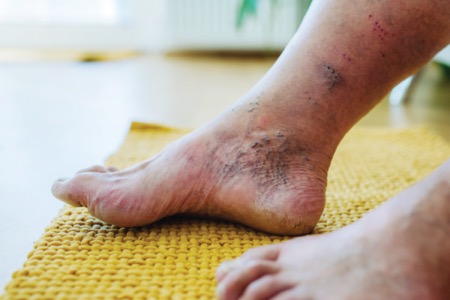
The majority of general surgeons see a diabetic patient with wound healing problems and immediately think of circulation. However, only 25% of diabetics with nonhealing wounds have vascular problems; the other 75% who have leg amputations due to diabetes actually have neuropathy. Symptoms of numbness and tingling in the legs should prompt the general surgeon to refer these patients to a vascular surgeon to assess the ankle-brachial index (ABI) for circulation. If the ABI is 0.4 or less, vascular surgery is appropriate, and the patient may need a bypass. However, something that is not commonly thought about in terms of blood flow is nerve compression.

There are three reasons that a diabetic is susceptible to nerve compression. The first and most obvious is that diabetic nerves retain water. When glucose levels are high, large amounts of sugars are entering the nerve and being converted to sorbitol, which then pulls water into the nerve. The subsequent swelling of the nerve results in compression. The second method of compression is exemplified by the way that diabetics form multiple trigger fingers. This is due to glucose binding non-enzymatically to type IV collagen in the endoneurium, which will cause the collagen to stiffen, resulting in an alteration of the stress/strain relationship of the nerve and ultimately resulting in trigger finger deformity. The third mechanism is dysfunction of exoplasmic flow. It was shown very early that diabetic nerves have decreased exoplasmic flow, which carries building blocks down the nerve for the nerve to repair itself. If the nerve is stuck in a tight place and demyelination occurs, the axon cannot heal itself properly. These three mechanisms of compression ultimately result in less blood flow and oxygenation, which is manifested as the pins and needles symptoms that diabetics experience.

image

Dr. Montorfano: Can you prevent ulcerations and amputation in diabetics by decompressing the nerves in the lower extremities? What are the physiopathology changes you will see after nerve decompression in this patient population?

Dr. Dellon: The answer to the question is yes. There are many published studies that show this. Along with another researcher, we studied 50 patients in which I had performed nerve decompression on one lower extremity but had not operated on the other. The longest follow-up time was seven years. There are many patients that I had operated on only one foot, and I was done with them, never thinking of coming back for an operation on the other extremity. In this population, the lower extremity that was operated on typically had no new ulcers and no need for amputation, whereas the nonoperated leg often had amputations or ulcerations. These differences were shown in our studies to be statistically significant.1-5

My belief is that by decompression of a peripheral nerve, you can change the natural history of diabetic neuropathy. If you can regain sensation in a patient’s foot, they will be aware of injury to the foot. If you can regain some protective sensation, you will prevent neuropathic ulcers.

We published a prospective study involving 38 different surgeons trained by myself and involving 800 people who were treated, in which none of these people had amputations and about two people went on to develop new ulcers.1

Dr. Gargano: Could you describe the Dellon approach to neurolysis for diabetic patients?

Dr. Dellon: I published a paper on the Dellon approach3 and was asked to write a review for a German journal. I was once asked if this was due to the lack of confidence causing U.S. journals to not publish the Dellon approach. I wrote a novel called “The Prosector: To Be Remembered Is to Live Forever,” to address this question, which I do recommend reading.2

After plastic surgery, I trained in hand surgery. In hand surgery, I would receive diabetic patients with carpal tunnel syndrome. After carpal tunnel release, their carpal tunnel symptoms would improve; however, they would still complain of pain and tingling to the medial portion of the wrist. So, we published a paper on compression of the radial sensory nerve. Then the patients would want an operation on the opposite hand. Eventually, they would ask if there was anything we could do for the feet. That led me to start working on nerve compression of the lower extremities.

There were two separate studies published by orthopedic surgeons in the same year regarding symptomatic compression of nerves in the tarsal tunnel. The tarsal tunnel in the foot is proximal to the ankle where there is distal fascia, and I developed an approach that included decompression of the tibial nerve and its tunnels, now known as “the Dellon approach.” There are really four medial ankle tarsal tunnels. At the same time in the Dellon approach, there is decompression of the peroneal nerve system. Usually, the nerve is tender at the fibular neck, dorsum of the foot or in the anterolateral compartment. The typical patient who qualifies for the Dellon approach has a “Dellon triple”—compression of the tibial nerve at the ankle and its four tunnels; the deep peroneal nerve over the dorsum of the foot; the common peroneal nerve at the fibular neck; and 25% of patients also have the superficial peroneal nerve entrapped. That approach has been technically described in several different published articles.3

Dr. Montorfano: Is patient selection important at the time of performing this operation? Is there an ideal candidate?

Dr. Dellon: For any patient to be operated on, they need to have symptoms of nerve compression, typically numbness and tingling. Decompression would not be performed in asymptomatic diabetic patients. In my surgical experience with diabetic patients, I would say that approximately 80% who present to me are symptomatic. Patients who have numbness without pain are candidates. Patients who only have pain and no numbness are also candidates. Symptoms such as “clawing” of the foot associated with compression of the peroneal nerve are also considered for decompression. Patients with Tinel’s sign over the tibial nerve of the tarsal tunnel are also considered for decompression. In our experience, 80% of people with a positive Tinel’s sign see relief of their symptoms with decompression; however, only 30% show improvement of those without it.4

Therefore, patients must have symptoms and physical findings consistent with nerve compression to be candidates for decompression. We do not operate on patients with peripheral edema due to renal or cardiac abnormalities, as this is a contraindication to the procedure. They also need to have appropriate circulation. If they have a nonpalpable pulse or even have hair loss related to vascular disease, they need vascular surgery evaluation and ABI measurement. They need to be healthy enough to undergo general anesthesia. They also need to be in reasonable control of their blood sugar.

Dr. Gargano: Can patients expect return of baseline sensation or possibly improved sensation from baseline? Can this procedure prevent ulcerations and amputations? What is your experience?

Dr. Dellon: The 38-surgeon, multicenter prospective study involved observation of pain.1 The group that had pain—more than 600 people—had significant pain improvement. Sensibility, however, improved little by little throughout the three years that we followed them. That means that you need to have regeneration of a lot of nerve fibers for sensation to improve.

The other interesting thing that I have been criticized by neurologists for saying is that in the operating room, if you tickle the patient’s foot, they will laugh. So let’s go back to nerve compression. If you wake up at night and your fingers are asleep, as soon as you take the pressure off the nerve, the sensation is back within minutes. This can be painful as blood flows back through the nerve. Thus, if you have chronic nerve compression, some of those fibers have not died yet, and some of the nerves that have neuropraxia or an ischemic block will recover nerve fibers that have not truly died and are only partially demyelinated. You can learn more in the YouTube video “Dellon’s Test Tickle.”5

This exam is also very encouraging to the [patient’s] family. Diabetic neuropathy, by definition, is aggressive and irreversible. There is no hope that these patients are going to get better. Even with perfect glycemic control, they may just stay the same. I did not have to prove I could make people better; I did have to prove that I did not make them worse.

Dr. Montorfano: To conclude this interview, how can we spread the word so these procedures become standard of care? What advice would you give to plastic surgeons?

Dr. Dellon: One way of doing that is exactly what you are doing now, which is getting the information out. One of the problems in the beginning was that I was the only one doing this, which was a hard sell. Now there are 15 or more level 4 retrospective studies from all over the world that involve more than 500 patients, including from China.

The newest country in the world, which is the Republic of Macedonia, has only been around for about three years and has a chief of plastic surgery, Dr. Sophia. She has presented at the Peripheral Nerve Society about performing the Dellon decompression technique and is showing how she has gotten nonhealing wounds to heal. She is actually now publishing to prove that there is improved blood flow after decompression of the nerve.

There was a wonderful paper published in the Netherlands 10 years ago, in which they asked medical doctors, wound healing nurse specialists and the general public if they have ever heard of this decompression. Only about 3% to 4% said they had heard of it. You have to overcome this huge prejudice in the medical community where at least the older generation has only seen diabetics get worse from having surgery on their feet. But the technique we are using today for people who have had appropriate lower extremity nerve decompression does not have those types of results. So ultimately it is overcoming the resistance that has been built by seeing diabetic patients fail surgical management. Getting the word out has been a real problem for me because I am the one performing the surgery. So I am a suspect; it looks like I am marketing myself. It has been extremely helpful to have these other studies done to support my work.

References

  1. Dellon AL. Prevention of ulceration, amputation, and reduction of hospitalization: outcomes of a prospective multicenter trial of tibial neurolysis in patients with diabetic neuropathy. J Reconstr Microsurg. 2012;28(3):241-246.
  2. Dellon AL. The Prosector: To be Remembered Is to Live Forever. A. Lee Dellon, MD, PhD; 2022.
  3. Dellon AL. The Dellon approach to neurolysis in the neuropathy patient with chronic nerve compression. Handchir Mikrochir Plast Chir. 2008;40(1):1-10.
  4. Dellon AL, Muse VL, Nickerson DS, et al. A positive Tinel sign as predictor of pain relief or sensory recovery after decompression of chronic tibial nerve compression in patients with diabetic neuropathy. J Reconstr Microsurg. 2012;28(3):235-240.
  5. The Dellon test tickle [YouTube video]. 2020. Retrieved from https://www.youtube.com/watch?v=dhkaRcEDoNY

The Instrument, the Name: The Acland Micro Clamp

By Harrison Thomas, Toria Gargano, MD, and Lisandro Montorfano, MD
image
Dr. Robert Acland
Wikimedia Commons

The first use of an atraumatic vascular clamp was described in 1903, allowing for the advancement of modern-day vascular surgery techniques. However, the progression of vascular surgery to small-caliber vessels did not occur until the early 1960s. The application of the microscope to vascular surgery gave rise to the field of microsurgery, requiring the invention or adaptation of tools to perform anastomoses on millimeter-scale vessels.

There were several attempts to design microvascular clamps during the 1960s, but it was not until 1972 that Dr. Robert Acland invented his own microvascular clamp, which has now become the gold standard for microsurgery. The predecessors to the “Acland micro vessel clamp” were either too bulky or caused undesirable trauma to the vessels. Born in 1941, Dr. Acland was a British-trained surgeon and, early in his career, took a keen interest in advancing the field of microsurgery. He spent the early part of the 1970s conducting research at the London Hospital to perfect his clamp design, as well as microsuture.

His clamp design consisted of two clamps on a fixed axis and spaced to allow for vessel opposition and anastomosis. The clamp also featured a mechanism to wrap “stay sutures” for vessel lumen retraction. This design enabled accurate microsurgical anastomoses to be made without assistance or retraction from another individual. Acland’s slim clamp design also facilitates flipping the vessels to construct an anastomosis in a front wall, then back wall, fashion.

Modern adaptations of the Acland clamp have resulted in “single” Acland clamps in addition to the inventor’s original double clamp design. In 1987, Acland’s design was modified from a reusable metal clamp to a plastic clamp that could serve as a single-use device. This was patented in 2006 by Synovis, and is widely used alongside the metal, reusable Acland clamps. Despite the major advancements in the field of microsurgery since 1970, the microsurgical techniques that are now commonplace would not be possible without the precise and delicate blood flow control that is offered by the Acland clamp.

Suggested Reading

  1. Acland RD. New instruments for microvascular surgery. Br J Surg. 1972;59(3):181-184.
  2. Acland RD. Microvascular anastomosis: a device for holding stay sutures and a new vascular clamp. Surgery. 1974;75(2):185-187.
  3. Fricker J. Robert Acland (obituary). BMJ. 2016;352:i1761.
  4. Kuester WF III. Vascular clamp. U.S. Patent No. 7,144,402. December 5, 2006.
  5. McGrouther DA. Robert Acland (1941-2016) innovator, microsurgeon, anatomist and teacher. J Plast Reconstr Aesthet Surg. 2018;71(2):126-131.
  6. Yoshii T, Tamai S, Mizumoto S, et al. A new disposable microvascular double clip. J Reconstr Microsurg. 1987;3(2):133-136.

Harrison Thomas is a fourth-year medical student at Vanderbilt University, in Nashville, Tenn. Dr. Gargano is a general surgery resident at HCA East Florida Consortium, in Fort Lauderdale. Dr. Montorfano is a plastic surgery fellow at Vanderbilt University Medical Center, in Nashville, Tenn.