

×
ADVERTISEMENT

OCTOBER 8, 2024

Optimizing Anesthesia for Hip Replacement In a Patient With Severe Scoliosis


Originally published by our sister publication Anesthesiology News

img-button
Esha Jain, MD
Department of Rehabilitation and Human Performance
Icahn School of Medicine at Mount Sinai
New York City
Uchenna O. Umeh, MD
Department of Anesthesiology, Critical Care and Pain Management
Hospital for Special Surgery
Department of Anesthesiology
Weill Cornell Medicine
New York City
Editor: Karen Sibert, MD

For patients with severe scoliosis, careful preoperative planning is paramount for intraoperative and postoperative care
Originally published by our sister publication Anesthesiology News

img-button
Esha Jain, MD
Department of Rehabilitation and Human Performance
Icahn School of Medicine at Mount Sinai
New York City
Uchenna O. Umeh, MD
Department of Anesthesiology, Critical Care and Pain Management
Hospital for Special Surgery
Department of Anesthesiology
Weill Cornell Medicine
New York City
Editor: Karen Sibert, MD

For patients with severe scoliosis, careful preoperative planning is paramount for intraoperative and postoperative care to avoid complications from anesthesia, control pain and promote mobility. We present a case of a patient with severe scoliosis who presented for elective hip replacement surgery and underwent successful spinal anesthesia, a tailored pain management plan with multimodal analgesia, and rehabilitation with early mobilization.
Case Presentation

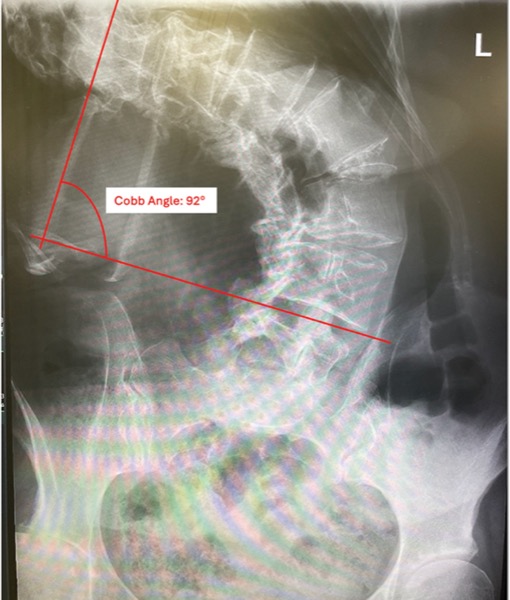
A 66-year-old woman presented for total hip replacement due to osteoarthritis. Her medical history was significant for severe thoracolumbar scoliosis with a Cobb angle of 92 degrees (Figure 1), restrictive lung disease, hypertension and obstructive sleep apnea managed with an oral appliance. Her height was 5 feet, 4 inches and weight 54.4 kg. Her daily home medications included 5 mg of amlodipine, 25 mg of hydrochlorothiazide, 10 mg of ramipril, 200 mg of extended-release metoprolol and 1,000 mcg of cyanocobalamin. She was unable to lie completely supine due to her spinal curvature.

image
Figure 1. Thoracolumbar scoliosis with a Cobb angle of 92 degrees.

Pulmonary function testing revealed a forced vital capacity (FVC) of 43% predicted and forced expiratory volume in one second (FEV1) of 41% predicted, with FEV1/FVC 96%, indicating severe restrictive disease. Chest radiography showed markedly rotated scoliotic curvature altering the cardiomediastinal silhouette, with grossly clear lung fields and a tortuous aorta.

Transthoracic echocardiography (a technically limited study) showed normal valvular function, normal left ventricular size and function with a left ventricular ejection fraction of 65%, and mild tricuspid insufficiency with mildly elevated pulmonary artery pressures.

The patient’s preoperative laboratory tests were remarkable for an abnormally elevated carbon dioxide (CO2) level of 40 mmol/L (normal, 23-29 mmol/L) and a low chloride level of 93 mmol/L (normal, 96-106 mmol/L), indicating chronic CO2 retention. A complete blood count was within normal limits. On the day of surgery, the patient’s blood pressure was 128/63 mm Hg, pulse 68 beats per minute, respiratory rate 18 breaths per minute and oxygen saturation 97% on room air.

After discussion with the patient and her family, she consented to spinal anesthesia with IV sedation. Pericapsular nerve group (PENG) and suprainguinal fascia iliaca (SIFI) blocks were planned for postoperative pain control.

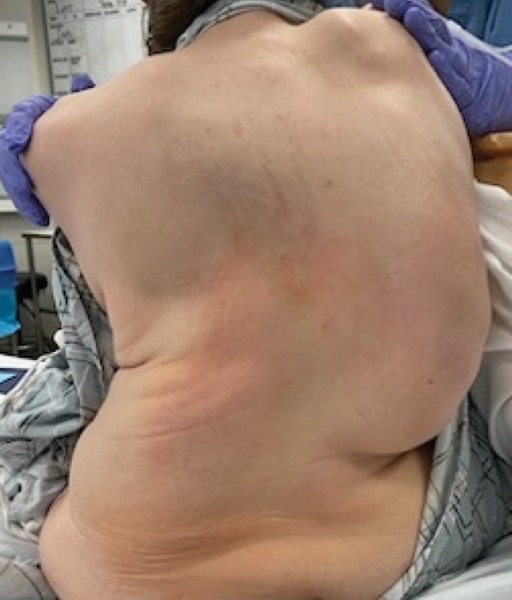
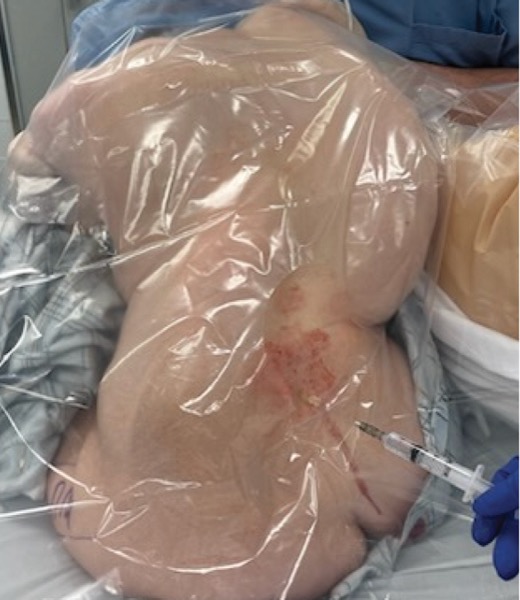
In the OR, standard ASA (American Society of Anesthesiologists) monitors were applied and supplemental oxygen was supplied via nasal cannula. X-rays of the lumbar spine and pelvis were reviewed to help localize the approach for spinal anesthesia. The patient received IV sedation with 4 mg of midazolam and 20 mg of ketamine, and was placed in the sitting position supported with pillows (Figure 2). Propofol 20 mg IV was given. A 20-g introducer needle and 5-inch, 27-g BD Whitacre needle were inserted under sterile technique at the L3-L4 interspace using the convex side with an angulated midline approach (Figure 3). After several attempts, free flow of cerebrospinal fluid was obtained and 4 cc of isobaric mepivacaine 1.5% was injected.

image
Figure 2. Patient in sitting position for spinal anesthetic.
image
Figure 3. Spinal needle angle during midline intrathecal injection.

The patient was returned to the supine position for placement of the PENG and SIFI blocks under ultrasound guidance using bupivacaine 0.25% and 0.125%, respectively. Sedation was maintained with a propofol IV infusion at 50 mcg/kg per minute, and 20 mg of IV ketamine in divided doses. She was positioned in the right lateral decubitus position for surgery, which proceeded uneventfully. No opioids were administered, either intravenously or intrathecally.

At the end of surgery, the propofol infusion was discontinued and the patient was taken to the PACU. An opioid-sparing multimodal analgesic protocol was instituted. She received four doses of 15 mg of IV ketorolac every six hours, and then transitioned to meloxicam. She also received three doses of IV acetaminophen beginning in the PACU and continued on 650 mg of oral acetaminophen every six hours. With this protocol, she received no parenteral or oral opioids during her hospital stay in a non-monitored bed.

One day after the procedure, the patient was evaluated by occupational and physical therapy. She required minimal assistance to transfer to a sitting position. The patient was able to initiate walking with a rollator walker, although she was limited in progress by discomfort and fatigue. She progressed satisfactorily and was discharged home on her second postoperative day.

Discussion

Scoliosis is a distortion of the spine that causes lateral curvature and rotation of the spine, as well as deformity of the rib cage. It is defined as a curvature greater than 10 degrees and occurs with an incidence of 2% in the general population. It is more common in females, can present either in childhood or adulthood, and may develop in the thoracic or lumbar spine or in both. Scoliosis may be classified as primary idiopathic or secondary to a disease process. Adolescent idiopathic scoliosis is the most common type and comprises 70% of cases.1-3 Depending on the degree of lateral curvature or Cobb angle, idiopathic scoliosis is classified as mild (11-25 degrees), moderate (25-50 degrees) or severe (>50 degrees).4,5

image

Severe scoliosis is associated with comorbidities including restrictive lung disease, pulmonary hypertension, right ventricular hypertrophy and cardiomyopathy. Management of these patients involves a multidisciplinary team to guide them through the intraoperative and postoperative periods and facilitate appropriate rehabilitation.

Before surgery, a thorough preoperative evaluation must be completed to assess the likelihood of difficult intubation, the stability of the spine and any neurologic deficits. Echocardiography and pulmonary function testing may be indicated for patients with moderate to severe scoliosis.

Anesthetic and pain management considerations are particularly important for this specialized group of patients. Neuraxial anesthesia is an excellent technique for elective total joint arthroplasty and may minimize the use of intraoperative opioids, as well as reduce postoperative pulmonary complications, intraoperative blood loss and adverse events. We prefer an isobaric solution for spinal anesthesia because it results in less sympathectomy and corresponding hypotension.

However, patients with scoliosis present a technical challenge for neuraxial anesthesia. Many anesthesiologists are reluctant to administer spinal or epidural anesthesia in these patients for fear of postoperative neurologic deficits, multiple attempts required, unpredictability in the level of blockade and an uneven pattern of blockade. Imaging modalities such as ultrasonography or fluoroscopy can facilitate placement of spinal and epidural anesthesia. The usefulness of imaging may be limited by lack of clinician experience with it and the availability of equipment.

The optimal level of needle insertion for neuraxial anesthesia is typically identified by palpating the patient’s surface landmarks. However, the rotation of uncorrected scoliosis distorts surface anatomy, and palpation is not always a reliable means of orientation.

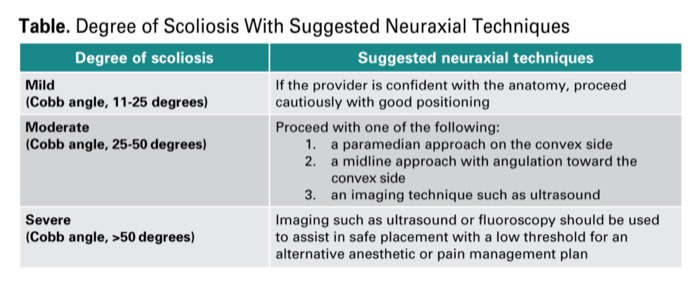
Bowens et al created an algorithm to improve success and safety during neuraxial placement in patients with scoliosis (Table).5 Moderate scoliosis may be managed with a paramedian approach on the convex side of the spine’s curve or a midline approach with angulation toward the convex side. Severe scoliosis may require the assistance of ultrasound or fluoroscopic imaging.5 Although we did not use any imaging in placing this patient’s spinal anesthetic, in hindsight it might have reduced the number of attempts and would have been reasonable to consider.

image
Table. Degree of Scoliosis With Suggested Neuraxial Techniques
Degree of scoliosisSuggested neuraxial techniques
Mild (Cobb angle, 11-25 degrees)If the provider is confident with the anatomy, proceed cautiously with good positioning
Moderate (Cobb angle, 25-50degrees)Proceed with one of the following: a paramedian approach on the convex side a midline approach with angulation toward the convex side an imaging technique such as ultrasound
Severe (Cobb angle, >50degrees)Imaging such as ultrasound or fluoroscopy should be used to assist in safe placement with a low threshold for an alternative anesthetic or pain management plan

Kirby et al described successful use of a modified Taylor’s approach for successful spinal placement.6 Taylor’s lumbosacral approach utilizes the L5-S1 interspace, which is the largest interspace. In Kirby’s modification, a preoperative lumbar x-ray is used to quantify the distance between the L5-S1 interspace and a palpable landmark such as the iliac crest.6

After surgery in patients with severe scoliosis, a multidisciplinary approach with pain management and rehabilitation is vital to promote recovery. Multiple studies have shown the benefit of enhanced recovery pathways with early pain management, physical therapy and rehabilitation after surgery to correct scoliosis.7-9

Pain control may be achieved with a multimodal regimen including opioids, acetaminophen and nonsteroidal anti-inflammatory drugs. Postoperative pain can also be managed with epidural analgesia and peripheral nerve blocks, if available. Both PENG and SIFI blocks have been shown to decrease postoperative pain in patients after hip replacement surgery, and in our experience single-shot blocks may provide analgesia for up to 18 hours.10,11

Conclusion

In patients with severe scoliosis, careful preoperative optimization and planning for the intraoperative and postoperative periods are the keys to success. Even with severe scoliosis, neuraxial anesthesia may be possible. Multimodal opioid-sparing analgesia and prompt initiation of rehabilitation with early mobilization are useful techniques that promote rapid recovery and early discharge.


The Frost Series is named in recognition of Elizabeth Frost, MD, who started this feature in the early 1980s.

Sibert, a past president of the California Society of Anesthesiologists and member of the Anesthesiology News editorial advisory board, is the medical editor of “The Frost Series.” Authors who wish to submit a case to her may send it to FrostCaseSubmission@gmail.com. Please limit text to about 1,200 words and include an image, if possible.

References

  1. Aebi M. The adult scoliosis. Eur Spine J. 2005;14(10):925-948.
  2. World Federation of Societies of Anaesthesiologists. Obstetrics Anaesthesia Tutorial 350. Neuraxial anesthesia for scoliosis and previous spinal surgery for pregnancy. https://resources.wfsahq.org/atotw/ neuraxial-anesthesia-for-scoliosis-and-previous-spinal-surgery-in-pregnancy/ . Accessed July 8, 2024.
  3. Ko JY, et al. Clinical implications of neuraxial anesthesia in the parturient with scoliosis. Anesth Analg. 2009;109(6):1930-1934.
  4. Ballarapu GK, et al. Thoracolumbar curve and Cobb angle in determining spread of spinal anesthesia in scoliosis. An observational prospective pilot study. Indian J Anaesth. 2020;64(7):594-598.
  5. Bowens C, et al. An approach to neuraxial anaesthesia for the severely scoliotic spine. Br J Anaesth. 2013;111(5):807-811.
  6. Kirby GA, et al. Using lumbar x-ray to facilitate modified Taylor’s approach of spinal anesthesia in an elderly patient with scoliosis. Cureus. 2021;13(1):e12556.
  7. Fletcher ND, et al. Use of a novel pathway for early discharge was associated with a 48% shorter length of stay after posterior spinal fusion for adolescent idiopathic scoliosis. J Pediatr Orthop. 2017;37(2):92-97.
  8. Muhly WT, et al. Rapid recovery pathway after spinal fusion for idiopathic scoliosis. Pediatrics. 2016;137(4):e20151568.
  9. Gornitzky AL, et al. A rapid recovery pathway for adolescent idiopathic scoliosis that improves pain control and reduces time to inpatient recovery after posterior spinal fusion. Spine Deform. 2016;4(4):288-295.
  10. Pascarella G, et al. Impact of the pericapsular nerve group (PENG) block on postoperative analgesia and functional recovery following total hip arthroplasty: a randomised, observer-masked, controlled trial. Anaesthesia. 2021;76(11):1492-1498.
  11. Wang YL, et al. Ultrasound-guided, direct suprainguinal injection for fascia iliaca block for total hip arthroplasty: a retrospective study. World J Clin Cases. 2021;9(15):3567-3575.