

×
ADVERTISEMENT

SEPTEMBER 23, 2024

Peripheral Nerve Blocks Safe for Patients With Congenital Bleeding Disorders


Originally published by our sister publication Anesthesiology News

SAN DIEGO—Peripheral nerve blocks appear to be safe in patients with congenital bleeding disorders in the immediate postoperative period, according to a study presented at the 2024 annual spring meeting of the American Society of Regional Anesthesia and Pain Medicine (abstract 5502).

However, researchers at The University of Texas Health Science Center at Houston noted that coagulation factors must first be optimized by a


Originally published by our sister publication Anesthesiology News

SAN DIEGO—Peripheral nerve blocks appear to be safe in patients with congenital bleeding disorders in the immediate postoperative period, according to a study presented at the 2024 annual spring meeting of the American Society of Regional Anesthesia and Pain Medicine (abstract 5502).

However, researchers at The University of Texas Health Science Center at Houston noted that coagulation factors must first be optimized by a hematologist before clinicians consider performing such blocks in these patients.

According to study author Mackenzie Jacoby, MD, a fellow anesthesiologist at the institution, congenital bleeding disorders often present with recurrent joint hematoma and progressive joint deterioration, which can necessitate multiple orthopedic procedures. In addition, while pain management after joint surgery typically comprises a multimodal analgesic regimen with regional anesthesia, few studies have examined the safety of single-shot peripheral nerve blocks in patients with congenital bleeding disorders.

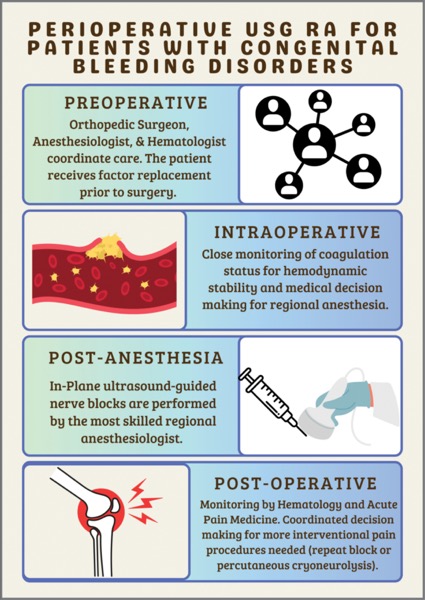
To bridge this gap, the investigators conducted a retrospective cohort analysis of 17 instances at the institution when peripheral nerve blocks were used for postoperative pain management in patients with congenital bleeding disorders undergoing elective orthopedic surgery. In each case, multidisciplinary meetings were held with an anesthesiologist, a hematologist and a surgeon to coordinate a perioperative plan of care. Ultrasound-guided nerve blocks were performed by fellowship-trained regional anesthesiologists in the recovery area within four hours of preoperative factor administration and after surgical hemostasis was ensured by a hematologist.

image

As Jacoby reported, peripheral nerve block targets in the cohort included the adductor canal (n=12), sciatic nerve (n=3), supraclavicular brachial plexus (n=3) and femoral nerve (n=2). Three patients received repeat nerve blocks. The analysis found that no apparent complications occurred that were attributable to peripheral nerve blockade, including hematoma.

The study also found no statistically significant differences in postoperative pain scores or opioid requirements between the two groups. The researchers did observe a statistically nonsignificant increase in intraoperative opioid requirement among patients in the peripheral nerve block group, which they said may suggest increased operative pain and/or selection bias.

image

“We deal with these patients in a coordinated fashion with the surgeon and hematologist,” said study co-investigator Nadia Hernandez, MD, an associate professor of anesthesiology at the institution. “Before the case, we all get together and plan the best approach.”

By Michael Vlessides


Hernandez and Jacoby reported no relevant financial disclosures.