

×
ADVERTISEMENT

JULY 8, 2024

Palliative Cancer Care Often Poses Ethical Dilemmas


Originally published by our sister publication Pharmacy Practice News

By Marcus A. Banks
image
Karen Fancher, PharmD

Ethical dilemmas confront pharmacists routinely, particularly when the choice is between moving to palliative care or continuing with different medication strategies that are likely to fail. As part of an interactive session at the HOPA Annual Conference 2024, in Tampa, Fla., attendees discussed a patient case that exemplified this challenge.

“Ethics are not part of the standard


Originally published by our sister publication Pharmacy Practice News

By Marcus A. Banks
image
Karen Fancher, PharmD

Ethical dilemmas confront pharmacists routinely, particularly when the choice is between moving to palliative care or continuing with different medication strategies that are likely to fail. As part of an interactive session at the HOPA Annual Conference 2024, in Tampa, Fla., attendees discussed a patient case that exemplified this challenge.

Ethics are not part of the standard pharmacy school curriculum,” noted Karen Fancher, PharmD, BCOP, an associate professor of pharmacy practice at the Duquesne University School of Pharmacy, in Pittsburgh.

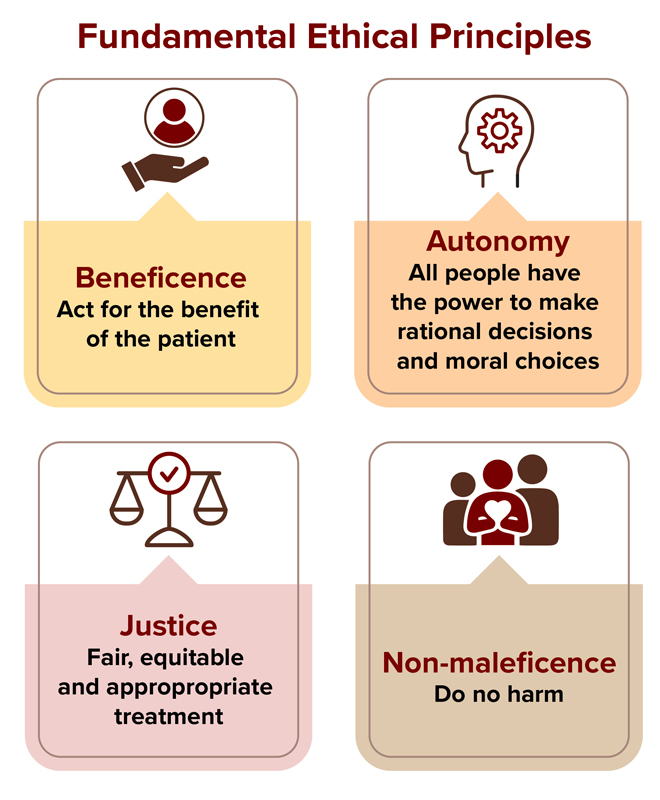
Given that reality, Dr. Fancher gave attendees an orientation on the four principles medical ethicists have developed (Med Princ Pract 2021;30[1]:17-28). To the greatest extent possible, all decisions should involve justice (be just), beneficence (improve outcomes) with non-maleficence (limit harms), and autonomy (respect a patient’s right to make their own decisions) (Figure).

With that background established, Dr. Fancher moved into the patient case with the preface: “I hope everyone is ready to be uncomfortable.”

The case was Sam, a 47-year-old man with advanced colon cancer, whose disease had progressed despite resection and adjuvant chemotherapy. He was clinically ineligible for immunotherapy or targeted therapy, and frequently entered the hospital for shortness of breath caused by rapid fluid accumulation that could not be addressed with paracentesis.

image
Source: Varkey B. Med Princ Pract 2021;30:17-28

In private conversations with his pharmacist, Sam admitted to feeling “tired of fighting,” but in the presence of his wife and daughter vowed to do whatever it takes to live as long as possible.

The medical oncologist was willing to try the combination of trifluridine-tipiracil (Lonsurf, Taiho) plus bevacizumab, but told Sam this was unlikely to extend his life span significantly. His family members adamantly refused hospice care, and his wife asked to always be in the room once she learned that her husband had a private conversation with his pharmacist.

Dr. Fancher noted tension between individual autonomy—that is, Sam confiding he gets “tired of fighting”—and “relational autonomy,” because his family members are ultimately responsible for addressing Sam’s health and so are entitled to express their concerns. There is also the tension between trying to improve Sam’s health (beneficence) with treatments that are unlikely to work (non-maleficence).

After presenting the case, Dr. Fancher asked the audience members what else they needed to know to navigate this situation, noting that “bad facts make bad decisions.”

The audience members asked numerous questions, including whether there were any contraindications to the proposed targeted therapy (unclear due to lab values), whether the family had power of attorney (no), and whether Sam had spoken to a chaplain (although offered, he declined).

Sam’s caregivers consulted with the medical ethics committee at their institution. Committee members affirmed the family’s right to be present at every meeting. Ultimately, Sam left the hospital and died at home rather than in hospice.

A Growing Interest in Ethics

The case study that Dr. Fancher presented at HOPA was modified from a real experience she encountered at the University of Pittsburgh Medical Center at Passavant, with some details and all names changed to protect patient privacy. Working through these real-world dilemmas encouraged her to begin a seminar series about ethics for Duquesne pharmacy students, with a colleague who has a doctorate in medical ethics.

“I said pharmacy curricula typically do not cover ethics, and that’s true. But we have made some strides at Duquesne,” Dr. Fancher said. The medical ethics colleague recently retired, so today she manages the seminar series on her own.

Given her dedication to ethical issues, the medical ethics committee at the medical center invited her to join the committee. This was the first time a pharmacist was included, Dr. Fancher noted.

“Whenever someone requests an ethics consult, the committee schedules a meeting. People really do not have [to navigate] these questions alone,” she said. As was true with Sam, in each case the committee weighs the competing priorities at hand and provides a recommendation. The committee is composed of people with many different types of expertise, Dr. Fancher noted, including physicians, nurses and attorneys who advise about how to proceed in any situation with legal implications. Whenever questions about medication dosing or how to discuss the risks and benefits of different medications arise, Dr. Fancher provides her expertise.

Clinical Experience as the Foundation

Similar to Dr. Fancher, Basil Varkey, MD, a pulmonologist and professor emeritus at the Medical College of Wisconsin, in Milwaukee, gained interest in medical ethics from clinical experience.

“It wasn’t one aha moment, but more of an accumulation of experience that brought ethical questions to the fore,” said Dr. Varkey, who wrote the overview of ethical principles that Dr. Fancher cited in her talk.

As an educator, Dr. Varkey’s goal was to give students more confidence in handling ethical quandaries, based on the underlying principle that the physician’s or pharmacist’s first responsibility is to honor the wishes of the patient as much as possible.

“If I thought a treatment approach was not likely to do much good, I would tell the patient,” Dr. Varkey said. “But as long as the treatment was not harmful and the patient was of sound mind, I’d honor their wishes.”


Dr. Fancher reported a financial relationship with AstraZeneca. Dr. Varkey reported no relevant financial disclosures.

Related Keywords