

×
ADVERTISEMENT

MAY 7, 2025

ISMP Issues Medication Safety Tips to Heed For Specialty Pharmacy


Originally published by our sister publication Specialty Pharmacy Continuum

By Gina Shaw

The Institute for Safe Medication Practices (ISMP) took its safety message on the road at the NASP 2024 Annual Meeting & Expo, in Nashville, Tenn., where they presented several core practices that specialty pharmacists should follow to protect patients from drug harms.

Jennifer Young, PharmD, BCPS, CSP, a medication safety specialist with ISMP, recommended that specialty pharmacies start by making use of


Originally published by our sister publication Specialty Pharmacy Continuum

By Gina Shaw

The Institute for Safe Medication Practices (ISMP) took its safety message on the road at the NASP 2024 Annual Meeting & Expo, in Nashville, Tenn., where they presented several core practices that specialty pharmacists should follow to protect patients from drug harms.

Jennifer Young, PharmD, BCPS, CSP, a medication safety specialist with ISMP, recommended that specialty pharmacies start by making use of ISMP’s 2023-2024 Targeted Medication Safety Best Practices for Community Pharmacy. “Best practice number 4 states that pharmacies should standardize the use of metric units of measure when prescribing, dispensing and measuring oral liquid medications,” she noted, citing one of several core concepts.

The Best Practices tool comes with a useful worksheet that allows pharmacies to document their implementation status for each practice area. The worksheet is designed to help users identify safety gaps and develop an action plan to address any vulnerabilities.

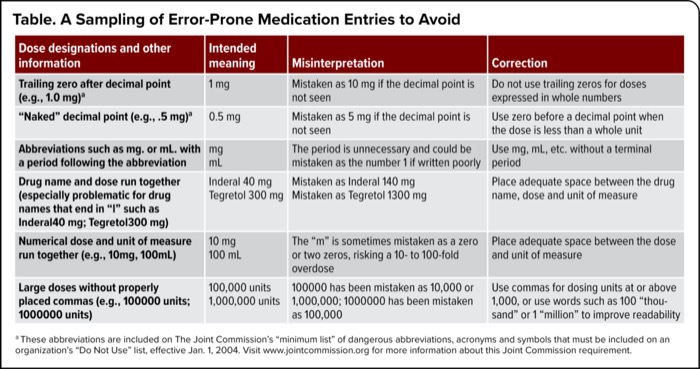
To further ensure drug prep safety, ISMP has develped a List of Error-Prone Abbreviations, Symbols, and Dose Designations. The list standardizes the use of metric units, demonstrates how to safely express decimals and fractions of dose units, and suggests how to avoid other error-prone abbreviations, symbols and dose designations. (See Table for dose designations excerpt; full Table can be accessed at bit.ly/4hI1p96.)

image
Table. A Sampling of Error-Prone Medication Entries to Avoid
Dose designations and other informationIntended meaningMisinterpretationCorrection
Trailing zero after decimal point (e.g., 1.0 mg)a1 mgMistaken as 10 mg if the decimal point is not seenDo not use trailing zeros for doses expressed in whole numbers
“Naked” decimal point (e.g., .5 mg)a0.5 mgMistaken as 5 mg if the decimal point is not seenUse zero before a decimal point when the dose is less than a whole unit
Abbreviations such as mg. or mL. with a period following the abbreviationmg mLThe period is unnecessary and could be mistaken as the number 1 if written poorlyUse mg, mL, etc. without a terminal period
Drug name and dose run together (especially problematic for drug names that end in “l” such as Inderal 40 mg; Tegretol300 mg)Inderal 40 mg Tegretol 300 mgMistaken as Inderal 140 mg Mistaken as Tegretol 1300 mgPlace adequate space between the drug name, dose and unit of measure
Numerical dose and unit of measure run together (e.g., 10mg, 100mL)10 mg 100 mLThe “m” is sometimes mistaken as a zero or two zeros, risking a 10- to 100-fold overdosePlace adequate space between the dose and unit of measure
Large doses without properly placed commas (e.g., 100000 units; 1000000 units)100,000 units 1,000,000 units100000 has been mistaken as 10,000 or 1,000,000; 1000000 has been mistaken as 100,000Use commas for dosing units at or above 1,000, or use words such as 100 “thousand” or 1 “million” to improve readability
a These abbreviations are included on The Joint Commission’s “minimum list” of dangerous abbreviations, acronyms and symbols that must be included on an organization’s “Do Not Use” list, effective Jan. 1, 2004. Visit www.jointcommission.org for more information about this Joint Commission requirement.

3 Primary Goals

As for more generalized medication safety tips, Dr. Young noted that “healthcare is complex, and risk is everywhere. So keep in mind three primary goals for medication safety when working toward proactively controlling risk: We want to prevent and ultimately eliminate errors; we want to make errors visible; and if an error does occur, we want to mitigate harm. The intent is to consider all three of these goals when choosing effective strategies to reduce risk.”

image

ISMP has published a hierarchy of risk mitigation strategies, ranging from high leverage (typically the most effective but hardest to implement) to low leverage (least effective, but easier to implement). “The top, high-leverage strategies rely on systems, and are the most effective because they eliminate the risk for errors and associated harm by designing out hazards through interventions like forcing functions, barriers and fail-safes, and automation. However, they often require complex implementation plans,” Dr. Young said.

Medium-leverage strategies such as standardized protocols, warnings and checklists reduce the likelihood of errors or minimize harm, but may need periodic updating and reinforcement. Low-leverage, easy-to-implement strategies such as educational programs and rules and policies, while important, are insufficient, she noted. “Education absolutely has its place as a prerequisite and ... is often necessary to review new drugs hitting the market, new medication delivery devices, and new or changed automation processes.” However, “it must be coupled with a medium- and/or high-level strategy to drive the greatest impact on system reliability and patient safety.”

One particularly challenging safety issue is the misuse of medication error rate data for benchmarking, said Christina Michalek, BS, RPh, the director of ISMP’s Membership and Patient Safety Organization. ISMP defines benchmarking as “an ongoing process that determines how other organizations have achieved the best performance and suggests ways for adapting the best practices that result in this exceptional performance.”

However, for benchmarking to be effective, “it’s got to be a dual process,” Ms. Michalek said, adding that “we question the wisdom of applying a benchmark of error rates to the medication-use process because the true incidence of errors varies for a number of different reasons.” She added that “people can fall into the mistaken belief that the benchmark is simply about comparing the numbers and not identifying the enablers of good performance.”

Accreditors, Payors Watching

Specialty pharmacies all need to play in the same sandbox as accreditors and third-party payors, so it’s important to remember that most of those organizations require collection and tracking of medication error data. “Some payors require pharmacies to maintain a specific accuracy rate; if an error rate is too high, the payor contract may be lost,” she said. “But there really is no consistent way to detect and report errors, and we know that many errors go undetected. So, if you have a high error rate, does that mean that you really have unsafe practices, or might it mean that you have a really healthy reporting culture? If you have a low error rate, does that mean that you’re very successful at preventing errors? Or maybe your culture is punitive?”

What is more important “is the quality of the information collected, data analysis and system improvements to prevent patient harm,” Ms. Michalek said. “What do you do when you learn about a risk? What are the process improvements that you put in place when you have a risk identified? We recommend that you strive for increased actionable reporting, using your reporting systems to generate impactful changes and communicate those with the frontline staff so that they give you more and more information and you become more proactive about risk reduction.”

More useful ways to collect data, she said, include:

  • technology, such as medication barcode scanning used during fulfillment;
  • culture of safety surveys such as the Agency for Healthcare Research and Quality’s Surveys on Patient Safety Culture; and
  • data to quantify system changes.

“You can build an interactive dashboard [that includes] a number of these things,” she said. “If you are required to collect and report an error rate, there is no national comparison, and we would rather see organizations look for a demonstration of movement toward safer and more reliable medication-use systems.”


The sources reported no relevant financial disclosures.