×
ADVERTISEMENT

APRIL 3, 2026

Up to 1 in 4 Patients Experience Complications After Major Surgery, Analysis Shows


Originally published by our sister publication Anesthesiology News

 03260310-Surgery AS916705031--lovemask-[Converted]
© fotohansel

SAN ANTONIO—Complications following major inpatient surgery affect approximately 1 in 4 patients, according to the results of a multicenter analysis comprising more than 1 million patients. The investigators said the results not only confirm findings of previous research but also demonstrate the need to develop realistic pathways that reduce inpatient morbidity.

According to Joshua Bloomstone, MD, prior


Originally published by our sister publication Anesthesiology News

 03260310-Surgery AS916705031--lovemask-[Converted]
© fotohansel

SAN ANTONIO—Complications following major inpatient surgery affect approximately 1 in 4 patients, according to the results of a multicenter analysis comprising more than 1 million patients. The investigators said the results not only confirm findings of previous research but also demonstrate the need to develop realistic pathways that reduce inpatient morbidity.

According to Joshua Bloomstone, MD, prior literature has indicated that between 5% and 45% of the approximately 48 million individuals who undergo surgery in the United States annually experience a postoperative complication. And while it is known that different surgical services and procedures have varying complication rates, few large investigations have been performed on the topic. As such, the primary purpose of the database study was to validate the findings of several smaller trials showing that major inpatient surgery is associated with high postsurgical complication rates.

“In order to truly understand the role and context of our work, we need to understand the burden of inpatient surgery,” Bloomstone said.

With that in mind, Bloomstone, a clinical professor of anesthesiology at the University of Arizona College of Medicine, in Phoenix, and his colleagues analyzed data from a database cohort of 1,214,539 surgical inpatients patients who had presented to one of 35 centers between Oct. 1, 2017, and Dec. 12, 2023, and received care from at least one anesthesiologist, certified registered nurse anesthetist, and hospitalist.

 03260310-Surgery AS916705031--lovemask-[Converted]
Figure. Medical record documentation and coding capture inpatient complications after surgery.
© lovemask - stock.adobe.com

Specific surgical procedures were classified according to Current Procedural Terminology codes and categorized into individual surgical service lines, including cardiac surgery, thoracic surgery, general surgery, neurosurgery, urology, gynecology, and orthopedics. Postoperative morbidities were defined and categorized into different categories using ICD-10 Revision codes. Finally, a number of end points were abstracted from the database, including patient age, sex, and the postoperative day when the complication was documented (Figure).

 03260310-Surgery AS916705031--lovemask-[Converted]
Joshua Bloomstone, MD

For purposes of the analysis, the proportion of postoperative complications was defined as the total number of complications divided by the total surgical inpatient population. These data were further stratified according to surgical service, procedure type, and the postoperative day on which the complication was noted.

“I got together with two brilliant data scientists, Boyoung In and Nihar Garlapati, and we developed a tool that follows patients throughout their entire surgical journey, from admission to discharge,” Bloomstone explained at the 2025 annual meeting of the ASA (abstract A3179). “The tool identifies and timestamps new clinical conditions, such as pneumonia or postoperative acute kidney injury, and quantifies these based upon submitted medical records from the patient stay.”

A total of 92,311 complications occurred, resulting in a complication rate of 7.6%. Complications were most common in cardiac surgery patients (23.72%), followed by extracorporeal membrane oxygenation (20.31%), neurosurgery (19.89%), thoracic surgery (19.08%), vascular surgery (11.59%), general surgery (10.39%), orthopedic surgery (8.86%), urology (7.82%), gynecology (2.16%), and ophthalmology (0.52%).

When the researchers assessed the frequency of major postoperative complications occurring within seven days of surgery, they found that pulmonary complications were most common (6.41/1,000 patients), followed by acute kidney injury (5.36/1,000), postoperative sepsis (4.64/1,000), acute coronary syndrome (1.00/1,000), stroke and new neurologic deficit (0.69/1,000), and cardiac arrest (0.63/1,000). Complications occurred more often in men (9.20%) than in women (6.46%), despite the fact that more female patients underwent surgery than male patients in the dataset.

“The good news is that it appears in our patient sample of 1.2 million that the overall complication rates are about half of what is actually in the literature today,” Bloomstone commented.

“The hard truth is that in heart surgery, brain surgery, and lung surgery, complications still occur in up to 1 in 4 or 1 in 5 patients,” he continued. “That is something that hasn’t changed in the literature for over a decade, and represents a burning platform that demands being extinguished.”

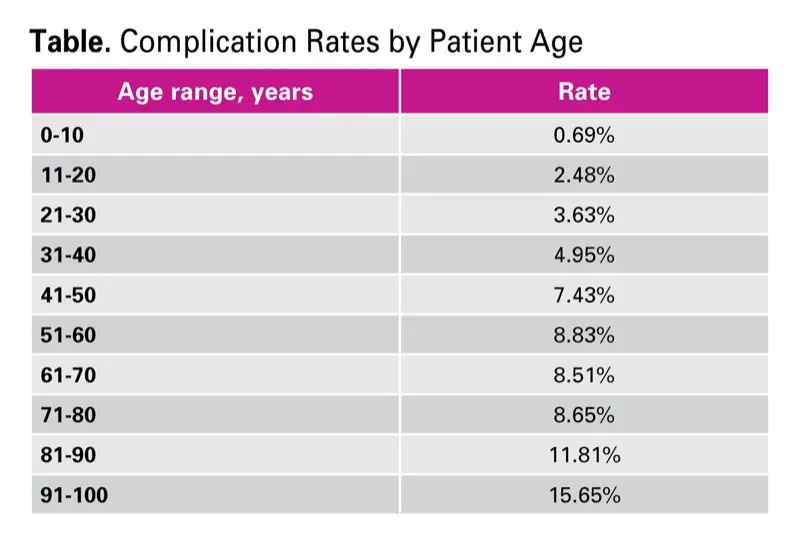
Complication rates were also found to increase with age, as the Table illustrates.

Table. Complication Rates by Patient Age
Age range, years Rate
0-10 0.69%
11-20 2.48%
21-30 3.63%
31-40 4.95%
41-50 7.43%
51-60 8.83%
61-70 8.51%
71-80 8.65%
81-90 11.81%
91-100 15.65%

Of note, the study also revealed that while there was tremendous interinstitutional variability in complication rates, these rates were largely dependent on procedural volume.

“So if you actually undergo an operation that a hospital rarely performs, you’re likely going to experience a higher rate of major complications,” Bloomstone said.

Complication rates fluctuated over the study period. In 2017-2018, the rate was 6.0% (likely affected by small numbers in the data set at that time), rising sharply over the next two years to 9.5% in 2018-2019 and peaking at 9.7% in 2019-2020. Rates then declined, falling to 8.9% in 2020-2021 and continuing downward to 7.7% in 2021-2022. During the emergency surgery–only phase of the COVID-19 shutdown, complication rates exceeded 10%.

“There’s a value proposition to all of this,” Bloomstone concluded. “The bottom line is that these complications cost billions of excess dollars. If we can develop meaningful, multi-institutional, outcomes-focused datasets, and develop standardized, pragmatic evidence-based pathways and protocols that are known to mitigate these injuries, there is value in this work.”

Daniel T. Sessler, MD, a professor and the vice president for clinical and outcomes research at UTHealth Houston, said the study’s overall conclusion—that serious complications are common—is surely correct as well as important.

“A reasonable correlate is that anesthesiologists need to take the postoperative period seriously since that is when most perioperative complications occur,” he said. “Restricting anesthetic management to the intraoperative period is the same as defining anesthesia as irrelevant to the major perioperative problem. That approach would be disastrous for the long-term health of our specialty.”

Sessler also noted that the methodology employed in the analysis could have a profound effect on its results, beginning with how complications are defined.

“For example, if PONV [postoperative nausea and vomiting] is considered a complication, about 30% of patients will have one,” he noted. “In addition, many complications may be missed in observational datasets.”

Complication severity is another critical consideration, one that not only differs widely but also affects the interpretation of incidence.

“It is nonetheless obvious that serious postoperative complications are common and kill many patients,” Sessler said. “That conclusion is well supported by the report.”


Bloomstone and Sessler reported no relevant financial disclosures. The following were all involved in the project: Benjamin Houseman, MD, PhD; Tania Haddad, DMD, MD; Bruce Kingsley, MD; Sara Sigler, PhD; Boyoung In, MBA; Nihar Garlapati, MS.

By Michael Vlessides