

×
ADVERTISEMENT

MARCH 19, 2025

Cryoablation May Prevent Post-op Pain From Abdominal Wall Surgery


Originally published by our sister publication General Surgery News

By Monica J. Smith
image
Ian Hodgdon, MD

In patients undergoing abdominal wall surgery, cryoablation administered subcutaneously up to a month before surgery is showing potential to keep them numb and free of pain for weeks and possibly months after surgery, reducing or eliminating the need for narcotic painkillers while they recover, according to one institution’s experience.

Ian Hodgdon, MD, an associate professor of surgery at


Originally published by our sister publication General Surgery News

By Monica J. Smith
image
Ian Hodgdon, MD

In patients undergoing abdominal wall surgery, cryoablation administered subcutaneously up to a month before surgery is showing potential to keep them numb and free of pain for weeks and possibly months after surgery, reducing or eliminating the need for narcotic painkillers while they recover, according to one institution’s experience.

Ian Hodgdon, MD, an associate professor of surgery at Louisiana State University School of Medicine, in New Orleans, and his colleagues stumbled on the approach somewhat by accident, when one of their thoracic surgeons—“a leader in rib reconstruction”—who uses cryoablation to freeze the intercostal nerves, shot too low. This resulted in abdominal laxity that looked like a hernia, and the patient’s primary care doctor referred him to Dr. Hodgdon for an evaluation.
Taking the patient’s history into account, Dr. Hodgdon realized the patient had undergone an intraoperative thoracic cryoablation. “And I said, ‘I bet you have eventration of the left abdomen from that.’ A couple of months later, his abdomen returned to normal because the nerves went back to normal.”

Given that two of the big challenges Dr. Hodgdon faces in managing complicated abdominal wall patients is overcoming tension and controlling postoperative pain, the concept of being able to administer something that creates both laxity and long-lasting insensateness had its appeal.

image
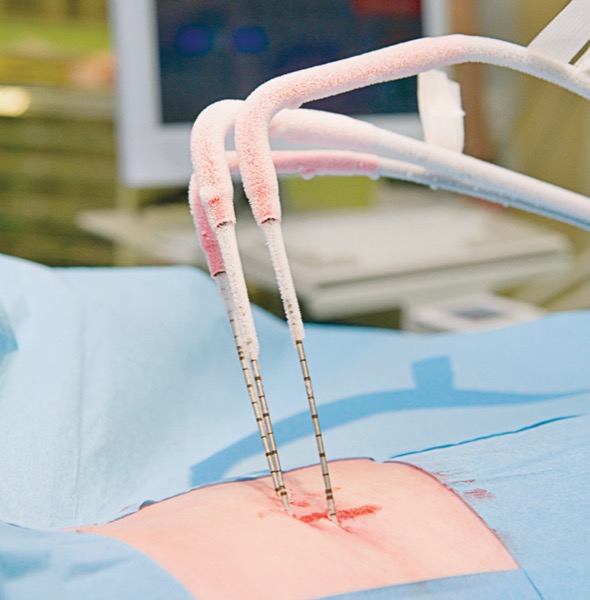
Cryoablation needle creating an ice ball between two ribs.
Photo courtesy of Ian Hodgdon, MD.

“Cold works. At extreme temperatures, it kills the axon and the myelin—the extensions of the nerve coming from the dorsal root are dead—but it preserves the surrounding epineural, perineural and endoneural tissues. It keeps that highway,” Dr. Hodgdon said. “That part of the axon cannot transmit pain, but it can still grow down the highway, taking a couple of weeks to a couple of months.”

Although cryoablation has been used extensively for thoracic and knee surgeries, no one had tried it as a temporary treatment for the abdominal wall (T9 to T11). Investigators’ first attempt at cryoablation for abdominal wall reconstruction, which required monitored anesthesia care in addition to local anesthetic due to the size of the trocar they had available, wasn’t ideal. “We were unable to introduce cryoablation into our practice as we are doing now due to the patient not being able to tolerate the sedation,” Dr. Hodgdon said, noting that they were able to freeze only half of her abdomen.

“We fixed her hernia, and the three-month pain control was excellent, but it was too involved for patients to need sedation and cryoablation and didn’t seem feasible,” he explained.

Then their interventional radiology (IR) colleagues, who use cryoablation extensively for pelvic pain, acquired a smaller, less expensive, more portable device that uses a single carbon dioxide canister and a smaller needle, and requires only local anesthesia for the cryoablation administration.

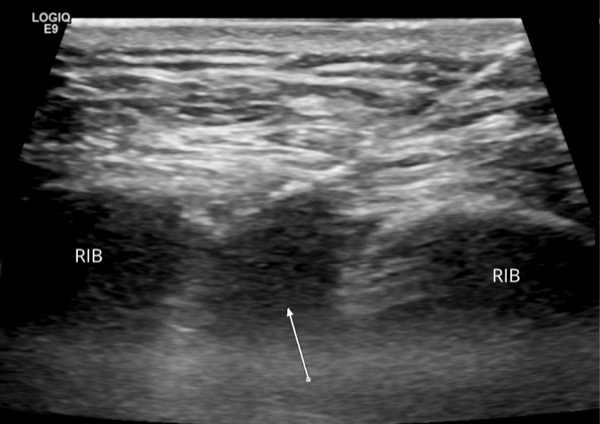
“This is what they do: Lay the patient on their side, use ultrasound to find the intercostal nerves, freeze them and make a big ice ball,” Dr. Hodgdon said.

Since starting their retrospective study, he and his team have had 12 patients, no complications related to the cryoablation, all with return to normal sensation. “A lot of them have used no narcotics or minimal narcotics,” Dr. Hodgdon said. “But this is why you need big numbers: I’ve had two patients in this series who used narcotics to control postoperative pain from corneal abrasions after getting scratched by anesthesia, but they had no abdominal pain.”

image

Additionally, they never again encountered the eventration Dr. Hodgdon witnessed in the patient referred to him whose hernia was not a hernia. “I think that’s due to the larger amount of freezing they can perform while the patient is under general anesthesia for intrathoracic surgeries.”

About a year into reviewing their results, the researchers haven’t seen laxity, but the pain control has been quite good, lasting on average about three months. “We have reached out to our GYN, colorectal and trauma colleagues to consider cryoablation as an alternative to narcotics,” Dr. Hodgdon said. “There are no insurance issues. It’s cheaper than [onabotulinumtoxinA]. We’re going to continue to do it T9 through T11 in the preoperative setting, work on our data and present it next year.”

Pain management and control in the perioperative setting are always among an operating team’s top concerns, noted Raymond J. Lanzafame, MD, the executive director and chairman of the Society of Laparoscopic & Robotic Surgeons, in Rochester, N.Y. “You want to achieve all the protocols and benchmarks, reduce complications and length of stay and facilitate your ability to do the operation while trying to reduce the use of and potential subsequent dependence on opioid medications in both the long term and the short term.”

Dr. Lanzafame applauded Dr. Hodgdon and his colleagues for coming up with this innovative approach, although he also pointed out some limitations. “This might not be something your average surgeon could do; in all likelihood, you’d need a tertiary center with IR, and specifically trained experts in anesthesiology and pain management. And we’d want to know if there are any potential risks or downsides to having a numb abdomen for three months.

“But keeping patients off pain medication and getting them up and out of the hospital: These are clearly good things, and I hope this all bears out in a larger study,” Dr. Lanzafame said.

Related Keywords